
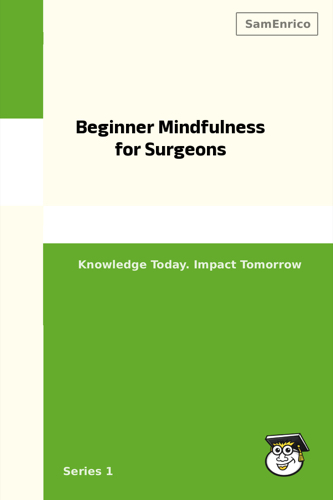
Beginner Mindfulness for Surgeons eBook
Maintain steady hands and focus during long proced
Maintain steady hands and focus during long procedures.
Formats
Free sample
Chapter 1: The Surgeon’s Paradox--–- The vascular surgeon’s hands hovered over the open abdomen, steady as a seismograph during a calm week. Three hours into a complex aortic repair, he had achieved what his residency director once called “the divine monotony”—that state where every movement flows into the next without conscious effort. His bladder screamed. His neck had fossilized into a block of granite. The anesthesiologist had just announced, in that flat tone that meant “I’m telling you this but not panicking yet,” that the patient’s blood pressure was drifting downward.He needed something.
Not a break—there was no break. Not caffeine—that would make the tremor worse. He remembered the hospital’s wellness lecture from six months ago. A woman with a calm voice and expensive shoes had talked about “mindful breathing.” She said that when stress mounted, you could take a deep breath, exhale slowly, and feel the tension dissolve. He had rolled his eyes then.
But now, with a retroperitoneal exposure that looked like a plate of wet spaghetti and a systolic pressure flirting with 70, he decided to try it.He inhaled deeply. Held it. Exhaled slowly.And immediately felt drowsy.Not calm. Not focused. Drowsy.
His eyelids grew heavy. His hands, which had been steady, felt heavy and slow. The edge—that sharp, predatory alertness that separates a surgeon from a spectator—vanished. He blinked hard, shook his head, and cursed under his breath. The mindfulness experiment was over.
He never tried it again.This surgeon is not a failure of will. He is not resistant to self-improvement. He is a victim of a fundamental misunderstanding that pervades almost every mindfulness book ever written for professionals. Those books assume that the goal of mindfulness is relaxation. For a surgeon, relaxation is not the goal.
Relaxation is the enemy.The Hidden Contradiction at the Heart of Surgical Performance The problem is not that mindfulness cannot help surgeons. The problem is that the mindfulness being taught to surgeons was designed for people whose jobs do not involve cutting into living tissue. Corporate executives need to lower their cortisol before a board presentation. Anxious parents need to quiet their racing minds before bed. Insomniacs need to slow their heart rates enough to fall asleep.
All of these people benefit from techniques that produce hypo-arousal—a sustained state of reduced physiological activation.Hypo-arousal is wonderful for sleeping. It is wonderful for anxiety disorders. It is a catastrophe in the operating room.Surgery requires what we might call optimal arousal—a state of alert, narrow vigilance that sits exactly at the peak of an inverted-U curve. Too little arousal, and you are drowsy, slow, and prone to missing subtle cues. Too much arousal, and you are panicked, tremulous, and prone to freezing.
The surgeon must live on the knife-edge of the curve, neither hypo-aroused nor hyper-aroused, but perfectly balanced.The vascular surgeon who tried the relaxation breath was already at optimal arousal after three hours of intense focus. His body had found its peak. When he added a relaxation breath, he pushed himself leftward on the curve, into hypo-arousal. He felt drowsy not because mindfulness failed, but because he used the wrong tool for the wrong job.This book exists because no one has yet written the mindfulness book for surgeons—not the one that makes you calm, but the one that makes you present. The one that trains your attention like a scalpel, that gives you off-ramps from panic and on-ramps to flow, that understands that a steady hand is not a relaxed hand but a hand attached to a mind that knows exactly where to look and what to ignore.The Inverted-U: Your New Mental Model To understand why surgeons need a different kind of mindfulness, you must understand the Yerkes-Dodson Law, also known as the Inverted-U Hypothesis.
In 1908, psychologists Robert Yerkes and John Dodson discovered that performance improves with physiological arousal—but only to a point. Up to that point, arousal sharpens focus, quickens reaction time, and enhances fine motor control. Beyond that point, arousal degrades performance, causing tunnel vision, tremor, and cognitive rigidity.Imagine an upside-down U. On the left side, low arousal: bored, drowsy, slow. On the right side, high arousal: panicked, tremulous, frozen.
At the top of the U, optimal arousal: alert, focused, fluid.Most people walk around at the left side of the curve. They need relaxation to move rightward toward the peak. Surgeons, by contrast, spend their days at or near the peak. The operating room provides natural arousal—the stakes, the responsibility, the sheer physical demand of standing for hours while performing micro-surgery. A surgeon who tries to “relax” in the OR is like a race car driver who eases off the gas on the final straightaway.
You do not need more relaxation. You need more control—the ability to recognize when you have drifted off the peak and to guide yourself back.Here is what the Inverted-U curve looks like in surgical terms:Low Arousal (Hypo-arousal)Signs: Heavy eyelids, slow movements, difficulty concentrating, apathy Surgical consequences: Missed anatomy, delayed reactions, incomplete exploration When it happens: 4 AM on call, post-lunch slump, monotonous cases Optimal Arousal Signs: Alert but not jittery, focused but not rigid, aware of peripheral field Surgical consequences: Flow state, steady hands, efficient movements When it happens: The sweet spot of a complex case, after a good night’s sleep High Arousal (Hyper-arousal)Signs: Racing heart, coarse tremor, tunnel vision, irritability Surgical consequences: Shaky suturing, freezing during complications, snapped instruments When it happens: Unexpected bleeding, critical comment from attending, running behind schedule Most mindfulness books are designed to move people from low arousal to optimal. Surgeons need something different: the ability to recognize when they have drifted into hyper-arousal (too far right) or hypo-arousal (too far left) and to execute a brief, targeted phasic reset that returns them to the peak.Notice the word phasic. This is crucial. A tonic change is sustained—lowering your baseline arousal for hours.
That is what relaxation breathing does. A phasic reset is brief—a 10- to 20-second intervention that corrects a momentary deviation without changing your overall baseline. Surgeons need phasic resets, not tonic relaxation. The distinction will appear throughout this book, and it is the reason why techniques that work for insomniacs fail for surgeons.When Flow Becomes Mindfulness Neurosurgeon Theodore Schwartz, in his book Gray Matters, described something that every surgeon has experienced but few have articulated: the operating room as the ultimate meditation. He wrote that during a good case, the external world ceases to exist.
The surgeon does not feel fatigue, hunger, or the need to urinate. Time dilates. Six hours feel like twenty minutes. The surgeon and the tissue become one system.This is flow. Psychologist Mihaly Csikszentmihalyi, who coined the term, described it as “being completely involved in an activity for its own sake.
Time flies. Every action, movement, and thought follows inevitably from the previous one.” Flow is the closest thing to a superpower that humans can reliably access. And surgeons access it more regularly than almost any other profession.But flow has a problem: it is unreliable. It happens when…
This is the end of the free sample. Get the eBook to keep going. Buy now
About this book
Details
- Author
- Oconnor Tuyet
- Publisher
- SamEnrico
- Language
- English
- Genre
- Non-Fiction, Self-Help, Surgery
- Released
- 2026-06-06
- Pages (approx.)
- 144
- Available as
- eBook, Audiobook

Read better in the ZLOADR app
Your eBooks on your phone or tablet. Sign in with your SamEnrico account and start reading.
More by Oconnor Tuyet
 Loving Kindness for Political Polarization WorkbookOconnor Tuyet$11.99
 Self Talk for Spiritual CrisisOconnor Tuyet$11.99
 Religious Difference Relationship GuideOconnor Tuyet$11.99
 Strength Band Workout SeniorsOconnor Tuyet$11.99
 The First Lady Who Defied a King: The Untold Story of Queen Elizabeth The Queen MotherOconnor Tuyet$11.99
 The Frozen Rescue: The Legend of the Pamir Ice WarriorsOconnor Tuyet$11.99
 Understanding Dementia, VascularOconnor Tuyet$17.99
 How to Become a CharterOconnor Tuyet$11.99
 Bilkent University GuideOconnor Tuyet$12.99
 Data Breach Notification LawsOconnor Tuyet$12.99
You may also like
 Hong Kong Handover 1997Dunn Johnnie$11.99
 Zumba For Postnatal Recovery CourseNeal Christian$11.99
 Zumba for BeginnersLadner Nikia$11.99
 YouTube Comment Mining GuideHumes Pandora$12.99
 Worry Box MeditationCarlin Rudy$11.99
 Workplace Stress MeditationNguyen Lynn$11.99
 Workplace Stress and Sleep RepairHawley Ivory$11.99
 Workplace Perfectionism CureDelaney Jeffry$11.99
 Workplace Injustice Anger GuideWallen Isabelle$11.99
 Work Addiction and Burnout LinkGreenwood Ester$11.99
 Women in Yoga and WellnessBeattie Galina$11.99
 Women in Stand Up ComedyChun Evangeline$11.99