
Non-FictionSelf-HelpRegretForgiveness
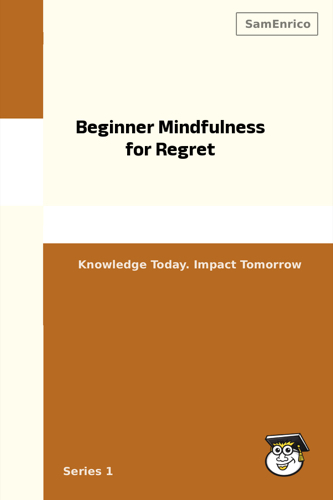
Beginner Mindfulness for Regret eBook
Hold past mistakes with compassion rather than rum
Hold past mistakes with compassion rather than rumination.
Formats
Free sample
Chapter 1: The Second Arrow--–- You are about to discover something that will change how you see every mistake you have ever made. It is not a technique. It is not positive thinking. It is a single image, over two thousand years old, that has helped countless people stop torturing themselves for the past. The Buddha taught it.
Neuroscientists have proven it works. And you can learn it in the next ten minutes.Here is the image.Imagine you are walking through a forest. It is quiet. The light filters through the leaves. You are not expecting anything.
Then, without warning, an arrow strikes you. It comes from nowhere. The pain is sharp, immediate, undeniable. That is the first arrow. It is the event itself—the mistake, the loss, the thing you said, the thing you did not do.
The first arrow is inevitable. Every human being who has ever lived has been struck by first arrows. You cannot be alive and avoid them.But then something strange happens. Instead of tending to the wound, you pick up a second arrow. You hold it in your hands.
You look at it. And then, deliberately, you shoot it into yourself. Right next to the first one. And then another. And another.
The second arrow is everything you tell yourself after the mistake: “I am so stupid.” “I should have known better.” “I always ruin everything.” “What kind of person does that?” “I will never forgive myself.”The first arrow is the event. The second arrow is your reaction to the event. And here is the truth that changes everything: you cannot always stop the first arrow. Life will wound you. You will make mistakes.
People will hurt you. That is the cost of being human. But the second arrow? That one you are holding. That one you are shooting.
That one is optional.Not easy to stop. Not automatic. But optional.This entire book is about learning to catch that second arrow before it leaves your hand.The Mistake Almost Everyone Makes Most people who struggle with regret believe their problem is the first arrow. They say things like, “If only I hadn’t made that decision.” “If only I hadn’t hurt that person.” “If only I had been smarter, kinder, more aware.” They believe that the pain they feel is caused by the original event. And that is partly true.
The first arrow hurts. But here is what the research shows—and what the Buddha understood intuitively thousands of years ago: the vast majority of suffering you feel about a past mistake comes from the second arrow, not the first.Let me prove this to you with a simple thought experiment.Think of a regret you have. Something that still bothers you. Now, imagine that same event happened to someone you love—your best friend, your sibling, your child. They come to you, ashamed, and tell you exactly what they did.
They say, “I made this terrible mistake. I cannot believe I did that.” Now, ask yourself: would you shoot them with the second arrow? Would you say to them, “You are so stupid. You should have known better. You always ruin everything.
I will never forgive you”?Of course not. You would say something like, “You made a mistake. It hurts. But you are not a monster. Let’s figure out what you can learn from this.”Why do you offer compassion to someone you love but self-torture to yourself?That gap—between how you treat others and how you treat yourself—is the exact space where the second arrow lives.
The event is the same. The first arrow is the same. But the second arrow? You only shoot it at yourself.A Clear Definition of Rumination Before we go any further, I need to define a term that will appear throughout this book. That term is rumination.
And because misunderstandings about this word have caused confusion in other books, I am going to give you a very specific, operational definition that will remain consistent from this chapter all the way to the final page.Rumination is any repetitive thinking about a past event that does not lead to new insight or changed behavior.That is it. Notice what this definition does not say. It does not say that thinking about the past is always bad. It does not say that you should never ask “Why did I do that?” It does not say that remorse is the enemy. In fact, healthy remorse—thinking that leads to genuine learning and different choices in the future—is the opposite of rumination.
Healthy remorse moves you forward. Rumination keeps you stuck in a loop.Here is the test: if you are asking the same question and getting the same painful answer, you are ruminating. If you have replayed the same memory fifty times and still feel just as ashamed as the first time, you are ruminating. If you have spent hours trying to figure out why you made a particular mistake but have not changed a single behavior as a result, you are ruminating.Rumination is not about the amount of time you spend thinking. It is about the trajectory.
Rumination is a circle. Learning is a line.Throughout this book, whenever I use the word rumination, I mean this: repetitive, looping, circular thinking that produces no new insight and no behavioral change. You will learn specific tools to break that loop. But the first step is simply recognizing it.Healthy Remorse vs. Unhealthy Rumination Because the definition of rumination depends on what it does not do (lead to insight or change), it helps to contrast it with its healthy counterpart: remorse.Remorse is the emotional signal that you have violated one of your own values.
It feels uncomfortable. It is supposed to feel uncomfortable. That discomfort is not punishment; it is information. It is like the pain in your finger when you touch a hot stove. The pain is not the enemy.
The pain is the messenger. It tells you, “Do not do that again.”Healthy remorse follows a predictable arc. Something happens. You feel the sting of having acted against your values. You ask yourself what happened.
You take responsibility. You make amends if possible. You change your behavior going forward. And then—and this is the crucial part—the remorse fades. It has done its job.
It delivered the message. You do not need to keep opening the envelope.Unhealthy rumination follows a different arc. Something happens. You feel the sting. But instead of asking “What can I learn?” you ask “Why am I so terrible?” Instead of taking responsibility once, you take responsibility a thousand times.
Instead of changing behavior, you change nothing—except that you feel worse. And the feeling does not fade. It loops. It plays on repeat. It becomes part of your identity.Here is a side-by-side comparison:Healthy Remorse Unhealthy Rumination“I hurt someone.
That is not who I want to be.”“I am a hurtful person. I always hurt everyone.”Asks: “What can I do differently next time?”Asks: “Why am I so broken?”Leads to changed behavior Leads to repeated self-punishment Fades after the…
This is the end of the free sample. Get the eBook to keep going. Buy now
About this book
Details
- Author
- Gallagher Williams
- Publisher
- SamEnrico
- Language
- English
- Genre
- Non-Fiction, Self-Help, Regret, Forgiveness
- Released
- 2026-06-08
- Pages (approx.)
- 134
- Available as
- eBook, Audiobook

Read better in the ZLOADR app
Your eBooks on your phone or tablet. Sign in with your SamEnrico account and start reading.
More by Gallagher Williams
 The Anger in Prolonged GriefGallagher Williams$11.99
 Pet Loss For Military FamiliesGallagher Williams$11.99
 The Helen Keller ActivistGallagher Williams$11.99
 Construction Manager CreativityGallagher Williams$11.99
 Love in the Cage: The Forbidden Romance of the First Female UFC FightersGallagher Williams$11.99
 Procurement Training FrameworkGallagher Williams$12.99
 Export Sustainability Certification GuideGallagher Williams$12.99
 Construction Business AnalystGallagher Williams$11.99
 How to Start a Callipers Business (Beginners Guide)Gallagher Williams$11.99
 Understanding Stratton–Parker SyndromeGallagher Williams$17.99
You may also like
 Hong Kong Handover 1997Dunn Johnnie$11.99
 Zumba For Postnatal Recovery CourseNeal Christian$11.99
 Zumba for BeginnersLadner Nikia$11.99
 YouTube Comment Mining GuideHumes Pandora$12.99
 Worry Box MeditationCarlin Rudy$11.99
 Workplace Stress MeditationNguyen Lynn$11.99
 Workplace Stress and Sleep RepairHawley Ivory$11.99
 Workplace Perfectionism CureDelaney Jeffry$11.99
 Workplace Injustice Anger GuideWallen Isabelle$11.99
 Work Addiction and Burnout LinkGreenwood Ester$11.99
 Women in Yoga and WellnessBeattie Galina$11.99
 Women in Stand Up ComedyChun Evangeline$11.99