
Non-FictionSelf-HelpAnger ManagementEmotional Intelligence
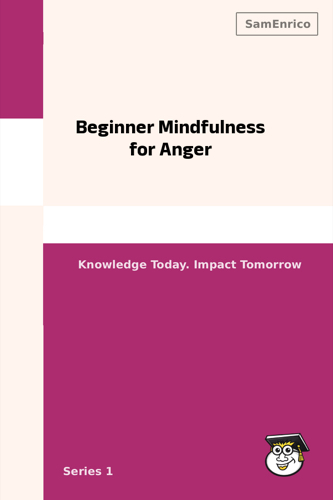
Beginner Mindfulness for Anger eBook
Notice the heat of anger without acting, creating
by Baird Mitsue
Notice the heat of anger without acting, creating space for choice.
Formats
Free sample
Chapter 1: The Autopilot Lie...--You said something three seconds ago that you already regret. Your chest is hot. Your jaw is clenched. The other person’s face has that look—the one that says “wounded” or “furious” or “done.” And somewhere beneath the adrenaline, a quiet voice whispers: That wasn’t me. I didn’t mean to do that.That voice is telling the truth.You didn’t mean to explode.
You didn’t plan to say the cruel thing. You didn’t wake up this morning thinking, At 3:47 PM, I will ruin a relationship. And yet, here you are. Again.This is the autopilot trap.It is the single most important concept in this entire book, because until you understand how anger hijacks your brain, you will keep believing the lie that you are the problem—that you are broken, or weak, or simply “an angry person.” None of that is true. What is true is that your brain has learned a shortcut.
A very fast, very old, very stupid shortcut. And the first step to changing anything is to stop blaming yourself for a neurological design flaw that evolution installed millions of years before you were born.Let’s start with a simple exercise. Do not skip this. It will take twelve seconds.Think of the most recent time you lost your temper. Just the most recent one.
Now ask yourself: Was the harm caused by the feeling of anger, or by what I did next?Sit with that for a moment. Most people, when they answer honestly, realize that the feeling of anger was not the problem. The problem was the action—the yelling, the slamming, the email sent at 11 PM, the word that cannot be taken back. The feeling is a biological signal. The action is a choice.
But when you are on autopilot, it does not feel like a choice. It feels like the anger made you do it.That is the lie. Anger never made anyone do anything. Anger is a sensation. What you do with that sensation is learned behavior.
And learned behavior can be unlearned.The Myth of the “Angry Person”Before we go any further, we need to kill something. An identity. A label. A story you have probably been telling yourself for years.Maybe you have been called “intense.” Maybe you grew up in a house where yelling was normal. Maybe you have tried to stop getting angry and failed so many times that you now believe something is fundamentally wrong with you.
Here is what I need you to hear, and I need you to hear it clearly:There is no such thing as an “angry person.”There are people who have practiced angry reactions so many times that those reactions have become automatic. That is not an identity. That is a habit. And habits are not who you are. They are just what you have done.This distinction matters more than almost anything else in this book.
Because if you believe you are an angry person, then every time you lose your temper, you feel shame. And shame does not lead to change. Shame leads to more anger, which leads to more shame, which leads to a spiral that ends with you saying “See? I told you. I’m just an angry person.”But if you believe that anger is a sensation and aggression is a learned habit, then losing your temper is not proof of your brokenness.
It is just data. It tells you: That habit is still there. And habits can be rewritten.So here is the first commitment of this book. I am not asking you to never feel angry again. That would be impossible and, frankly, unhealthy.
Anger is a valid emotion. It tells you when a boundary has been crossed. It gives you energy to protect yourself and the people you love. The goal is not to eliminate anger. The goal is to stop letting anger drive the car.The Amygdala Hijack: Your Brain on Autopilot Let’s get under the hood.Inside your brain, tucked deep behind your eyes, is a small almond-shaped cluster of neurons called the amygdala.
Its job is simple: detect threats. In evolutionary terms, this is one of your oldest systems. It was fully operational in your ancestors who lived in caves and had to worry about saber-toothed tigers. And it works incredibly well—for saber-toothed tigers.Here is what happens when your amygdala detects a threat. Within milliseconds, it sends a distress signal to another part of your brain called the hypothalamus, which then activates your sympathetic nervous system.
Your adrenal glands dump cortisol and adrenaline into your bloodstream. Your heart rate spikes. Your breathing becomes shallow. Blood rushes to your large muscles. Your pupils dilate.
Your digestion shuts down. Your face flushes. Your jaw clenches.This is the fight-or-flight response. It is designed to help you survive an immediate physical threat. And it is blindingly fast—faster than conscious thought.Here is the problem.
Your amygdala cannot tell the difference between a saber-toothed tiger and a rude email. It cannot distinguish between someone threatening your physical safety and someone cutting you off in traffic. It just detects a threat and hits the alarm. By the time your prefrontal cortex—the logical, planning, reasoning part of your brain—gets the message, the alarm has already been ringing for a full second. And in that second, you have already started to react.This is called an amygdala hijack.
The term was popularized by psychologist Daniel Goleman, and it describes exactly what happens when you “lose it.” Your logical brain gets bypassed. Your body prepares for battle. And you act—not from choice, but from ancient survival programming that does not know you are sitting in a climate-controlled office arguing about a spreadsheet.Now, here is what most people get wrong. They think the amygdala hijack is the problem. It is not.
The amygdala hijack is a biological fact. You cannot prevent it. You cannot meditate your way out of having an amygdala. What you can change is what happens after the alarm goes off.Think of it this way. Your amygdala is a smoke detector.
A good smoke detector goes off when there is smoke. A great smoke detector goes off when there is any smoke, even from burnt toast. Your amygdala is a great smoke detector. It will go off. That is its job.The question is not how to disable the smoke detector.
The question is: What do you do when it goes off?Do you grab a fire extinguisher and spray the kitchen? Do you call the fire department? Do you run out of the house screaming? Or do you open a window, wave a towel, and say, “It’s just toast”?Right now, your autopilot response to the amygdala hijack is probably closer to “call the fire department.” This book will teach you to wave a towel. Not because the threat isn’t real to you—it feels real, and that feeling is valid.
But because most of the time, it really is just toast.The Difference Between Feeling and Action This is the single…
This is the end of the free sample. Get the eBook to keep going. Buy now
About this book
Details
- Author
- Baird Mitsue
- Publisher
- SamEnrico
- Language
- English
- Genre
- Non-Fiction, Self-Help, Anger Management, Emotional Intelligence
- Released
- 2026-06-09
- Pages (approx.)
- 122
- Available as
- eBook, Audiobook

Read better in the ZLOADR app
Your eBooks on your phone or tablet. Sign in with your SamEnrico account and start reading.
More by Baird Mitsue
 Bereavement After Long IllnessBaird Mitsue$11.99
 Complicated Grief After OverdoseBaird Mitsue$11.99
 The Emotional Validation in HealthcareBaird Mitsue$11.99
 Architect Creative GuideBaird Mitsue$11.99
 The Battle of the Lighthouse: The Dutch Defy the Mighty Spanish Armada (1597)Baird Mitsue$11.99
 How to Start a Accessories for Photographic Equipment Business (Beginners Guide)Baird Mitsue$11.99
 Procurement Bottleneck GuideBaird Mitsue$12.99
 Chatbot Accounting AssistantBaird Mitsue$12.99
 Understanding Stimmler SyndromeBaird Mitsue$17.99
 Client Operations SpecialistBaird Mitsue$11.99Client Operations SpecialistBaird Mitsue$11.99Client Operations SpecialistBaird Mitsue$11.99
You may also like
 Hong Kong Handover 1997Dunn Johnnie$11.99
 Zumba For Postnatal Recovery CourseNeal Christian$11.99
 Zumba for BeginnersLadner Nikia$11.99
 YouTube Comment Mining GuideHumes Pandora$12.99
 Worry Box MeditationCarlin Rudy$11.99
 Workplace Stress MeditationNguyen Lynn$11.99
 Workplace Stress and Sleep RepairHawley Ivory$11.99
 Workplace Perfectionism CureDelaney Jeffry$11.99
 Workplace Injustice Anger GuideWallen Isabelle$11.99
 Work Addiction and Burnout LinkGreenwood Ester$11.99
 Women in Yoga and WellnessBeattie Galina$11.99
 Women in Stand Up ComedyChun Evangeline$11.99