
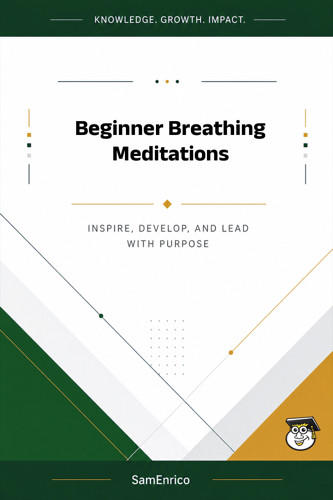
Non-FictionSelf-HelpBreathwork
Beginner Breathing Meditations eBook
Learn foundational breath awareness techniques to
Learn foundational breath awareness techniques to anchor your mindfulness practice.
Formats
Free sample
Chapter 1: The 22,000 Thieves--You will take approximately 22,000 breaths today. By the time you finish reading this sentence, you will have inhaled and exhaled at least once. By the time you finish this chapter, you will have taken roughly two hundred breaths. And you will not have noticed a single one of them.This is not a criticism. It is simply a fact of modern human neurology.
Your brain has evolved to automate breathing so completely that the process vanishes from conscious awareness entirely—unless something goes wrong. You notice your breath only when you cannot catch it (panic, asthma, a sprint to catch a train) or when someone explicitly tells you to notice it (a yoga teacher, a meditation app, or this book). The rest of the time, your breath runs on autopilot, silent and invisible, like the operating system of a computer that you never see but that controls everything.Here is the problem with that invisibility. The same breath that keeps you alive also holds the key to your mental freedom—but you cannot use a key you do not know you possess. Every best-selling book on mindfulness, from Jon Kabat-Zinn’s Full Catastrophe Living to Thich Nhat Hanh’s The Miracle of Mindfulness, agrees on one foundational truth: the breath is the single most accessible, portable, and powerful anchor for training the distracted mind.
But knowing this intellectually is like knowing that exercise is good for you while sitting on a couch. The gap between knowing and doing is where this book lives.The Monkey Mind Epidemic There is a term in Buddhist psychology that has migrated into mainstream language because it describes the modern condition so perfectly: Monkey Mind. The image is simple and devastating. Imagine a monkey swinging wildly from branch to branch, grabbing at one vine, then another, never still, never satisfied, driven by impulse and fear. That is your ordinary waking mind.
You wake up, and before your feet touch the floor, the monkey has already swung to yesterday’s argument, tomorrow’s deadline, a text message you forgot to send, a worry about your health, a fantasy about a vacation, a memory of an embarrassment from 2007. This is not a defect. It is evolution. Your brain’s default mode network—the neural circuitry that activates when you are not focused on a task—is designed to scan for threats, plan for the future, and review the past. That kept your ancestors alive on the savanna.
It is slowly driving you insane in the open-plan office.The average person spends nearly fifty percent of their waking hours mind wandering. Half of your life is lived somewhere other than where you actually are. Half of your life, you are not here. You are there—in the past, in the future, in a fantasy, in a fear. And here is the kicker: research from Harvard psychologist Matthew Killingsworth shows that a wandering mind is an unhappy mind.
Not sometimes. Not on average. Almost always. When you are present, you are reasonably content. When you are not, you are not.
The causality runs both ways, but the correlation is undeniable: the monkey makes you miserable, and misery makes the monkey swing faster.This is where the breath enters. The breath is the only thing happening right now that is also happening every moment of your life. It is the only anchor that is always available, always neutral, and always now. You cannot breathe in the past. You cannot breathe in the future.
You can only breathe in this exact millisecond. Which means that every time you return your attention to your breath, you are training your brain to leave the past and the future and to land, gently, in the present.Why Beginners Fail (And Why That Is Not Your Fault)Before we go any further, let me tell you why most people quit meditation within the first two weeks. It is not because they lack willpower. It is not because they are too busy. It is not because meditation does not work.
It is because they were taught wrong.The typical beginner sits down, closes their eyes, and tries to stop thinking. They have been told—explicitly or implicitly—that meditation means achieving a blank, silent mind. So they sit there, fighting thoughts like a bad martial arts movie, punching and blocking and sweating, and after ten minutes they have fought a thousand thoughts and lost to every single one. They open their eyes, conclude that they are "bad at meditation," and never sit again.Here is the truth that changes everything: meditation is not about stopping thoughts. It is about stopping the war with thoughts.The mind thinks the way the heart pumps and the lungs breathe.
It is what minds do. Trying to stop thinking is like trying to stop your heart. You cannot do it, and if you could, you would be dead. The goal of breath meditation is not to eliminate thoughts. The goal is to notice that you are thinking, to stop believing every thought as if it were a command, and to gently return your attention to the breath.
The returning—not the stillness—is the practice.Think of it like physical therapy for attention. If you broke your arm, the physical therapist would not say, "Hold your arm perfectly still for ten minutes or you have failed." They would say, "Move it a little. Feel the sensation. When it hurts, stop. Try again tomorrow." Meditation is the same.
Every time you notice that your mind has wandered and you bring it back to the breath, you have done one repetition. One rep. And just like bicep curls, the more reps you do, the stronger the muscle gets. The muscle in this case is attention. And the weight is your own wandering mind.The Breath as the Only Bridge You Will Ever Need Here is a fact that will change how you understand meditation forever.
Most of your body’s functions are completely automatic. Your heart beats. Your stomach digests. Your pupils dilate. You cannot consciously control any of these things—at least not directly.
You cannot tell your liver to process toxins faster. You cannot tell your kidneys to filter more efficiently. But your breath is different. Your breath is the only autonomic function that you can also consciously control. You can hold it.
You can slow it. You can speed it up. You can breathe deeply into your belly or shallowly into your chest. This makes the breath a bridge.One side of the bridge is the conscious mind—the part of you that makes decisions, sets goals, and reads books like this one. The other side of the bridge is the autonomic nervous system—the ancient, unconscious part of you that controls heart rate, stress hormones, and the fight-or-flight response.
You cannot talk directly to your autonomic nervous system. It does not understand English. It does not respond to reason. It responds to ancient biological signals: danger, safety, hunger, threat, rest. But you can talk to it through your breath.When you breathe fast and shallow (like a scared animal hiding in a bush), your autonomic nervous system…
This is the end of the free sample. Get the eBook to keep going. Buy now
About this book
Details
- Author
- Mullen Jayson
- Publisher
- SamEnrico
- Language
- English
- Genre
- Non-Fiction, Self-Help, Breathwork
- Released
- 2026-06-07
- Pages (approx.)
- 147
- Available as
- eBook, Audiobook

Read better in the ZLOADR app
Your eBooks on your phone or tablet. Sign in with your SamEnrico account and start reading.
More by Mullen Jayson
 Customer Service Priority QueuingMullen Jayson$11.99
 Francis First FollowersMullen Jayson$11.99
 Single And Lonely No MoreMullen Jayson$11.99
 The Antidepressant Pain GuideMullen Jayson$11.99
 The Voice of the People: How a Singaporean Editor Defied Censorship and Changed a NationMullen Jayson$11.99
 How to Become a Steak Sauce MakerMullen Jayson$11.99
 Pivot During FundraisingMullen Jayson$12.99
 Project Management MOOC GuideMullen Jayson$12.99
 Learn to Play the Tambou Bas a Yon FasMullen Jayson$11.99
 Algorithmic Information Acoustic Resonance TechnicianMullen Jayson$11.99
You may also like
 Hong Kong Handover 1997Dunn Johnnie$11.99
 Zumba For Postnatal Recovery CourseNeal Christian$11.99
 Zumba for BeginnersLadner Nikia$11.99
 YouTube Comment Mining GuideHumes Pandora$12.99
 Worry Box MeditationCarlin Rudy$11.99
 Workplace Stress MeditationNguyen Lynn$11.99
 Workplace Stress and Sleep RepairHawley Ivory$11.99
 Workplace Perfectionism CureDelaney Jeffry$11.99
 Workplace Injustice Anger GuideWallen Isabelle$11.99
 Work Addiction and Burnout LinkGreenwood Ester$11.99
 Women in Yoga and WellnessBeattie Galina$11.99
 Women in Stand Up ComedyChun Evangeline$11.99