
Non-FictionHealth & WellnessHome Fitness
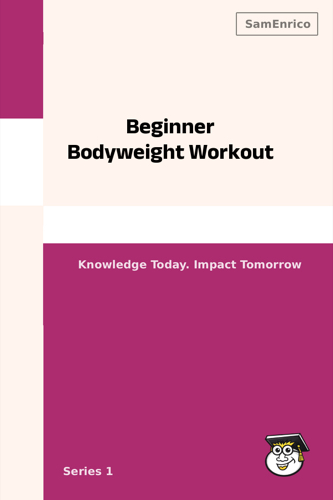
Beginner Bodyweight Workout eBook
Perform squats, push ups, and planks at home with
Perform squats, push ups, and planks at home with no equipment.
Formats
Free sample
Chapter 1: The $10,000 Lie--–- You have been sold a lie. It is a beautiful lie, wrapped in glossy magazine ads, polished You Tube thumbnails, and the quiet desperation of January gym parking lots. The lie sounds like this: You cannot get fit without equipment. You need weights. You need machines.
You need a monthly membership, special shoes, resistance bands with different color-coded tensions, and preferably a trainer who uses words like “plyometric” and “proprioception” while you stand there feeling underdressed and underqualified.The fitness industry is worth more than $30 billion dollars annually in the United States alone. That money pays for billboards of airbrushed models holding dumbbells. It pays for infomercials featuring foldable weight benches that somehow also toast bread. It pays for gym memberships that auto-draft from your bank account long after you have stopped attending. And here is the uncomfortable truth that none of those billboards will tell you: **The human body does not know the difference between a $200 kettlebell and your own thigh pressing against gravity.** Muscle tension is muscle tension.
Mechanical load is mechanical load. Your biceps cannot read price tags.This chapter exists to dismantle the equipment myth so thoroughly that you never again believe you need to buy anything to become strong. By the time you finish these pages, you will understand exactly how three simple movements—all of which you can perform in a ten-foot square of carpet—build more functional strength than ninety percent of gym-goers will ever achieve with their fancy belts and wrist straps and chalk clouds. More importantly, you will understand why the industry wants you to believe otherwise. Because a person who knows they can train anywhere, anytime, with nothing but their own body is a person who never buys a squat rack.
And that is bad for business.The Billion-Dollar Illusion Let us walk through a typical fitness journey. A beginner decides they want to get stronger. They walk into a big-box gym and are immediately confronted with rows of gleaming metal contraptions that resemble medieval torture devices. Each machine has a diagram showing a cartoon figure with arrows pointing at various muscles. The beginner has no idea which machine to start with.
They wander. They sit on a leg press and push a weighted platform. It feels vaguely productive, like doing data entry. They do three sets of ten, wipe down the seat with a sanitary wipe, and leave. They return fourteen times over the next three months.
Then they stop. The auto-draft continues.This story repeats millions of times every year. And the problem is not the beginner’s willpower. The problem is that the entire equipment-based model violates how human beings actually learn to move. We did not evolve to push weighted sleds while seated.
We evolved to squat, to push, to hold tension against gravity. Every child knows how to perform a perfect squat—watch any toddler pick up a toy from the floor. They drop their hips, keep their chest up, and rise without a moment’s hesitation. No toddler has ever asked for a Smith machine.The equipment industry has convinced you that strength is something external that you must purchase and bolt to your floor. But strength is a neurological adaptation.
When you perform a squat, your brain sends signals down your spinal cord, through your nerves, into your muscle fibers. Those fibers contract. Over time, your brain gets better at recruiting more fibers simultaneously. Your muscles get slightly denser. Your connective tissue toughens.
None of these adaptations require anything heavier than your own body mass—provided you understand how to manipulate leverage, tempo, and volume.Why Three Movements Are Enough You might be thinking: Surely I need more variety. Surely the human body requires dozens of different exercises to develop evenly. This belief is also a lie, though a more subtle one. The fitness industry profits from complexity because complexity sells programs, books, certifications, and equipment attachments. If the truth were simple—do these three movements, progress them slowly, eat decently, sleep adequately—there would be no reason to buy the next shiny object.But the truth is simple.
Here is why three movements cover nearly the entire spectrum of beginner strength development:Squats are the master lower-body movement. They train every muscle below the waist: quadriceps, hamstrings, glutes, calves, and the deep stabilizers of the hip. They also demand core engagement; try squatting with a relaxed belly and you will immediately feel unstable. A correctly performed squat transfers directly to standing up from a chair, climbing stairs, lifting a suitcase, and picking up a child. No machine-based leg exercise—not the leg press, not the leg extension, not the hamstring curl—replicates the full-body coordination of a squat because machines lock you into a fixed plane of motion.
Real life does not have rails.Push-ups are the master upper-body pushing movement. They train the chest, shoulders, triceps, and the serratus anterior (the muscle that stabilizes your shoulder blade against your ribcage). More importantly, push-ups teach full-body tension. A correct push-up is not a chest exercise with a limp body attached. It is a moving plank.
Your glutes must be squeezed. Your abs must be braced. Your quads must be locked. This full-body integration is why push-ups are actually harder than a bench press for many people—the bench press lets you relax everything except your chest and triceps. Push-ups demand everything.Planks are the master stability movement.
They train anti-extension of the spine, which is a fancy way of saying they teach your core to resist the force of gravity trying to pull your lower back toward the floor. A strong plank prevents lower back pain, improves posture, and transfers to every other movement you will ever perform. You cannot squat heavy (relative to your bodyweight) without a stable core. You cannot do a single proper push-up without a rigid torso. The plank is the foundation upon which all other bodyweight strength is built.Together, these three movements form a complete system.
Squats load the lower body. Push-ups load the upper body. Planks load the core and teach tension. There is no major muscle group left untouched. There is no functional movement pattern—pushing, squatting, bracing—that remains untrained.
And unlike a gym routine that requires you to learn fifteen different machine configurations, this system can be learned in an afternoon and refined over a lifetime.The Science of Bodyweight Progression The most common objection to bodyweight training is: But how do I make it harder? Eventually my bodyweight becomes too easy, right? This objection reveals a fundamental misunderstanding of how progressive overload works. Progressive overload is simply the gradual increase of stress placed on the body during training. Most people think the only way to increase stress is to add external weight.
This is demonstrably false.There are at least seven distinct ways to increase exercise difficulty without adding a single pound of external weight:1. Leverage manipulation. Moving your hands closer together during a push-up shifts more load onto your triceps. Moving your feet closer together during a squat changes the leverage angle at the hip. Raising your feet on an elevation during a push-up increases the percentage…
This is the end of the free sample. Get the eBook to keep going. Buy now
About this book
Details
- Author
- Mccullough Leann
- Publisher
- SamEnrico
- Language
- English
- Genre
- Non-Fiction, Health & Wellness, Home Fitness
- Released
- 2026-06-07
- Pages (approx.)
- 137
- Available as
- eBook, Audiobook

Read better in the ZLOADR app
Your eBooks on your phone or tablet. Sign in with your SamEnrico account and start reading.
More by Mccullough Leann
 The Anger Time-Out ProtocolMccullough Leann$11.99
 Accountant Interruption ManualMccullough Leann$11.99
 Self Hypnosis Induction Techniques CourseMccullough Leann$11.99
 Language Acquisition ChunkingMccullough Leann$11.99
 The Phoenix Protocol: How a 19th-Century Fire Code Saved a CityMccullough Leann$11.99
 The Billion-Dollar Bubble: How a Math Genius and a Wall Street Whiz Kid Blew Up the WorldMccullough Leann$11.99
 Understanding Emphysema-penoscrotal Web-deafness-mental RetardationMccullough Leann$17.99
 Financial Reporting AnalystMccullough Leann$11.99
 Dangerous Goods LogisticsMccullough Leann$12.99
 Bookkeeping Automation GuideMccullough Leann$12.99
 How to Start a Process Pressure Sphere Business (Beginners Guide)Mccullough Leann$11.99
You may also like
 Hong Kong Handover 1997Dunn Johnnie$11.99
 Zumba For Postnatal Recovery CourseNeal Christian$11.99
 Zumba for BeginnersLadner Nikia$11.99
 YouTube Comment Mining GuideHumes Pandora$12.99
 Worry Box MeditationCarlin Rudy$11.99
 Workplace Stress MeditationNguyen Lynn$11.99
 Workplace Stress and Sleep RepairHawley Ivory$11.99
 Workplace Perfectionism CureDelaney Jeffry$11.99
 Workplace Injustice Anger GuideWallen Isabelle$11.99
 Work Addiction and Burnout LinkGreenwood Ester$11.99
 Women in Yoga and WellnessBeattie Galina$11.99
 Women in Stand Up ComedyChun Evangeline$11.99