
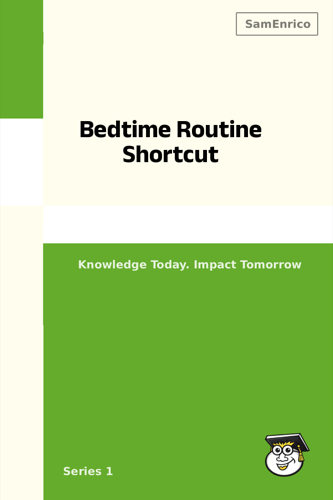
Bedtime Routine Shortcut eBook
Create wind down rituals that get kids to sleep fa
by Bogan Suzie
Create wind down rituals that get kids to sleep faster and earlier.
Formats
Free sample
Chapter 1: The 20-Minute Trap...--–- You have been lied to. Not by a person, but by a feeling. That creeping sense that if bedtime is taking forever, you must not be doing enough. Add another story. One more lullaby.
Ten more minutes of rocking. Surely, more time equals more sleep. That is the lie, and it is costing you hours of your life.You are about to discover the single most counterintuitive truth in all of pediatric sleep science: a longer bedtime routine does not produce faster sleep. It produces the opposite. And once you understand why, you will never waste another evening trapped in the 45-minute marathon that leaves you exhausted, frustrated, and wondering where you went wrong.This chapter is not gentle.
It is not theoretical. It is the wrecking ball that will demolish everything you thought you knew about putting your child to bed. By the time you finish reading, you will see bedtime differently. You will see your child differently. And most importantly, you will see the exit door from the 20-Minute Trap.The Confession Every Parent Is Afraid to Make Let us name the thing you have been silently thinking.
You love your child. You would do anything for them. But somewhere around the third request for water, the fourth stall about a monster in the closet, and the fifth time they pop up after you thought they were finally asleep—you feel it. A hot flash of resentment. A whispered thought: Why is this so hard?
Why can’t you just sleep?Here is the truth that no parenting book has been brave enough to say clearly: It is not your fault, and it is not your child’s fault. It is the length of your routine.Yes, you read that correctly. The very thing you have been adding to—more stories, more songs, more cuddles—is the engine driving your child’s resistance. Every extra minute you spend in that bedroom after they are ready to sleep is a minute you are actively waking them back up.This is not opinion. This is biology.The Cortisol Paradox: Why Exhausted Children Bounce Off Walls You have seen it a hundred times.
It is 8:30 PM. Your toddler has been up since 6:00 AM. They skipped their nap. They ran around the playground for two hours. By every logical measure, they should be collapsing with fatigue.
Instead, they are zooming around the living room, giggling maniacally, throwing stuffed animals, and looking at you with eyes that say, "I could do this all night."You think: They are not tired yet.You are wrong. They are overtired. And overtired is a different beast entirely.Let us go under the hood. The human body has a built-in alarm system called the hypothalamic-pituitary-adrenal (HPA) axis. When the brain senses a threat—hunger, danger, or in this case, extreme fatigue—it releases two hormones: cortisol and adrenaline.
These are the same chemicals that give a mother the strength to lift a car off her child. They are designed for survival, not for sleep.Cortisol is the body’s primary stress hormone. It raises blood sugar, sharpens focus, and tells every system in the body: Stay alert. Danger may be near. Adrenaline increases heart rate, floods muscles with oxygen, and creates that jittery, electric feeling you get when you are startled awake.Now imagine those hormones flooding your toddler’s tiny body.
They are not feeling sleepy. They are feeling activated. Their heart is racing. Their muscles are twitching. Their brain is scanning the room for threats.
They are not bouncing off the walls because they have energy to burn. They are bouncing off the walls because their body has entered fight-or-flight mode.And here is the cruelest irony: you caused it. Not on purpose. Not maliciously. But every minute you delayed bedtime past their natural "sleep window," you pushed their body closer to that cortisol threshold.
The longer you waited, the more stressed their system became. By the time you finally started the routine, you were not trying to put a tired child to bed. You were trying to sedate a hormonal firestorm.This is called the Cortisol Paradox: The more exhausted a child becomes, the more awake they appear. And the more awake they appear, the more parents extend the routine, which delays sleep further, which raises cortisol even higher. It is a vicious spiral, and the only way out is to stop lengthening the routine and start shortening it.The Sleep Window: Your Child’s Natural Off Switch Every child, from infancy through early childhood, has a biological sleep window.
This is not a parenting concept. It is a neurological fact. The sleep window is a narrow period—typically three to five minutes long—during which the brain is primed to transition from wakefulness to sleep with minimal resistance.Inside this window, melatonin (the sleep hormone) is rising, cortisol is naturally dropping, and the parasympathetic nervous system (rest-and-digest) is ready to take over. A child who is put to bed during their sleep window will often yawn once, roll over, and be unconscious within ten minutes. No fighting.
No stalling. No third request for water.Outside this window? You have already seen what happens. Cortisol spikes. The child becomes hyperalert.
And the peaceful transition you were hoping for turns into a battle of wills.Here is what most parents do not realize: the sleep window does not wait for you to finish your routine. You do not get to decide when it happens. Your child’s circadian rhythm decides. And if you are still brushing teeth, reading stories, or doing the Caterpillar Crush when that window opens, you will miss it entirely.The sleep window announces itself with subtle cues. Most parents are trained to look for obvious signs of tiredness—eye rubbing, yawning, drooping eyelids.
But those are actually late-stage cues. They mean the window has already opened and is about to close. The true sleep window cues are quieter, easier to miss, and absolutely critical to recognize.The Five Micro-Cues of the Sleep Window Over the next three nights, you will observe your child during the 30 minutes before you think they should go to bed. You are looking for any of these five micro-cues. They can appear in any order, and they may last only a few seconds.1.
The Unfocus. Your child’s eyes lose their sharpness. They stare at a spot on the wall or at nothing at all. Their gaze goes soft, almost dreamy. This is not boredom.
This is the brain beginning to power down visual processing.2. The Still Point. A child who has been moving suddenly stops. Not because they are listening or thinking—because their motor cortex is receiving the first waves of sleep pressure. They may pause mid-sentence, mid-step, or mid-tantrum.
This stillness rarely lasts longer than ten seconds.3. The Face Rub. Not a deliberate eye rub with a fist. This is subtler: the child presses their cheek against your shoulder, the couch cushion, or their own hand. They are seeking proprioceptive input (deep pressure) that helps lower heart rate.
This is an unconscious action, not a choice.4. The Single Deep Exhale. This is the most reliable cue and the…
This is the end of the free sample. Get the eBook to keep going. Buy now
About this book
Details
- Author
- Bogan Suzie
- Publisher
- SamEnrico
- Language
- English
- Genre
- Non-Fiction, Self-Help, Sleep
- Released
- 2026-06-10
- Pages (approx.)
- 141
- Available as
- eBook, Audiobook

Read better in the ZLOADR app
Your eBooks on your phone or tablet. Sign in with your SamEnrico account and start reading.
More by Bogan Suzie
 Depression and Appetite ChangesBogan Suzie$11.99
 Leitner Box MethodBogan Suzie$11.99
 Brooks Koepka Major KillerBogan Suzie$11.99
 Phobia Support GroupsBogan Suzie$11.99
 Euthanasia Decision GuideBogan Suzie$11.99
 Decatastrophizing Anger TriggersBogan Suzie$11.99
 Oral Hygiene MasterBogan Suzie$11.99
 The Curse of the Lombardi: How the 49ers Broke the NFL's Longest DroughtBogan Suzie$11.99
 The Boston Strangler: The City Under Siege (1962-1964)Bogan Suzie$11.99
 Service Providers Guide to General RemodelingBogan Suzie$11.99
 How to Become a Manual-arts TherapistBogan Suzie$11.99
 How to Produce Hubs and SwitchesBogan Suzie$11.99
You may also like
 Hong Kong Handover 1997Dunn Johnnie$11.99
 Zumba For Postnatal Recovery CourseNeal Christian$11.99
 Zumba for BeginnersLadner Nikia$11.99
 YouTube Comment Mining GuideHumes Pandora$12.99
 Worry Box MeditationCarlin Rudy$11.99
 Workplace Stress MeditationNguyen Lynn$11.99
 Workplace Stress and Sleep RepairHawley Ivory$11.99
 Workplace Perfectionism CureDelaney Jeffry$11.99
 Workplace Injustice Anger GuideWallen Isabelle$11.99
 Work Addiction and Burnout LinkGreenwood Ester$11.99
 Women in Yoga and WellnessBeattie Galina$11.99
 Women in Stand Up ComedyChun Evangeline$11.99