
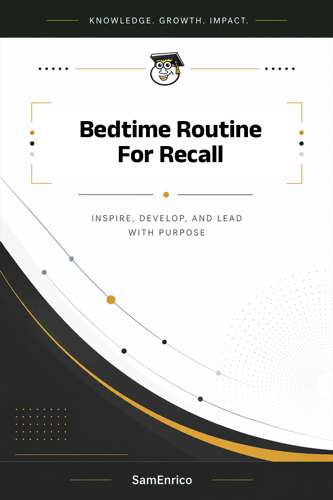
Non-FictionSelf-HelpEvening Rituals
Bedtime Routine For Recall eBook
Prepares mind for memory storage.
Prepares mind for memory storage.
Formats
Free sample
Chapter 1: The Midnight Eraser--You are about to lose 70 percent of what you learned today. Not next week. Not next month. By tomorrow morning.If you read a book for two hours tonight, you will remember less than thirty minutes of it when you wake up. If you studied a language for an hour, you will recall approximately eighteen minutes of vocabulary.
If you had a breakthrough conversation with your partner, a moment of clarity about your career, or a brilliant insight during a meeting—that insight has a 70 percent chance of being gone before you brush your teeth in the morning.This is not a guess. This is not an exaggeration to sell you something. This is the Forgetting Curve, discovered by German psychologist Hermann Ebbinghaus in 1885 and replicated in hundreds of studies since. The shape of that curve is brutal: steepest in the first hour, still falling through the evening, and merciless overnight. By the time your alarm goes off, your brain has deliberately, systematically deleted the majority of what you worked so hard to acquire.But here is the question that almost no one asks: why?Why would your own brain sabotage you?
Why would evolution design a memory system that throws away most of what you learn? The answer is both unsettling and liberating. Your brain is not trying to help you remember. It is trying to help you survive. And those two goals are not the same.The Brain as a Filter, Not a Storage Unit Open your phone.
Look at your camera roll. How many photos do you have stored? Thousands? Tens of thousands? Now imagine that every single photo you have ever taken—every blurry screenshot, every duplicate, every picture of a receipt—was automatically saved in full resolution forever.
Your phone would crash within weeks.Your brain faces the same constraint but with infinitely higher stakes. Your sensory receptors take in approximately eleven million bits of information every second. Your conscious mind can process roughly fifty of those bits. The remaining 10,999,950 bits are filtered out before you even notice them. This is not a flaw.
This is a necessity. If you were consciously aware of your socks touching your ankles, the slight pressure of your chair, the ambient hum of a refrigerator, and the subtle temperature variation across your left forearm, you would never be able to focus on a conversation, read a book, or cross a street safely.Your brain is not a storage device. It is a filter. And the primary job of that filter is to answer one question: What can I safely forget?This is the single most important sentence in this chapter: Your brain assumes, by default, that most of your day is junk.Think about that. Evolution shaped your brain in an environment where learning the location of a water source was life or death, but remembering what you ate for breakfast three weeks ago was useless.
Where recognizing the growl of a predator was critical, but recalling the exact pattern of clouds from yesterday was a waste of energy. Your brain is optimized for forgetting because forgetting is efficient. Forgetting is adaptive. Forgetting kept your ancestors alive.The problem is that you no longer live on the savanna. You live in a world where you need to remember software updates, medical information, client names, investment strategies, language vocabulary, and the emotional needs of your partner.
Your brain has not caught up. It is still running survival software in an information economy. And every night, while you sleep, it runs its automated deletion routine—erasing anything it has classified as "non-essential for immediate survival."Introducing the Midnight Eraser Let us name this deletion routine. Call it the Midnight Eraser.The Midnight Eraser is not a monster under your bed. It is a set of neural processes that evaluate every memory from your day and assign it a priority score.
Memories with high emotional charge get saved. Memories that you rehearsed multiple times get saved. Memories connected to existing strong networks get saved. Everything else gets deleted.Here is what the Midnight Eraser does not care about: your goals, your study plans, your New Year's resolutions, the expensive course you bought, or the conversation with your child that you swore you would never forget. It only cares about survival signals.
And survival signals are almost always negative: fear, pain, hunger, threat, rejection, embarrassment, anxiety.This creates a devastating asymmetry. Positive or neutral information—a new word in Spanish, a principle of economics, a fact about human anatomy—carries low emotional charge. It does not scream "survive!" to your brain. But a snide comment from a coworker? That carries high emotional charge.
A worry about tomorrow's presentation? Extremely high charge. An argument with your partner? Off the charts.So here is what the Midnight Eraser does every night while you sleep: it looks at everything you experienced, learned, and thought about during the day. It asks, "What was most emotionally intense?" And then it saves those memories while deleting the rest.Think about the implications.
Without an intentional bedtime routine, your brain is systematically archiving your anxieties, your embarrassments, your regrets, and your arguments—while deleting your hard-won knowledge, your insights, and your growth. You are not forgetting because you are lazy or stupid. You are forgetting because your brain is doing exactly what evolution designed it to do: prioritize threat over learning.The Glymphatic System: Your Brain's Nightly Cleaning Crew To understand why the Midnight Eraser is so active during sleep, we need to look under the hood. In 2012, Dr. Maiken Nedergaard at the University of Rochester discovered a previously unknown system in the brain called the glymphatic system.
The name combines "glial cells" (the brain's support cells) with "lymphatic" (the body's waste removal system). Here is what she found:While you are awake, your brain cells are active. They fire, communicate, and produce metabolic waste products—including beta-amyloid, the protein associated with Alzheimer's disease. This waste builds up in the spaces between your brain cells. During wakefulness, your brain has no efficient way to clear this waste.
It's like a kitchen with no garbage disposal and a sink that drains slowly.But when you sleep, something remarkable happens. Your brain cells shrink by approximately 60 percent. This creates more space between them—like widening the gaps between rocks in a riverbed. Cerebrospinal fluid then floods through these expanded spaces, washing away the metabolic waste that accumulated during the day. The glymphatic system is most active during deep, non-REM sleep (Slow-Wave Sleep).
This is when the cleaning happens.Now connect this to memory. The glymphatic system does not discriminate between "good" waste and "bad" waste. It clears everything that is not firmly attached. If a memory is weakly encoded—if you only thought about it once, if it had no emotional tag, if you did not rehearse it—the glymphatic system will wash it away along with the metabolic trash. The memory is physically, biologically deleted.This is not metaphor.
This is fluid dynamics inside your skull. If you do not tag a memory as important before you sleep, the night cleaning crew will assume it is junk and…
This is the end of the free sample. Get the eBook to keep going. Buy now
About this book
Details
- Author
- Gooden Danyell
- Publisher
- SamEnrico
- Language
- English
- Genre
- Non-Fiction, Self-Help, Evening Rituals
- Released
- 2026-06-05
- Pages (approx.)
- 130
- Available as
- eBook, Audiobook

Read better in the ZLOADR app
Your eBooks on your phone or tablet. Sign in with your SamEnrico account and start reading.
More by Gooden Danyell
 The Governor's Climate OrderGooden Danyell$11.99
 Parental Sleep Deprivation RecoveryGooden Danyell$11.99
 Empathy For Phobias GuideGooden Danyell$11.99
 Thyroid Disorders CourseGooden Danyell$11.99
 Divorce Financial Stress RecoveryGooden Danyell$11.99
 Blastocystis HominisGooden Danyell$11.99
 Romantic Relationship BoundariesGooden Danyell$11.99
 The Symphony of the Sun: Black Composers Who Shaped Classical MusicGooden Danyell$11.99
 First 24 Hours Crisis ResponseGooden Danyell$11.99
 Beneath the Black Waves: The Lost Fleet of the CyclopsGooden Danyell$11.99
 The Great Emu War: Australia’s Feathered Gold Rush FiascoGooden Danyell$11.99
 The Mineral Guide to GlaucochroiteGooden Danyell$11.99
You may also like
 Hong Kong Handover 1997Dunn Johnnie$11.99
 Zumba For Postnatal Recovery CourseNeal Christian$11.99
 Zumba for BeginnersLadner Nikia$11.99
 YouTube Comment Mining GuideHumes Pandora$12.99
 Worry Box MeditationCarlin Rudy$11.99
 Workplace Stress MeditationNguyen Lynn$11.99
 Workplace Stress and Sleep RepairHawley Ivory$11.99
 Workplace Perfectionism CureDelaney Jeffry$11.99
 Workplace Injustice Anger GuideWallen Isabelle$11.99
 Work Addiction and Burnout LinkGreenwood Ester$11.99
 Women in Yoga and WellnessBeattie Galina$11.99
 Women in Stand Up ComedyChun Evangeline$11.99