
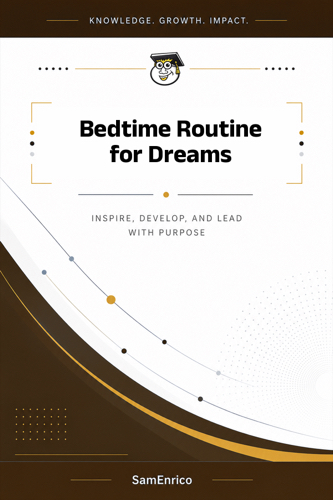
Bedtime Routine for Dreams Audiobook
Create sleep habits that promote positive dream re
Create sleep habits that promote positive dream recall.
Formats
Free sample
Chapter 1: The Recall Paradox...-- Every morning, approximately two billion people wake up convinced they have not dreamed. They roll over, check their phones, stretch, and step into the shower carrying an invisible weight they cannot name—a vague sense that something happened in the night, some flicker of narrative or emotion, now dissolved like a sugar cube in hot coffee. They are wrong. They did dream. Every single one of them.
The polysomnography is unambiguous: all humans dream four to six times per night, accumulating somewhere between ninety minutes and two hours of dream time across a full sleep cycle. The problem is not an absence of dreaming. The problem is a catastrophic failure of recall, and that failure is not accidental. It is engineered by the very architecture of the sleeping brain.This chapter reveals the uncomfortable truth about why you forget nearly everything that happens between the moment your head touches the pillow and the moment your alarm clock announces the morning. More importantly, it hands you the biological keys to reverse that forgetting—not through mystical practices or expensive gadgets, but through a precise understanding of how the hippocampus, the prefrontal cortex, and the amygdala conspire to erase your dreams before you can catch them.The Thief Inside Your Skull Let us begin with the most important fact in this entire book: forgetting your dreams is not a sign that you sleep poorly or that your mind is somehow broken.
It is the default state of the human brain. Evolution did not design you to remember your dreams. Evolution designed you to survive predators, find food, avoid social conflict, and reproduce. Dream recall conferred no survival advantage on the savanna, and so the machinery of memory was never optimized to preserve the strange, associative, emotionally charged narratives that unfold during REM sleep.But here is the paradox. While you forget most dreams, the dreams themselves are doing critical work.
Matthew Walker, the director of UC Berkeley’s Center for Human Sleep Science and author of Why We Sleep, describes the dreaming brain as an overnight therapist. During REM sleep, the amygdala—the brain’s fear and emotion center—fires at levels two to three times higher than during waking hours. At the same time, the prefrontal cortex, which houses rational thought, impulse control, and working memory, is actively suppressed. This neurochemical arrangement allows the brain to process emotional memories without…
This is the end of the free sample. Get the Audiobook to keep going. Buy now
About this book
Details
- Author
- Kitchens Hung
- Publisher
- SamEnrico
- Language
- English
- Genre
- Non-Fiction, Self-Help, Bedtime
- Released
- 2026-06-09
- Pages (approx.)
- 142
- Available as
- eBook, Audiobook

Listen in the VoxFlicks app
Audiobooks and audio dramas wherever you go. Sign in with your SamEnrico account and press play.
More by Kitchens Hung
 Transcendental Meditation for TeensKitchens Hung$11.99
 Gluten Free Breastfeeding GuideKitchens Hung$11.99
 Drowning SurvivorKitchens Hung$11.99
 Lead Paint Home Detection GuideKitchens Hung$11.99
 Bipolar Antipsychotics GuideKitchens Hung$11.99
 Water Bottle Toxin PreventionKitchens Hung$11.99
 Sarcopenia Sleep Repair GuideKitchens Hung$11.99
 Journaling Dreams for AnswersKitchens Hung$11.99
 The Archimedes Code: Mathematics as a Weapon of Western GeniusKitchens Hung$11.99
 The Great Unfollow: How Social Media Divided a GenerationKitchens Hung$11.99
 Location Independent Business ModelsKitchens Hung$11.99
 The Dancer's Guide to TsyganochkaKitchens Hung$11.99
You may also like
 Hong Kong Handover 1997Dunn Johnnie$11.99
 Zumba For Postnatal Recovery CourseNeal Christian$11.99
 Zumba for BeginnersLadner Nikia$11.99
 YouTube Comment Mining GuideHumes Pandora$12.99
 Worry Box MeditationCarlin Rudy$11.99
 Workplace Stress MeditationNguyen Lynn$11.99
 Workplace Stress and Sleep RepairHawley Ivory$11.99
 Workplace Perfectionism CureDelaney Jeffry$11.99
 Workplace Injustice Anger GuideWallen Isabelle$11.99
 Work Addiction and Burnout LinkGreenwood Ester$11.99
 Women in Yoga and WellnessBeattie Galina$11.99
 Women in Stand Up ComedyChun Evangeline$11.99