
Non-FictionMental WealthSleep Regulation
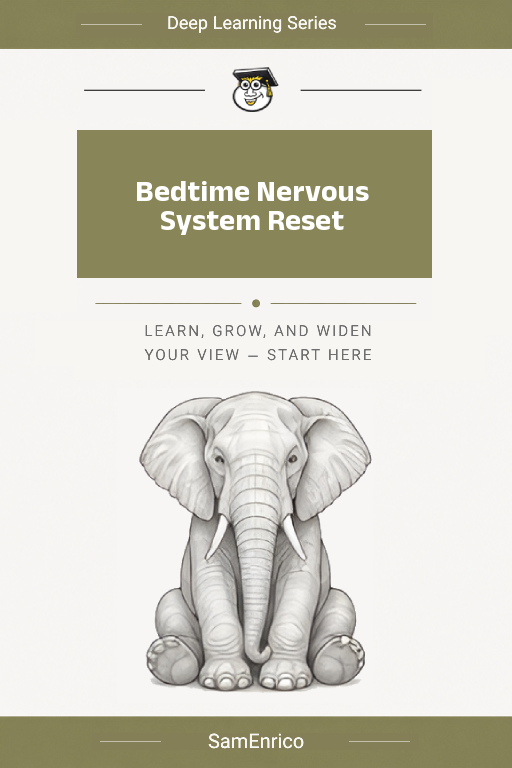
Bedtime Nervous System Reset eBook
Wind down with a 10 minute micro-break sequence th
Wind down with a 10 minute micro-break sequence that lowers nocturnal sympathetic activation for deeper sleep.
Formats
Free sample
Chapter 1: The 3 AM Treadmill--–- You have probably experienced it. The moment when you are lying in bed, utterly exhausted, but your mind will not stop. It is not that you are worried about anything specific, necessarily. It is that your brain seems to have a mind of its own, racing from thought to thought, replaying the day's events, anticipating tomorrow's challenges. Your body feels the fatigue, but your nervous system feels the urgency.
You are stuck in a state that sleep scientists call cognitive arousal, and it is the single most common cause of difficulty falling asleep.Perhaps it happened last night. Or the night before. Or every night for the past several weeks. You climbed into bed after a long day. Your body was tired.
Your eyes were heavy. But your brain was running a marathon. It replayed the awkward thing you said in a meeting. It planned tomorrow's to-do list. It worried about a deadline that is still three weeks away.
The more you tried to force sleep, the more elusive it became. You checked the clock. 11:47 PM. You checked again. 12:23 AM.
You checked again. 1:05 AM. The spiral continued.This experience is so common that it has become a cliché. But clichés exist because they are true. According to the American Sleep Association, approximately fifty to seventy million adults in the United States suffer from some form of sleep disorder.
Among them, the most common complaint is not the inability to stay asleep—it is the inability to fall asleep. The racing mind. The spinning thoughts. The feeling of being exhausted and wired at the same time.Here is the truth that most people do not realize: this is not a moral failing. It is not a sign that you are weak, undisciplined, or broken.
It is a physiological condition rooted in the most fundamental system of your body—the autonomic nervous system. And like any physiological condition, it can be understood, managed, and ultimately changed.The Two Gears of Your Nervous System Your body has an internal operating system that runs without your conscious input. It controls your heart rate, your breathing, your digestion, your blood pressure, and your stress responses. This system is called the autonomic nervous system, and it has two primary branches that operate like the gears of a car.The first branch is the sympathetic nervous system. This is often described as the "fight or flight" system.
It activates when you face a challenge, a deadline, a confrontation, or a perceived threat. When the sympathetic nervous system is engaged, your heart rate increases. Your blood pressure rises. Your muscles tense. Your pupils dilate.
Your digestion slows. Your body releases stress hormones like cortisol and adrenaline. These responses are designed for short-term survival. They help you flee a predator, meet a deadline, or navigate a difficult conversation.The second branch is the parasympathetic nervous system. This is often described as the "rest and digest" system.
It activates when you are safe, calm, and ready to recover. When the parasympathetic nervous system is engaged, your heart rate slows. Your blood pressure lowers. Your muscles relax. Your digestion activates.
Your body releases hormones that support healing and restoration. This is the system that should be dominant when you are in bed, preparing for sleep.These two systems are designed to work in balance. During the day, sympathetic activation helps you perform. During the night, parasympathetic activation helps you restore. The problem is that modern life has disrupted this balance for millions of people.The Busy Brain Phenomenon Dr.
Romie Mushtaq, a triple-board-certified neurologist, has a name for the state that keeps people awake at night. She calls it the "Busy Brain." It is a brain riddled with anxiety, insomnia, and an inability to focus. It is not a permanent condition. It is a learned state, and it can be unlearned.The Busy Brain develops through a process of chronic sympathetic activation. You wake up with a racing mind, so you immediately start planning your day.
You work through lunch because there is too much to do. You answer emails in the evening because you want to get ahead. You scroll through social media before bed because you need to unwind. Each of these activities keeps your sympathetic nervous system engaged. You are not giving your parasympathetic system a chance to activate.Over time, this becomes a habit.
Your brain learns that sympathetic activation is the default state, even at night. When you lie down in bed, your brain does not automatically shift into rest mode. It stays in alert mode, scanning for threats, replaying the day, anticipating tomorrow. The threats are not real—there is no predator in your bedroom, no deadline at 3 AM—but your nervous system does not know the difference. It responds to perceived threats the same way it responds to real ones.The result is the 3 AM treadmill.
You are exhausted, but you cannot sleep. You are still, but your nervous system is not.The Physiology of a Wired Brain To understand why this happens, it helps to look at the specific physiology of chronic sympathetic activation. When your sympathetic nervous system is activated for extended periods, your body releases stress hormones like cortisol and adrenaline. These hormones are designed for short bursts of activity, not for sustained elevation.Cortisol follows a natural daily rhythm called the circadian cycle. In a healthy system, cortisol peaks in the morning, helping you wake up and feel alert.
It gradually decreases throughout the day, reaching its lowest point in the middle of the night. This pattern allows your body to be alert when you need to be alert and rest when you need to rest.But chronic stress disrupts this rhythm. When you are constantly activated, your cortisol levels remain high even at night. High nighttime cortisol interferes with sleep onset—it takes longer to fall asleep. It reduces deep sleep—you spend less time in the restorative stages of sleep.
It causes nighttime awakenings—you wake up more often and have trouble falling back asleep. Even if you fall asleep, you do not stay asleep. Even if you stay asleep, you do not wake up feeling restored.This creates a vicious cycle. Poor sleep increases stress. Increased stress disrupts sleep.
The cycle continues, and you feel worse over time.The Good News: Neuroplasticity Here is the most important message of this chapter, and perhaps of this entire book: your nervous system is plastic. It can change. The Busy Brain is not a life sentence. It is a pattern that you have learned, and patterns that are learned can be unlearned.Neuroplasticity is the brain's ability to reorganize itself by forming new neural connections throughout life. Every time you practice a new behavior, you strengthen the neural pathways that support that behavior.
Over time, the new behavior becomes easier, more automatic, and eventually default.The bedtime reset sequence in this book is designed to take advantage of neuroplasticity. Each time you practice the sequence, you strengthen the neural pathways that support parasympathetic activation. You weaken the pathways that keep you stuck in sympathetic dominance. Over time, the shift becomes easier and faster. Your body…
This is the end of the free sample. Get the eBook to keep going. Buy now
About this book
Details
- Author
- Rodrigue Beverlee
- Publisher
- SamEnrico
- Language
- English
- Genre
- Non-Fiction, Mental Wealth, Sleep Regulation
- Released
- 2026-05-30
- Pages (approx.)
- 130
- Available as
- eBook, Audiobook

Read better in the ZLOADR app
Your eBooks on your phone or tablet. Sign in with your SamEnrico account and start reading.
More by Rodrigue Beverlee
 Money Laundering Through CyprusRodrigue Beverlee$11.99
 Legacy of 1857 MutinyRodrigue Beverlee$11.99
 Anger Mindfulness MeditationRodrigue Beverlee$11.99
 The Automotive Parts Safety StockRodrigue Beverlee$11.99
 Overcoming Procrastination for TeachersRodrigue Beverlee$11.99
 Lord Curzon Viceroy IndiaRodrigue Beverlee$11.99
 Brainstorming for TeamsRodrigue Beverlee$11.99
 The Wise Old Man ArchetypeRodrigue Beverlee$11.99
 The Poisoned Tea: A Love Triangle That Shook Singapore (1960)Rodrigue Beverlee$11.99
 The Emperor's Face: How Apelles Painted Alexander the Great (4th Century BCE)Rodrigue Beverlee$11.99
 How to Become a PhysicistRodrigue Beverlee$11.99
 How to Produce Power Supply UnitsRodrigue Beverlee$11.99
You may also like
 Hong Kong Handover 1997Dunn Johnnie$11.99
 Zumba For Postnatal Recovery CourseNeal Christian$11.99
 Zumba for BeginnersLadner Nikia$11.99
 YouTube Comment Mining GuideHumes Pandora$12.99
 Worry Box MeditationCarlin Rudy$11.99
 Workplace Stress MeditationNguyen Lynn$11.99
 Workplace Stress and Sleep RepairHawley Ivory$11.99
 Workplace Perfectionism CureDelaney Jeffry$11.99
 Workplace Injustice Anger GuideWallen Isabelle$11.99
 Work Addiction and Burnout LinkGreenwood Ester$11.99
 Women in Yoga and WellnessBeattie Galina$11.99
 Women in Stand Up ComedyChun Evangeline$11.99