
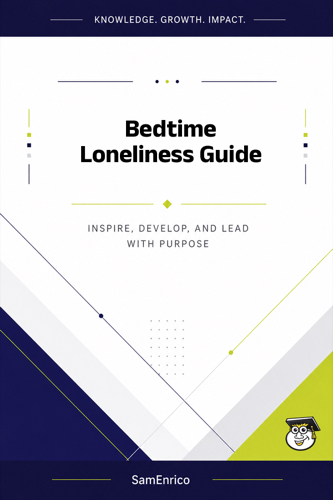
Bedtime Loneliness Guide eBook
Sleeps without a partner.
Sleeps without a partner.
Formats
Free sample
Chapter 1: The Cold Sheets Lie--Your hand drifts across the mattress in that hazy space between asleep and awake, searching for warmth, for the familiar curve of a shoulder or the steady rhythm of someone else's breathing. And finds nothing. Just cold, flat, unforgiving cotton. In that half-second of recognition, something in your chest seizes. Your eyes snap open.
Your heart pounds against your ribs like a trapped bird. You are suddenly, brutally awake, and the empty side of the bed feels less like a space and more like a verdict.If you are reading this book, you know exactly what that moment feels like. You have lived it dozens, perhaps hundreds, of times. You may have given it a name—loneliness, rejection, grief, failure, or just the dull ache of something missing. But here is the first and most important truth this book will teach you: what you feel in that moment is not a character flaw.
It is not proof that you are codependent, weak, broken, or unlovable. It is not a sign that you have failed at adulthood, relationships, or basic human functioning. That jolt of panic, that racing heart, that desperate reach across empty sheets—that is your 200,000-year-old primate brain doing exactly what evolution designed it to do. The problem is not your brain. The problem is that your brain is running software written for the African savanna while you are trying to sleep in a climate-controlled apartment in the twenty-first century.This chapter is called "The Cold Sheets Lie" because the cold sheets are not the problem.
The lie is the story you tell yourself about what the cold sheets mean. The lie is that your panic at 3:00 AM is an accurate report on the state of your life, your worth, or your future. The lie is that sleeping alone is a problem to be solved rather than a condition to be understood. By the time you finish this chapter, you will have a new relationship with that moment of reaching out into emptiness. You will still feel the jolt sometimes—biology is not easily overwritten—but you will no longer mistake biology for biography.The Primal Bedroom: Why Your Brain Still Thinks You Are in Danger To understand why the empty side of the bed triggers a physical panic response, you have to travel back to a time before mattresses, before bedrooms, before the very concept of sleeping alone as a regular occurrence.
Picture the African savanna, roughly 200,000 years ago. A small band of early humans huddles together as night falls. They have no walls, no locks, no alarm systems, no police forces, no deadbolts. Their only protection against predators—large cats, hyenas, snakes, rival tribes, and every other danger that lurks in the dark—is each other. They sleep in a tight cluster, bodies pressed together for warmth and for safety.
The group sleeps in shifts; someone is always partially awake, listening, ready to sound the alarm at the first sign of danger.In this environment, to sleep alone was to die. Period. A human separated from the group at night was not simply lonely or sad—they were vulnerable, exposed, and almost certainly doomed before dawn. The brain evolved accordingly. Over hundreds of thousands of years, natural selection wired the human nervous system to interpret "alone in the dark" as a life-threatening state and "another body next to me" as a safety state.
This is not a cultural preference, a personality quirk, or a sign of emotional neediness. It is a survival adaptation etched into the oldest, most primitive parts of your brain—the parts you share with every mammal on the planet, from mice to elephants to gorillas.Now fast forward to tonight. You are lying in a locked room, in a building with a door that closes and locks, in a neighborhood where the greatest threat is probably the neighbor's barking dog or the strange noise the water heater makes. You are perfectly safe. Your rational mind knows this.
You know that no saber-toothed tiger is going to leap through your window. You know that statistically, your bedroom is one of the safest places you will ever occupy. But the ancient part of your brain—the amygdala, a small almond-shaped cluster of neurons deep in the temporal lobe—does not know this. The amygdala does not understand deadbolts. It does not understand police forces, alarm systems, neighborhood watch programs, or the statistical unlikelihood of a predator breaking through your third-floor window.
The amygdala understands one thing and one thing only: alone equals danger. Body present equals safe.When you reach out and find cold sheets, your amygdala sounds the alarm. And it does not send you a polite memo or a gentle suggestion. It floods your system with stress hormones—cortisol, adrenaline, norepinephrine—that jack up your heart rate, sharpen your senses, dilate your pupils, and prepare your body for fight or flight. This is why you suddenly feel wide awake at 2:47 AM.
This is why your chest feels tight and your palms feel clammy. This is why your mind races with catastrophic thoughts about the breakup, about dying alone, about never finding love again. Your brain is not trying to punish you. It is not trying to remind you of your failures. It is trying to save your life, using a threat-detection system that has not received a software update in 200,000 years.Let me say that again because it is the most important sentence in this chapter: Your brain is trying to save your life.
The panic you feel is not a sign of weakness. It is a sign that your survival machinery is working exactly as it was designed to work. The only problem is that the machinery was designed for a world that no longer exists.The Hormonal Battle: Oxytocin Versus Cortisol To understand why the presence of another body is so profoundly calming to the mammalian nervous system—and why the absence of that body is so profoundly distressing—you need to understand two hormones: oxytocin and cortisol. They are chemical opposites, yin and yang, the angel and devil on your brain's shoulders. Understanding their relationship is the key to understanding why you feel the way you feel when you sleep alone.Let us start with cortisol.
Cortisol is the primary stress hormone, the chemical messenger that your body releases in response to any perceived threat. When your amygdala perceives danger—whether that danger is a literal predator or the absence of a warm body—it triggers a cascade of signals that result in the release of cortisol from your adrenal glands. Cortisol mobilizes energy (in the form of sugar) to your muscles, sharpens your focus, increases your heart rate, elevates your blood pressure, and temporarily suppresses non-essential functions like digestion, immune response, growth, and reproduction. Most importantly for our purposes, cortisol suppresses the ability to fall asleep and stay asleep. Cortisol is designed for short-term emergencies.
It is the hormone that lets you leap out of the way of a speeding car or fight off an attacker. But when cortisol stays elevated for long periods—when the threat does not go away, when you lie alone…
This is the end of the free sample. Get the eBook to keep going. Buy now
About this book
Details
- Author
- Rosado Ashely
- Publisher
- SamEnrico
- Language
- English
- Genre
- Non-Fiction, Self-Help, Sleep
- Released
- 2026-06-10
- Pages (approx.)
- 147
- Available as
- eBook, Audiobook

Read better in the ZLOADR app
Your eBooks on your phone or tablet. Sign in with your SamEnrico account and start reading.
More by Rosado Ashely
 Order Solar Telescope Death Transit Ritual CourseRosado Ashely$11.99
 TRT Therapy Decision GuideRosado Ashely$11.99
 Emotional Regulation LifespanRosado Ashely$11.99
 Mindfulness for Empath BurnoutRosado Ashely$11.99
 The Ballot That Broke the Internet: The 2000 Florida Recount & the Birth of Digital MisinformationRosado Ashely$11.99
 The Rendlesham Radio Silence: When the U.S. Military Encountered the UnknownRosado Ashely$11.99
 How to Start a Portable Wooden Buildings Business (Beginners Guide)Rosado Ashely$11.99
 Dubai Student Emergency ContactsRosado Ashely$12.99
 NSF Graduate Fellowship ProposalRosado Ashely$12.99
 Content Production PipelinesRosado Ashely$11.99
 Understanding Ceroid Lipofuscinois, Neuronal 3, JuvenileRosado Ashely$17.99
You may also like
 Hong Kong Handover 1997Dunn Johnnie$11.99
 Zumba For Postnatal Recovery CourseNeal Christian$11.99
 Zumba for BeginnersLadner Nikia$11.99
 YouTube Comment Mining GuideHumes Pandora$12.99
 Worry Box MeditationCarlin Rudy$11.99
 Workplace Stress MeditationNguyen Lynn$11.99
 Workplace Stress and Sleep RepairHawley Ivory$11.99
 Workplace Perfectionism CureDelaney Jeffry$11.99
 Workplace Injustice Anger GuideWallen Isabelle$11.99
 Work Addiction and Burnout LinkGreenwood Ester$11.99
 Women in Yoga and WellnessBeattie Galina$11.99
 Women in Stand Up ComedyChun Evangeline$11.99