
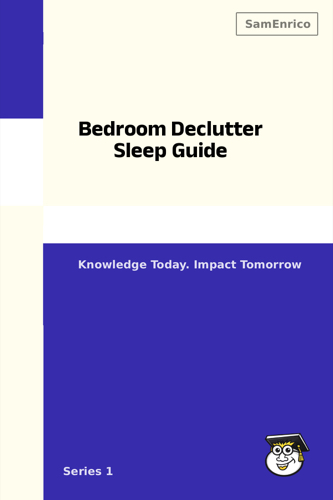
Bedroom Declutter Sleep Guide eBook
Remove work items and electronics from sleeping sp
by Nagy Elouise
Remove work items and electronics from sleeping space.
Formats
Free sample
Chapter 1: The Third Shift--–- The first time I realized my bedroom had become a workplace, I was answering emails at 2:47 AM. My laptop was balanced on my knees, the blue glow illuminating a pile of laundry that had been sitting there for eleven days. My phone, wedged between two pillows, buzzed with a Slack notification from a colleague in Singapore. My smartwatch, still on my wrist, informed me that I had taken 247 steps that day—most of them from my bed to the bathroom and back. I was exhausted, irritable, and vaguely nauseous.
And yet, I could not stop.I told myself this was productivity. I told myself I was "catching up." I told myself that checking emails in bed was no different from reading a book before sleep—just a modern version of winding down.I was lying to myself.What I was actually doing was working a third shift. An unpaid, unrecognized, and utterly exhausting shift that began the moment I got into bed and ended only when my eyes finally gave out—usually somewhere around 3:30 AM, only to start again when my 7:00 AM alarm (same phone, same smartwatch) dragged me back into the first shift.This is not a confession of unusual behavior. This is the new normal.According to a 2022 survey by the National Sleep Foundation, 67 percent of adults bring their phones into bed with them. Forty-three percent check work emails or messages after getting into bed.
Twenty-eight percent report that they have "often" or "always" taken a work call or responded to a work message while lying in bed. We have, collectively and without a formal vote, decided that our bedrooms are no longer places of rest. They are satellite offices. They are command centers. They are, for millions of people, the place where the workday never really ends.This chapter is called "The Third Shift" because that is exactly what you are working.
The first shift is your paid working hours. The second shift is household labor—cooking, cleaning, childcare, errands. The third shift is the insidious, self-inflicted labor that happens in the hours when you should be recovering. It is the email you answer at 11:00 PM. The project you "just finish" at midnight.
The social media scroll that was supposed to be five minutes and became ninety. The news alert that spikes your cortisol at 1:30 AM. The work chat that reminds you of a deadline you had forgotten, and now cannot stop thinking about.The third shift has no union. It has no overtime pay. It has no boundaries, because it has invaded the one place that was supposed to be a boundary: your bedroom.This book exists because the third shift is destroying your sleep, your health, and your ability to be present in your own life.
And the solution—surprisingly, almost embarrassingly simple—is to remove work items and electronics from your sleeping space. Not to meditate harder. Not to buy a $300 sleep tracker. Not to download another app. To physically, concretely, irrevocably remove the objects that are keeping you awake.Before we can do that, however, you need to understand exactly what is happening inside your brain and body when you bring work and electronics into bed.
This chapter will give you that understanding. It will explain the biology of interrupted rest, the psychology of digital boundaries, and the hidden costs of the third shift. By the end of this chapter, you will never look at your phone on your nightstand the same way again.The Invention of the 24-Hour Workday Let us start with a question that sounds ridiculous but is actually profound: When did you last truly stop working?Not "stop answering emails." Not "stop taking calls." Not "stop thinking about that project." When did your brain actually, fully, completely disengage from work?If you are like most people, the answer is: you cannot remember.This is not because you lack discipline. It is because the technology that was supposed to free us—laptops, smartphones, home internet—has instead tethered us to work in ways that would have been unimaginable thirty years ago. In 1995, when you left the office, you left the office.
Your work phone stayed on your desk. Your files stayed in your filing cabinet. Your ability to work from home was limited to bringing home a physical briefcase, which required deliberate effort and was generally reserved for emergencies.Today, your entire office fits in your pocket. Your email inbox follows you everywhere. Your colleagues can reach you at any hour, from any time zone.
Your work is never more than a thumb-scroll away.This is often celebrated as flexibility. It is not. It is the erosion of every boundary between labor and life.A 2018 study from the University of Texas at Austin found that the mere presence of a smartphone—even when turned off, even when face down—reduces cognitive performance. The researchers asked participants to complete a series of attention-demanding tasks. Some participants had their phones in the same room, face down on a desk.
Others had their phones in another room. The group with phones in the same room performed significantly worse, even though they never touched their phones and the phones never made a sound.The researchers called this "brain drain." The simple awareness that your phone is nearby—that a notification could arrive at any moment—consumes a small but measurable portion of your attentional resources. You are never fully focused on what you are doing because part of your brain is always waiting for the buzz, the ding, the vibration.Now imagine what happens when that phone is not just in the same room, but on your nightstand. Six inches from your head. In your hand.
Under your pillow.You are not "resting" in that bed. You are idling, waiting for something to demand your attention.The Biology of Light: Why Your Screen Is a Fake Sun To understand why electronics destroy sleep, you must first understand how sleep works at the biological level. This is not complicated, but it is essential.Deep inside your brain, in a region called the suprachiasmatic nucleus—let us call it your body's master clock—there is a tiny bundle of neurons that governs your circadian rhythm. This master clock receives information about light through your eyes, specifically through a type of cell called intrinsically photosensitive retinal ganglion cells. These cells are not used for vision in the way that rods and cones are.
They do not help you see shapes or colors. Their only job is to detect brightness and send that information to your master clock.When these cells detect bright light, they tell your master clock: "It is daytime. Suppress melatonin. Increase alertness."When they detect darkness, they tell your master clock: "It is nighttime. Release melatonin.
Prepare for sleep."This system evolved over hundreds of millions of years. It worked perfectly for almost all of human history because the only source of bright light after sunset was fire. Firelight is warm, orange, and low in the blue wavelengths that most powerfully stimulate those light-detecting cells. A campfire has an illuminance of roughly 10 to 50 lux (a measure of light…
This is the end of the free sample. Get the eBook to keep going. Buy now
About this book
Details
- Author
- Nagy Elouise
- Publisher
- SamEnrico
- Language
- English
- Genre
- Non-Fiction, Health & Wellness, Environment
- Released
- 2026-06-08
- Pages (approx.)
- 150
- Available as
- eBook, Audiobook

Read better in the ZLOADR app
Your eBooks on your phone or tablet. Sign in with your SamEnrico account and start reading.
More by Nagy Elouise
 Social Media Self Esteem RescueNagy Elouise$11.99
 Email Search Mastery GuideNagy Elouise$11.99
 Blue Zone Laughter Medicine GuideNagy Elouise$11.99
 The Five AM Club Morning GuideNagy Elouise$11.99
 The Sydney Siege: When South African Mercenaries Held Australia HostageNagy Elouise$11.99
 Marketplace CAC BalanceNagy Elouise$12.99
 Founder Depression JournalNagy Elouise$12.99
 Understanding Woods–black–norbury SyndromeNagy Elouise$17.99
 How to Start a Barometer (electronic) Business (Beginners Guide)Nagy Elouise$11.99
 Bird Flu Pandemic: H5N1 Goes GlobalNagy Elouise$11.99
You may also like
 The Bedroom Temperature GuideAlger Edwina$11.99
 Nap Environment SetupBaum Su$11.99
 Massage Studio SetupBlanchard Ivy$11.99
 Cue Elimination GuideTurley Kiyoko$11.99
 The Blackout Curtain GuideBrothers Humberto$11.99
 Blue Zones Air QualityKincaid Zachery$11.99
 Cooling Bedding GuideOtis Lai$11.99
 Bedroom EnvironmentHolland Kathy$11.99
 The Arthritis Weather GuideBlanco China$11.99
 Sleep Hygiene GuideMcconnell Micki$11.99
 SAD And DeclutteringBright Ivelisse$11.99