
Non-FictionInformativeEducational
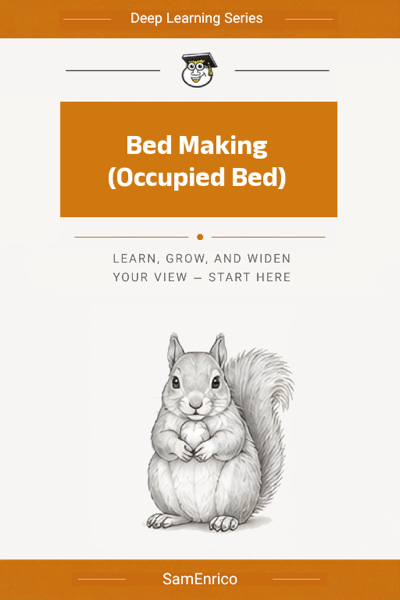
Bed Making (Occupied Bed) eBook
A Coursebook on Bed Making (Occupied Bed)
by Luce Kisha
A Coursebook on Bed Making (Occupied Bed)
Formats
Free sample
Chapter 1: The Wrinkle That Killed--–- The call came in at 2:47 AM on a Tuesday, not that the time mattered anymore. I had been a nurse for eleven years, and by then, 2:47 AM felt exactly like 11:00 AM or 8:00 PM—just another number on a clock that had stopped meaning anything. What I remember about that night is not the code blue, not the doctors shouting, not the family wailing in the hallway. What I remember is the wrinkle.The patient was Mr. Hendricks, an eighty-three-year-old former carpenter with diabetes, vascular disease, and a sacral pressure injury that had been documented as a Stage 2 for twelve consecutive days.
Twelve days. I had turned him myself every two hours, more or less. I had applied the barrier cream, repositioned the pillows, filled out the Braden Scale with the kind of automatic optimism that comes from believing you are doing everything right. But on the twelfth day, the wound care nurse peeled back the dressing and said the words that still live in my throat: "This is a Stage 4 now. Bone is visible."The wrinkle was on the bottom sheet, exactly two inches below his sacrum.
It was not a large wrinkle—maybe the width of two fingers, the kind of imperfection that every nurse has seen and ignored a thousand times. But that wrinkle had been pressing into his skin for twelve days, shifting slightly with every repositioning, creating a micro-environment of friction and moisture that turned a superficial wound into a bone-deep crater. He died six weeks later. Not from the pressure injury directly, but from the sepsis that followed, the infection that traveled from his sacrum to his bloodstream because his skin—the body's largest organ—had been breached by a fold in a bedsheet.I tell you this story not to frighten you, though you should be frightened. I tell you this story because for twelve years of nursing education and clinical practice, no one had ever told me that a wrinkle could kill a patient.
I learned about pressure injuries in nursing school. I memorized the stages, the risk factors, the turning schedules. But no one ever put a bedsheet in front of me and said, "This is a medical device. This is a vector of harm. This is a life-support system, and if you fail to operate it correctly, your patient may die."This book exists because of Mr.
Hendricks. And because of every nurse who has ever finished a shift with a sore back and a vague sense that there must be a better way. And because of every patient who has ever lain in a hospital bed, unable to move, feeling the tiny dig of a wrinkle they could not reach to smooth out. This is not a book about housekeeping. This is a book about the most fundamental, most frequent, most underestimated clinical intervention in all of nursing: making an occupied bed.The Invisible Procedure Every nurse makes an occupied bed.
Nursing students learn it in the first semester, practice it on mannequins in the simulation lab, and then perform it dozens of times per shift for the rest of their careers. It is so common, so routine, so seemingly simple that it has become invisible—a background task, like hand hygiene or vital signs, that we do without thinking.That invisibility is the danger.When a skill becomes automatic, it also becomes unexamined. We stop asking whether we are doing it correctly because we assume that "correctly" is whatever we learned in school or whatever the nurse preceptor showed us. But here is the truth that the top ten nursing fundamentals textbooks all acknowledge, though they hide it in different chapters: occupied bed making is one of the most complex, high-stakes, and frequently botched procedures in clinical practice.Consider what you are actually doing when you change an occupied bed. You are moving a patient who may be confused, in pain, or unstable.
You are managing multiple lines and tubes that can be dislodged. You are handling linens that may be contaminated with blood, urine, feces, or resistant organisms. You are positioning the patient in ways that can either prevent or cause pressure injuries. You are using your own body in ways that can either preserve or destroy your spine. And you are doing all of this while maintaining the patient's dignity, comfort, and trust.That is not housekeeping.
That is intensive care, delivered in seven minutes with a stack of sheets.What This Book Is (And Is Not)Let me be clear about what you are holding. This is not a textbook in the traditional sense. It will not present you with a list of learning objectives at the beginning of each chapter, followed by review questions and a glossary. There are other books that do that, and many of them are excellent. (See the appendix for a comparative analysis of the ten leading nursing fundamentals texts, including Potter & Perry, Taylor, Kozier & Erb's, and the open-source CNA curricula.) Those books will give you the standardized steps, the checklists, the evidence-based rationales.
They are essential resources, and I have synthesized their best content throughout these pages.But this book is something different. This book is a coursebook in the original sense of the word—a guide for a journey, not a reference for a library. It is designed to be read in order, practiced along the way, and returned to when you encounter a patient who challenges everything you thought you knew. Each chapter builds on the previous ones, and by the end, you will not merely know the steps of occupied bed making. You will understand why each step exists, how it connects to patient outcomes, and when to deviate from the standard protocol.This book is also a confession.
I have made every mistake I will describe. I have shaken linens and aerosolized pathogens. I have skipped the toe pleat and contributed to foot drop. I have turned patients alone when I should have asked for help, and I have asked for help when I could have done it alone. I have left wrinkles.
I have caused pain. I have, in small ways and large, failed my patients. The difference between me and many of my colleagues is that I have spent the last five years studying those failures, interviewing wound care nurses and physical therapists and infection control specialists, and synthesizing what I learned into a systematic approach.This book is also an argument. The argument is simple: occupied bed making is a core nursing competency that deserves the same level of attention, practice, and assessment as medication administration or wound care. It should be taught with the same rigor, evaluated with the same standards, and respected with the same seriousness.
When nursing programs spend three hours on bed making and thirty hours on pharmacology, they are not being practical. They are being negligent.The Five Pillars (A Preview)Before we dive into the step-by-step procedures that will occupy most of this book, I need to establish the foundational knowledge that underpins everything else. In Chapter 2, we will explore these five pillars in depth, but for now, let me introduce them…
This is the end of the free sample. Get the eBook to keep going. Buy now
About this book
Details
- Author
- Luce Kisha
- Publisher
- SamEnrico
- Language
- English
- Genre
- Non-Fiction, Informative, Educational
- Released
- 2026-06-02
- Pages (approx.)
- 158
- Available as
- eBook, Audiobook

Read better in the ZLOADR app
Your eBooks on your phone or tablet. Sign in with your SamEnrico account and start reading.
More by Luce Kisha
 Cognitive Decline Biomarkers GuideLuce Kisha$11.99
 Remote Coffee Shop GuideLuce Kisha$11.99
 Lonely After Job LossLuce Kisha$11.99
 Caucasus Mountains LeaderLuce Kisha$11.99
 The Evening Wind Down Cortisol DropLuce Kisha$11.99
 The Battle of Kosovo Field: The Blood That Forged a Nation (1389)Luce Kisha$11.99
 How to Start a Carbon or Graphite Electrodes Business (Beginners Guide)Luce Kisha$11.99
 Latin American Startup CompetitionsLuce Kisha$12.99
 EE for Agriculture GraduatesLuce Kisha$12.99
 Learn to Play the Contrabass ClarinetLuce Kisha$11.99
You may also like
 Hong Kong Handover 1997Dunn Johnnie$11.99
 Zumba For Postnatal Recovery CourseNeal Christian$11.99
 Zumba for BeginnersLadner Nikia$11.99
 YouTube Comment Mining GuideHumes Pandora$12.99
 Worry Box MeditationCarlin Rudy$11.99
 Workplace Stress MeditationNguyen Lynn$11.99
 Workplace Stress and Sleep RepairHawley Ivory$11.99
 Workplace Perfectionism CureDelaney Jeffry$11.99
 Workplace Injustice Anger GuideWallen Isabelle$11.99
 Work Addiction and Burnout LinkGreenwood Ester$11.99
 Women in Yoga and WellnessBeattie Galina$11.99
 Women in Stand Up ComedyChun Evangeline$11.99