
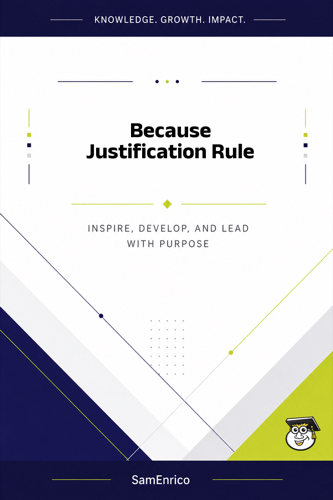
Non-FictionSelf-HelpJustification Psychology
Because Justification Rule eBook
Provide any reason to increase compliance signific
by Holman Gus
Provide any reason to increase compliance significantly.
Formats
Free sample
Chapter 1: The Copy Machine...--The line stretched fourteen people deep, snaking past the reference desk and curling toward the periodicals section. A graduate student clutching a stack of papers approached the front of the line and asked the woman at the Xerox machine a simple question. "Excuse me, I have five pages. May I use the copier?"Sixty percent of the time, the woman said yes.Then the graduate student changed exactly one word in her request. She said, "Excuse me, I have five pages.
May I use the copier because I am in a rush?"Ninety-four percent of the time, the woman said yes.Then the graduate student changed her request again, this time in a way that should have made no logical sense. She said, "Excuse me, I have five pages. May I use the copier because I need to make copies?"Ninety-three percent of the time, the woman said yes.The word "because" had transformed a request so ordinary it was barely noticeable into a nearly irresistible social command. And the reason for that transformation had nothing to do with the logic of the reason itself. "Because I need to make copies" is not an explanation.
It is a tautology. It explains nothing. It adds zero information. And yet it worked almost as powerfully as a genuinely urgent justification.This was the finding that shook the foundations of social psychology when Ellen Langer and her colleagues published their results in 1978. The implication was radical, almost uncomfortable: human beings are so deeply wired to respond to the structure of justification that we will comply with a request even when the justification is empty.
We do not process the content of the reason as carefully as we process the cue that a reason is being offered.This chapter is about that cue. It is about the autopilot trigger buried deep in the human brain that fires whenever someone says the word "because." It is about why that trigger exists, when it works, when it fails, and how you can use it ethically to increase compliance without manipulation. By the end of this chapter, you will understand the single most powerful word in the language of persuasion—and, just as importantly, you will understand its limits.The Experiment That Changed Everything Langer's photocopier study was not an accident. It was the culmination of a decade of research into what psychologists called "mindlessness"—the state of automatic, unreflective cognitive processing that governs most of our daily decisions. The researchers hypothesized that human beings are not the rational, deliberative creatures that classical economics imagined.
Instead, we are cognitive misers. We conserve mental energy wherever possible. We look for shortcuts. And one of the most deeply learned shortcuts in our social repertoire is the association between the word "because" and a legitimate request.To test this hypothesis, Langer designed a simple field experiment. In each trial, a confederate approached a person using a library photocopier and asked to cut in line.
The independent variable was the wording of the request. The dependent variable was compliance—whether the person using the copier stepped aside.The results were striking. When the confederate offered no reason, compliance was 60 percent. When the confederate offered a genuine, informative reason ("because I am in a rush"), compliance jumped to 94 percent. But the critical condition was the third: when the confederate offered a reason that was not a reason at all ("because I need to make copies"), compliance remained at 93 percent.Think about what this means.
Every person in that line knew that the confederate needed to make copies. That was why anyone uses a photocopier. The statement added no new information. It was logically vacuous. And yet it produced nearly the same compliance rate as a genuinely urgent justification.Langer replicated the finding in multiple contexts.
In one variation, the request was larger: "May I use the Xerox machine because I have to make copies?" Same result. In another variation, the confederate gave an even more blatantly nonsensical reason: "May I use the Xerox machine because I have to make copies and I'm in a hurry?" The redundancy did not matter. The word "because" was the engine.This experiment has been cited thousands of times in the academic literature. It has been replicated across cultures, across contexts, and across decades. The effect is robust.
It is not a statistical fluke or a laboratory artifact. It is a genuine feature of human social cognition. And it has profound implications for anyone who needs to ask for anything.Why "Because" Bypasses the Brain's Filter To understand why this works, we need to understand how the brain processes information. The Nobel Prize-winning psychologist Daniel Kahneman, building on decades of research by Amos Tversky and others, famously distinguished between two cognitive systems.System 1 is fast, automatic, intuitive, and emotional. It operates below the threshold of conscious awareness.
It is the system that allows you to drive a familiar route without thinking about the turns, to recognize a friend's face in a crowd, or to recoil from a hot stove before you consciously register the heat. System 1 runs constantly in the background, making thousands of rapid judgments every hour. It is efficient, but it is also biased. It takes shortcuts. It relies on heuristics—mental rules of thumb—that usually work but sometimes lead to systematic errors.System 2 is slow, deliberate, analytical, and logical.
It requires effort. It is the system you engage when you balance your checkbook, learn a new language, or decide which mortgage to accept. System 2 is powerful but lazy. It tires easily. It prefers to delegate decisions to System 1 whenever possible.
This is not a design flaw; it is an energy-saving feature. Your brain consumes about 20 percent of your body's calories while representing only 2 percent of your body's weight. Conscious deliberation is metabolically expensive. Your brain evolved to avoid it unless absolutely necessary.Most of the time, most people are operating in System 1. This is not a flaw; it is a feature.
If you had to consciously process every decision you face in a typical day—what to eat for breakfast, which route to take to work, how to respond to a colleague's greeting, what to say when someone asks for a favor—you would be paralyzed by analysis. System 1 is the brain's autopilot, and it works remarkably well. It gets you through the day without exhausting your有限的 cognitive resources.The word "because" is a learned cue that a legitimate request is following. From early childhood, we are taught that reasons matter. "Why do I have to eat my vegetables?" "Because they're good for you." "Why can't I stay up late?" "Because you need sleep." "Why do I have to go to school?" "Because education is important." The structure of justification—the "because" clause—becomes so deeply associated with legitimacy that the association becomes automatic.
When we hear "because," System 1 flags the request as probably reasonable, and we consent without further scrutiny.This is the autopilot trigger. And it is extraordinarily powerful precisely because it operates below conscious awareness. Most of the people in Langer's study did not realize they had been influenced by a vacuous reason. If asked, they…
This is the end of the free sample. Get the eBook to keep going. Buy now
About this book
Details
- Author
- Holman Gus
- Publisher
- SamEnrico
- Language
- English
- Genre
- Non-Fiction, Self-Help, Justification Psychology
- Released
- 2026-06-06
- Pages (approx.)
- 153
- Available as
- eBook, Audiobook

Read better in the ZLOADR app
Your eBooks on your phone or tablet. Sign in with your SamEnrico account and start reading.
More by Holman Gus
 Nuclear Engineering CreativityHolman Gus$11.99
 Growth Mindset For CouplesHolman Gus$11.99
 Strengthening Willpower Without ShameHolman Gus$11.99
 The Mediterranean Diet CookbookHolman Gus$11.99
 The Siege of Chandor: India's Stone Fortress That Defied the Mughals (1595)Holman Gus$11.99
 How to Start a Cigarette Lighters (wholesale) Business (Beginners Guide)Holman Gus$11.99
 YC African Startup Legal TipsHolman Gus$12.99
 VAT for Small BusinessesHolman Gus$12.99
 Understanding TuberculosisHolman Gus$17.99
 CRM Setup and Automation with HubSpotHolman Gus$11.99
You may also like
 Hong Kong Handover 1997Dunn Johnnie$11.99
 Zumba For Postnatal Recovery CourseNeal Christian$11.99
 Zumba for BeginnersLadner Nikia$11.99
 YouTube Comment Mining GuideHumes Pandora$12.99
 Worry Box MeditationCarlin Rudy$11.99
 Workplace Stress MeditationNguyen Lynn$11.99
 Workplace Stress and Sleep RepairHawley Ivory$11.99
 Workplace Perfectionism CureDelaney Jeffry$11.99
 Workplace Injustice Anger GuideWallen Isabelle$11.99
 Work Addiction and Burnout LinkGreenwood Ester$11.99
 Women in Yoga and WellnessBeattie Galina$11.99
 Women in Stand Up ComedyChun Evangeline$11.99