
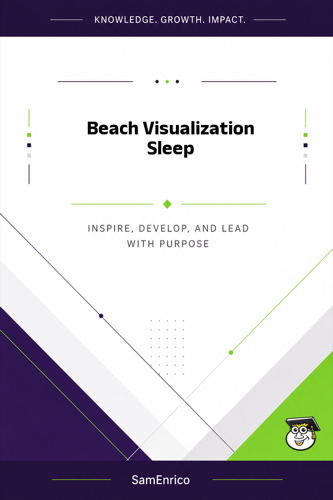
Beach Visualization Sleep eBook
Uses ocean imagery to wash away tension and induce
by Walter Ayako
Uses ocean imagery to wash away tension and induce rest.
Formats
Free sample
Chapter 1: The Saltwater Memory...–- Before you learned to worry, before you knew the names of your fears, your body knew the ocean. Not the ocean of postcards and cruise ships—the real one. The one that whispered to you from inside your mother’s womb, where you floated in a brine of exactly the same salinity as the primordial sea. You are not imagining a foreign place when you close your eyes and hear waves. You are remembering your first home.
This is not poetry. This is biology. And it is the single most important fact you will learn in this book, because it changes everything about how you approach sleep.Most sleep books make a catastrophic error. They assume that relaxation is something you must learn, as if your nervous system arrived on this earth as a tense, coiled spring that requires years of meditation to unwind. This is backwards.
You were born relaxed. You were born floating. The tension came later—layered on by deadlines, by alarms, by the thousand small violences of modern life. Your brain did not forget how to rest. It simply buried that memory under noise.
The ocean is the excavation tool. And in this chapter, you will begin the dig.The Problem with "Clearing Your Mind"If you have ever tried to fall asleep by "clearing your mind," you already know the dirty secret of the self-help industry: it doesn't work. Telling an anxious person to think of nothing is like telling an asthmatic to just breathe normally. The brain evolved to think. It is a prediction engine, constantly scanning the environment for threats, opportunities, and inconsistencies.
Emptying it is not a natural state—it is a neurological impossibility for most people.What the brain can do, however, is replace one pattern of thought with another. This is the central insight of this book. You cannot stop the tide of thoughts. But you can change what the tide carries. You can shift the texture of your inner noise from jagged and chaotic to rhythmic and predictable.
And there is no better template for rhythm than the ocean.Consider what happens when you try to "clear your mind." You notice a thought—say, about tomorrow's meeting. You try to push it away. The thought resists. You push harder. Now you are thinking about the fact that you are thinking about the meeting.
You have doubled your cognitive load. Your heart rate increases. Your jaw tightens. You are now less relaxed than when you started. This is the suppression paradox: the harder you try not to think of a white bear, the more you think of a white bear.Now consider the alternative.
Instead of pushing the thought away, you write it in the sand. You give it a form. You acknowledge its existence. Then you watch a wave erase it. You are not fighting.
You are not suppressing. You are replacing—the sharp, jagged thought is replaced by the smooth, rhythmic motion of water over sand. The thought does not vanish because you forced it to. It vanishes because your attention moved somewhere else. This is not magic.
This is the orienting response, hijacked for your benefit.The Blue Mind: What the Scans Show In the early 2010s, marine biologist Wallace J. Nichols began collecting neuroimaging data on what happens to the human brain when it sees, hears, or imagines water. The results were striking. When subjects viewed images of rhythmic, predictable water—waves lapping against a shore, rain falling on a lake, a river flowing over rocks—their amygdala (the brain's fear center) deactivated significantly. Simultaneously, the prefrontal cortex (the part of the brain responsible for focused attention, planning, and self-control) loosened its grip.
Not shut down. Loosened. Think of the difference between a clenched fist and an open hand. Both are capable. One is ready for a fight.
The other is ready to receive.Nichols called this state "Blue Mind" : the mildly meditative, calm-alert state we enter when we are near water. It is not sleep. It is the pleasant, drifting awareness of watching waves from a beach chair—interested enough to keep watching, relaxed enough to let time pass without resistance. Blue Mind is the bridge. It is where you want to be five minutes before you fall asleep.But there is a deeper state.
Nichols did not study sleep directly, but subsequent research has. When the brain is exposed to the rhythm of waves—specifically the 0.1 Hz rhythm of a wave every ten seconds—the electrical activity of the brain begins to synchronize with that rhythm. This is called Frequency Following Response, and it is one of the most reliable non-pharmacological ways to induce sleep. The brain does not choose to sync. It involuntarily syncs, the way a room full of metronomes will eventually tick together if placed on a moving surface.This is the state we call "Deep Blue Mind" : not calm alertness but actual sleep—specifically the transition from Theta brainwaves (deep meditation, hypnagogic imagery) to Delta brainwaves (dreamless, restorative sleep).
The ocean does not just relax you. It entrains you. It pulls your brain into its rhythm whether you want it to or not. Your only job is to get out of the way.Why the Ocean, Not the Forest You may have noticed that many guided relaxations use forest imagery. Birdsong, rustling leaves, dappled sunlight.
These are pleasant, and they work for some people. But they work differently than ocean imagery, and the difference matters for sleep.The forest is a place of potential threat. This is not a flaw in the imagery—it is an evolutionary reality. Our ancestors who survived were the ones who stayed vigilant in the forest. That rustle in the bushes could be a predator.
That sudden silence of the birds could signal danger. Even today, your brain processes forest sounds with a low-grade alertness. The birdsong that seems relaxing is actually a signal that no predators are currently present—a conditional all-clear. Your brain is still scanning.The ocean is different. Open water, especially the view from a shore, contains no places for predators to hide.
The horizon is infinite and flat. The waves are predictable. Your brain does not need to scan. It can rest. This is why the horizon line specifically lowers cortisol: the eye's natural resting point, when fixed on a flat, infinite boundary, signals "safety" to the brain stem.
There is no conditional. No "if." Just the endless, reliable rhythm of water meeting land.Moreover, the ocean is boring in exactly the right way. Psychologists call this "soft fascination" —attention that is held effortlessly, without effort. A campfire is soft fascination. Falling snow is soft fascination.
Waves are the perfect soft fascination because they are predictably unpredictable. Each wave is different, so your brain does not habituate and tune out. But each wave is similar enough that your brain does not have to work to understand it. You are interested, but not alert. Relaxed, but not asleep.
This is Blue Mind. This is where the journey begins.The Anchor Phrase: Your Neurological Shortcut Every successful sleep protocol needs a trigger—a single, portable stimulus that can induce…
This is the end of the free sample. Get the eBook to keep going. Buy now
About this book
Details
- Author
- Walter Ayako
- Publisher
- SamEnrico
- Language
- English
- Genre
- Non-Fiction, Self-Help, Beach Visualization
- Released
- 2026-06-08
- Pages (approx.)
- 135
- Available as
- eBook, Audiobook

Read better in the ZLOADR app
Your eBooks on your phone or tablet. Sign in with your SamEnrico account and start reading.
More by Walter Ayako
 Weekly Prioritization SystemWalter Ayako$11.99
 Self Empathy GuideWalter Ayako$11.99
 Robespierre and Jacobins GuideWalter Ayako$11.99
 Tianeptine Withdrawal ProtocolWalter Ayako$11.99
 DBT for Sadness ManagementWalter Ayako$11.99
 End of Day Shutdown RoutineWalter Ayako$11.99
 Blue Zone Laughter TherapyWalter Ayako$11.99
 The Last Ink of Sappho: Uncovering the Lost Voice of AntiquityWalter Ayako$11.99
 Isandlwana: The Day the Spears Shattered the EmpireWalter Ayako$11.99
 Service Providers Guide to Auto Repair & ServiceWalter Ayako$11.99
 A Collector's Handbook to the Hillman 16Walter Ayako$11.99
 How to Start a Nougat Business (Beginners Guide)Walter Ayako$11.99