
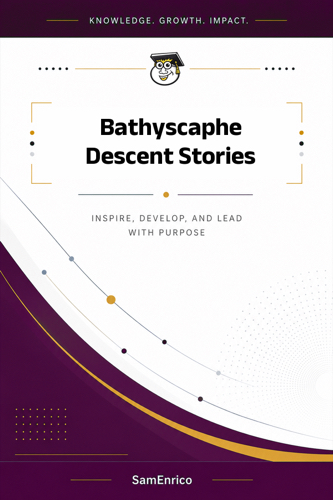
Non-FictionBiographyEngineering Memoir
Bathyscaphe Descent Stories eBook
Piloting a manned submersible to the Challenger De
Piloting a manned submersible to the Challenger Deep and witnessing the planet's deepest secret.
Formats
Free sample
Chapter 1: The Warehouse Ghost...–- The first time I saw the Trieste, I cried.Not because it was beautiful. It wasn't. The bathyscaphe that had carried Don Walsh and Jacques Piccard to the deepest place on Earth looked like a failed science experiment—a bulbous float tank painted in faded Navy gray, a cramped steel sphere bolted underneath, and years of dust settling into every crevice. It hung from the rafters of the decommissioned Navy warehouse in San Diego like a dead whale, silent and enormous and utterly indifferent to my presence.I had flown three thousand miles to stand here. My name is Dr.
Alex Thorne. I am a marine geologist, a submersible pilot, and, as of eighteen months ago, a person who had stopped believing in closure. I had come to see the Trieste because I was about to do something that everyone I respected had told me not to do: accept a seat in a privately funded bathyscaphe bound for the Challenger Deep.The Deep. Thirty-six thousand feet of seawater pressing down on a titanium sphere the size of a small bathroom. Sixteen thousand pounds per square inch.
A pressure so immense that it would crush a nuclear submarine like a beer can.And I was going there because I thought it might help me understand what happened to my brother.The Call That Changed Everything The invitation had arrived on a Tuesday. I was in my office at the Scripps Institution of Oceanography, grading undergraduate papers on deep-sea sediment cores, when my personal phone buzzed with a number I didn't recognize. I almost ignored it. Grading makes me irritable, and I had learned over the years that unknown numbers were usually reporters looking for a quote about the latest deep-sea discovery or, worse, documentary producers who wanted me to reenact dives for the camera.But something made me answer."Dr. Thorne," the voice said.
It was a woman, mid-forties, with the clipped efficiency of someone who had spent years in project management. "My name is Elena Vasquez. I'm the expedition coordinator for the Hadal Exploration Trust. We're preparing a manned descent to the Challenger Deep in eight months, and we're looking for a science pilot. You came highly recommended."I almost laughed.
The Hadal Exploration Trust was a consortium of private donors, tech philanthropists, and a few universities who had pooled resources to build a next-generation bathyscaphe. I had read about them in journals—the DSS Pressure Drop, a two-person, titanium-sphere submersible rated to 36,000 feet, with syntactic foam buoyancy, a 10,000-lumen LED array, and a manipulator arm capable of collecting samples from the hadal floor. It was, by every measure, one of the most advanced deep-submergence vehicles ever built.And they wanted me."Why me?" I asked."Because you're one of the only pilots alive who has logged more than two hundred hours in full-ocean-depth simulations. Because you have a background in marine geology, which means you'll actually understand what you're looking at down there. And because," she paused, "we know about your brother."The line went silent.
I knew what she meant. Everyone in the deep-submergence community knew about my brother. Lieutenant Commander Elias Thorne, United States Navy, pilot of the deep-submergence rescue vehicle Mystic. He had died fifteen years ago during a classified training exercise in the Atlantic. The Navy's official report cited a catastrophic failure of the electrical system—a fire that spread too quickly for the crew to escape.
But I had never believed it.I had spent fifteen years collecting fragments of the truth. Declassified documents. Interviews with former Navy personnel who spoke in whispers. And one thing that no one else had: a partial acoustic recording from the Mystic's final seconds, obtained from a source I could never publicly name.The recording was garbled, full of static and the hiss of failing equipment. But in the last seventeen seconds before the signal cut out, there was something else.
A low-frequency pulse. Rhythmic. Intentional. Not mechanical. Not human.I had spent fifteen years trying to match that frequency to something—anything—on Earth.
Volcanic activity. Seismic events. Whale calls. Military sonar. Nothing matched.Until six months before Elena's call.A colleague at Woods Hole Oceanographic Institution had been analyzing hydrophone data from the Pacific and had found a signal buried in the noise.
The frequency was almost identical to the one on my brother's recording. The source? The Mariana Trench. The Challenger Deep.Elena Vasquez knew this. The Hadal Exploration Trust knew this.
And they were offering me a seat on a submersible that could take me to the exact location where the signal had originated."I'll do it," I said.She didn't ask if I was sure. She just said, "Welcome aboard, Dr. Thorne. We launch in eight months."The Weight of History Standing in front of the Trieste now, eight months later, I understood why Walsh and Piccard had never returned to the Deep. It wasn't the engineering.
It was the memory.The year was 1960. The Cold War was at its peak, and the Space Race was consuming the nation's imagination. But beneath the waves, a different race was underway—one that would take humans not to the stars, but to the darkest corner of their own planet. The Trieste was a Swiss-designed bathyscaphe that the U.S. Navy had acquired and modified for deep diving.
It was not a submarine. Submarines swim. The Trieste fell.On the morning of January 23, 1960, Don Walsh and Jacques Piccard climbed into the steel sphere. The hatch was bolted shut from the outside. The support ship, the USS Wandank, positioned itself over the Challenger Deep—a gash in the Pacific floor near Guam that had been sounded but never seen.
Then the ballast was released, and the Trieste began its descent.The dive took four hours and forty-seven minutes. Most of that time was spent in absolute darkness, falling through water that had not seen light since the dinosaurs roamed the Earth. At 30,000 feet—still six thousand feet from the bottom—a loud crack echoed through the sphere. The outer Plexiglas fairing, a protective layer over the main acrylic window, had fractured under pressure. Walsh and Piccard froze.
They were too deep to abort. Too deep for rescue. Too deep for any human to reach them.They sat in silence for twenty minutes, waiting for the main window to fail. It didn't. The crack was in the fairing, not the window.
They survived. They reached the bottom—35,800 feet, by their instruments—and spent twenty minutes on the seafloor, their view obscured by silt stirred up by the landing. Then they dropped the ballast and rose.They were heroes. They were celebrated. And they never went back.The official reason was technical: the Trieste was retired, and the Navy shifted focus to other priorities.
But the unofficial reason, the one that appeared in classified psychological evaluations I had managed to obtain years ago, was something else. The Navy called it "operational fatigue." The pilots called it fear.Walsh had nightmares for years. Piccard, too, though he spoke of it less. The darkness, the pressure, the knowledge that the only thing between you and instant death…
This is the end of the free sample. Get the eBook to keep going. Buy now
About this book
Details
- Author
- Stegall Serita
- Publisher
- SamEnrico
- Language
- English
- Genre
- Non-Fiction, Biography, Engineering Memoir
- Released
- 2026-06-09
- Pages (approx.)
- 128
- Available as
- eBook, Audiobook

Read better in the ZLOADR app
Your eBooks on your phone or tablet. Sign in with your SamEnrico account and start reading.
More by Stegall Serita
 Self Esteem with Chronic IllnessStegall Serita$11.99
 Mindfulness of EmotionsStegall Serita$11.99
 Philae Temple IsisStegall Serita$11.99
 The Long Breath Short BreathStegall Serita$11.99
 Employment Contract AI ParsingStegall Serita$11.99
 Anger Management for ADHD at WorkStegall Serita$11.99
 Philosophy Concept PalaceStegall Serita$11.99
 Meditation For BurnoutStegall Serita$11.99
 The Puppet Masters of Silicon Valley: How a Handful of CEOs Secretly Shaped Global PolicyStegall Serita$11.99
 Florence Unleashed: The Sneaker Renaissance of the Medici DynastyStegall Serita$11.99
 The Silent Deep: AI’s First Oceanic AwakeningStegall Serita$11.99
 The Dancer's Guide to Basque DanceStegall Serita$11.99
You may also like
 Hong Kong Handover 1997Dunn Johnnie$11.99
 Zumba For Postnatal Recovery CourseNeal Christian$11.99
 Zumba for BeginnersLadner Nikia$11.99
 YouTube Comment Mining GuideHumes Pandora$12.99
 Worry Box MeditationCarlin Rudy$11.99
 Workplace Stress MeditationNguyen Lynn$11.99
 Workplace Stress and Sleep RepairHawley Ivory$11.99
 Workplace Perfectionism CureDelaney Jeffry$11.99
 Workplace Injustice Anger GuideWallen Isabelle$11.99
 Work Addiction and Burnout LinkGreenwood Ester$11.99
 Women in Yoga and WellnessBeattie Galina$11.99
 Women in Stand Up ComedyChun Evangeline$11.99