
Non-FictionHealth & WellnessBath
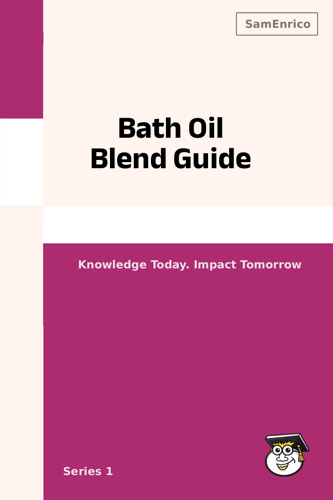
Bath Oil Blend Guide eBook
Create relaxing or energizing bath soaks using ess
by Ennis Stan
Create relaxing or energizing bath soaks using essential oils and Epsom salts.
Formats
Free sample
Chapter 1: The Alchemy of Ritual--–- The water is hot enough to fog the mirror, steam curling against the bathroom window like morning mist against a lake. You have fifteen minutes before the next meeting, before the kids wake up, before the world comes knocking. You drop a handful of salts into the tub, and something shifts. Not just in the water. In you.This is not a book about soap.This is a book about what happens when you stop treating your bath like a chore and start treating it like a conversation with your own nervous system.
It is about the alchemy that occurs when magnesium meets heat, when scent meets memory, when intention meets ritual. And it is about the quiet, radical act of choosing to care for yourself in a world that profits from your exhaustion.Let me tell you a story.Three years ago, I was not writing books about bath oils. I was hunched over a laptop at eleven o'clock at night, trying to answer emails that should have waited until morning, drinking coffee that had gone cold hours earlier, and wondering why my shoulders felt like they were permanently attached to my ears. I had tried meditation apps. I had tried breathing exercises.
I had tried telling myself to "just relax," which is about as effective as telling a thunderstorm to just stop raining.Then a friend gave me a small amber bottle. It was labeled with handwriting I could barely read: "Lavender. Clary Sage. Breathe." She told me to add five drops to a tablespoon of coconut oil, pour that into a bath, and sit there for twenty minutes without my phone. I thought it sounded ridiculous.
I did it anyway.The first thing I noticed was the smell. Not in a vague, candle-shop way. It was specific. The lavender was familiar but not cloying. The clary sage was something else entirely—herbal and slightly sweet, like walking through a garden after rain.
The steam carried the scent up to my face, and I felt something in my chest unlock. Not dramatically. Not like a movie scene where the character sighs and all their problems float away. It was smaller than that. It was a tiny, almost imperceptible loosening of a knot I had not even realized I was holding.I stayed in the water until it went cold.
I slept better that night than I had in months.That is not a miracle. It is biology.And that is what this chapter is about: the biology, the history, and the ritual of the aromatic bath. Because before you mix a single drop of oil, before you buy a single bag of Epsom salts, you need to understand what you are actually doing when you lower yourself into that water. You are not just getting clean. You are changing your chemistry.The Deep History: From Roman Aqueducts to Your Bathtub The aromatic bath is not a wellness trend.
It is not something invented by influencers or packaged into overpriced gift sets at department stores. It is one of the oldest self-care technologies in human history, and understanding its past helps explain why it works so reliably in the present.The ancient Romans were the first to build large-scale public baths, but they were not the first to understand the power of hot water and scent. That credit goes further back, to the Indus Valley Civilization around 2500 BCE, where archaeologists have found evidence of raised brick platforms in private homes—early bathtubs—alongside drains designed to carry water away. These early bathers used infused oils and herbs, though we have no surviving recipes to tell us exactly what they used.The Romans, however, left records. And what records they left.The Roman bathhouse, or thermae, was not a place for quick showers.
It was a multi-hour ritual involving several rooms: the tepidarium (warm room), the caldarium (hot room with a plunge bath), and the frigidarium (cold plunge). Between these rooms, bathers would apply scented oils to their skin, scrape themselves clean with a curved metal tool called a strigil, and then reapply fresh oils. The oils were not afterthoughts. They were the point. Roman physicians like Galen wrote extensively about the medicinal properties of infused oils, recommending specific blends for muscle pain, anxiety, and skin conditions.
The Romans understood something that modern science is only now catching up to: the skin is not a barrier. It is a gateway.After the fall of Rome, the tradition of aromatic bathing did not disappear. It moved east. In Japan, the onsen culture developed around natural hot springs, with bathers adding medicinal herbs and salts to the mineral-rich waters. In India, Ayurvedic medicine prescribed daily oil massage (abhyanga) followed by a warm bath infused with herbs tailored to each person's dosha, or constitutional type.
In the Middle East, hammams combined steam, scrubbing, and aromatic oiling into a weekly ritual of purification and social connection.Europe lost much of this tradition during the Middle Ages, when public baths fell out of favor due to plague fears and changing social mores. But by the Victorian era, the bath had returned—though in a form that would have baffled the Romans. Victorian bathers added proprietary bath powders and salts to their tubs, often heavily perfumed with synthetic fragrances. The therapeutic knowledge had been replaced by commercial marketing.We are the heirs of both traditions. We have the Victorian access to easy, home-based bathing.
And we are rediscovering the Roman understanding that what we add to the water matters.The Science of Sinking: What Actually Happens in a Warm Bath Before we talk about essential oils and Epsom salts, we need to talk about the water itself. Because the water is not neutral. Water is the medicine. The oils and salts are the messengers.When you submerge your body in hot water—meaning water between 98 and 102 degrees Fahrenheit, or 37 to 39 degrees Celsius—several predictable physiological changes occur. These are not subjective.
They are measurable. And they form the foundation upon which all aromatic blending rests.Your blood vessels dilate. Heat causes vasodilation, the widening of blood vessels near the skin's surface. This is why you turn pink in a hot bath. Your circulatory system redirects blood flow away from your internal organs and toward your skin, which has two effects.
First, your blood pressure drops slightly. Second, your heart rate increases to compensate, typically by five to ten beats per minute. This is generally safe and even therapeutic for healthy individuals, but it explains why people with certain heart conditions are advised to avoid very hot baths.Your muscles release tension. Muscle fibers are wrapped in a connective tissue called fascia. Heat makes fascia more pliable, allowing muscle fibers to slide past each other more easily.
This is why a hot bath reduces stiffness and why athletes have used hot water for recovery for thousands of years. The effect is temporary—lasting about an hour after you exit the bath—but consistent.Your body temperature rises slightly. A hot bath raises your core temperature by about one degree Fahrenheit. That may not sound like much, but it triggers a cascade of effects. Your…
This is the end of the free sample. Get the eBook to keep going. Buy now
About this book
Details
- Author
- Ennis Stan
- Publisher
- SamEnrico
- Language
- English
- Genre
- Non-Fiction, Health & Wellness, Bath
- Released
- 2026-06-09
- Pages (approx.)
- 134
- Available as
- eBook, Audiobook

Read better in the ZLOADR app
Your eBooks on your phone or tablet. Sign in with your SamEnrico account and start reading.
More by Ennis Stan
 BPH Anticholinergic Side EffectsEnnis Stan$11.99
 Async Brainstorming Methods BriefEnnis Stan$11.99
 Benzo Anxiety Without Pills HandbookEnnis Stan$11.99
 Limit Social Media for Self EsteemEnnis Stan$11.99
 The Forgotten Cartographers: Mapping the Soul of the Atlantic's Indigenous PeoplesEnnis Stan$11.99
 Codebreaker: The Woman Who Cracked the Enigma Before TuringEnnis Stan$11.99
 How to Become a Die BarberEnnis Stan$11.99
 Understanding Continuous Spike-wave During Slow Sleep SyndromeEnnis Stan$17.99
 Venture Debt LTV CovenantEnnis Stan$12.99
 Meta AI Ad Labeling RuleEnnis Stan$12.99
 Wire BondingEnnis Stan$11.99
You may also like
 Hong Kong Handover 1997Dunn Johnnie$11.99
 Zumba For Postnatal Recovery CourseNeal Christian$11.99
 Zumba for BeginnersLadner Nikia$11.99
 YouTube Comment Mining GuideHumes Pandora$12.99
 Worry Box MeditationCarlin Rudy$11.99
 Workplace Stress MeditationNguyen Lynn$11.99
 Workplace Stress and Sleep RepairHawley Ivory$11.99
 Workplace Perfectionism CureDelaney Jeffry$11.99
 Workplace Injustice Anger GuideWallen Isabelle$11.99
 Work Addiction and Burnout LinkGreenwood Ester$11.99
 Women in Yoga and WellnessBeattie Galina$11.99
 Women in Stand Up ComedyChun Evangeline$11.99