
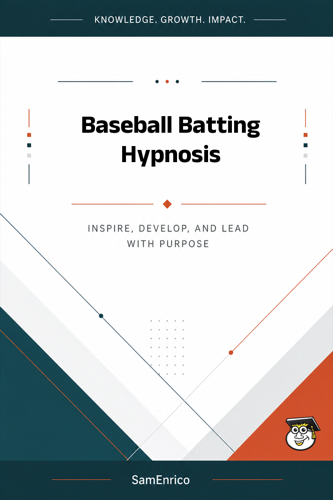
Baseball Batting Hypnosis eBook
See the ball clearly and swing without hesitation.
by Simon Penny
See the ball clearly and swing without hesitation.
Formats
Free sample
Chapter 1: The Watermelon Secret--–- The first time I saw a professional hitter fail, I was sitting in the third row behind home plate at a Triple-A game, and I watched a man who had been called up to the majors twice that season swing at a curveball that bounced two feet in front of the plate. The crowd groaned. The hitter walked back to the dugout with his head down, and I remember thinking something that would haunt me for years: He didn't miss because he's bad. He missed because he was thinking.That moment sent me down a rabbit hole that would take ten years to surface from. I started asking questions that hitting coaches couldn't answer.
Why do the best hitters in the world sometimes look like they've never held a bat? Why does a player in a slump stay in a slump even when nothing about his swing has changed? Why can a rookie come up from Triple-A hitting .350, then suddenly forget how to make contact after three weeks in the majors?The answers I found had nothing to do with mechanics. They had everything to do with a state of consciousness that researchers call "flow," athletes call "the zone," and hypnotists have called "trance" for over a century. And the most famous description of that state came from a Yankees outfielder who, during a rain delay in 1977, reportedly told his hitting coach something that would become legend.
Lou Piniella said: "I was seeing the ball like a watermelon."He wasn't being poetic. He was describing a real neurological phenomenon—one that you can learn to access on demand, without a hypnotist, without a pocket watch, and without any of the stage magic you've seen in movies. This book will teach you how.But first, we need to understand what "batting hypnosis" actually is—and what it absolutely is not.The Myth of Stage Hypnosis When most people hear the word "hypnosis," they picture a swinging pocket watch, a man in a velvet cape, and a volunteer clucking like a chicken on a stage. That's entertainment. It has about as much to do with real hypnosis as a Michael Bay movie has to do with actual physics.Clinical hypnosis—the kind used by licensed therapists, sports psychologists, and even the United States military—is simply a state of focused attention with reduced peripheral awareness and an enhanced capacity to respond to suggestion.
In plain English: it's when you're so locked in on one thing that the rest of the world fades away, and your brain becomes unusually receptive to new instructions.You've been in this state hundreds of times. Have you ever driven home from work and realized you don't remember the last ten minutes of the drive? That's a light hypnotic trance. Your conscious mind was elsewhere, but your subconscious navigated traffic, avoided accidents, and parked the car. Have you ever been so absorbed in a movie that you didn't hear someone call your name?
That's hypnosis. Have you ever lost track of time while playing a video game, practicing an instrument, or even having a deep conversation? That's the exact same neurological state that allows a batter to see a ninety-five-mile-per-hour fastball as if it's floating toward him in slow motion.The difference between those everyday trances and batting hypnosis is intentionality. Driving hypnosis happens by accident. Movie hypnosis happens because the director knows how to manipulate your attention.
Batting hypnosis happens because you have trained your brain to enter that state on command, in the 0.4 seconds between pitch release and contact.The 0.4 Second Problem Let me give you a number that will change how you think about hitting: 400 milliseconds.That's how long you have from the moment the ball leaves the pitcher's fingertips to the moment it reaches the hitting zone. Four-tenths of a second. To put that in perspective, a blink takes 300 milliseconds. A typical human reaction time to a visual stimulus is about 250 milliseconds. So you have roughly 150 milliseconds to decide where the ball is going, how fast it's coming, what kind of pitch it is, and whether to swing—and then another 250 milliseconds to execute that swing.Here's the problem: your conscious mind processes information at about 60 bits per second.
Hitting a ninety-five-mile-per-hour fastball requires processing about 11 million bits per second. The math is not on your side.Your conscious mind cannot do this job. It is literally too slow. But your subconscious mind—the part of you that controls your heartbeat, your breathing, your balance, and every other automatic function in your body—can handle that processing load easily. The only problem is that your conscious mind won't get out of the way.Every time you step into the batter's box and think "Don't strike out," or "Watch for the curveball," or "Keep your elbow up," you're asking your slow, clumsy conscious brain to do a job it was never designed for.
And it will fail. Not because you're a bad hitter, but because you're a human being with a human nervous system.The great hitters have figured this out intuitively. They've learned to shut off the conscious voice—or at least turn the volume down so low that it can't interfere. Ted Williams said that when he was hitting well, he could see the seams on the ball. Tony Gwynn said he felt like he was "half asleep" in the batter's box.
Ichiro Suzuki described his mental state as "empty." They weren't being metaphorical. They were describing a hypnotic trance.What Batting Hypnosis Is (And Isn't)Let me be absolutely clear about what this book is teaching.Batting hypnosis is not:Mind control or manipulation A way to "trick" yourself into being better than you are A substitute for practice, conditioning, or mechanical soundness A magic spell that guarantees a hit every time Something that requires a hypnotist or any special equipment Batting hypnosis is:A trained ability to enter a state of deep focus on command A method for silencing the analytical voice that ruins reaction time A visual training protocol that changes how your eyes track the ball A set of rituals and anchors that trigger automatic performance A scientifically validated approach used by MLB teams since the 1950s The last point deserves emphasis. In 1951, a psychologist named Dr. David F. Tracy published a book called The Psychologist at Bat.
Tracy worked directly with major league teams, using hypnotic suggestion to cure nervous rookies, break slumps, and eliminate the yips. His methods were controversial at the time—not because they didn't work, but because baseball was deeply conservative and suspicious of anything that smelled like "mind stuff." But the results were undeniable. Players who couldn't make contact were suddenly hitting. Players who flinched at inside pitches were staying in the box. Players who had lost all confidence were striding to the plate like All-Stars.The techniques in this book are the modern descendants of Tracy's work, updated with decades of sports psychology research, neuro-linguistic programming, and cognitive science.
But the core insight hasn't changed: you cannot try to see the ball. You must be trained to see it.The Two Types of Focus (And Why One Fails)To…
This is the end of the free sample. Get the eBook to keep going. Buy now
About this book
Details
- Author
- Simon Penny
- Publisher
- SamEnrico
- Language
- English
- Genre
- Non-Fiction, Self-Help, Baseball
- Released
- 2026-06-11
- Pages (approx.)
- 137
- Available as
- eBook, Audiobook

Read better in the ZLOADR app
Your eBooks on your phone or tablet. Sign in with your SamEnrico account and start reading.
More by Simon Penny
 Children of Addicts TriggersSimon Penny$11.99
 The Remote Time ChallengeSimon Penny$11.99
 Cynicism Reversal HandbookSimon Penny$11.99
 Early Riser Productivity PlanSimon Penny$11.99
 Cialdini Principles AppliedSimon Penny$11.99
 Burn Fluid ResuscitationSimon Penny$11.99
 Athlete Imposter SyndromeSimon Penny$11.99
 The Coral Sea Gambit: How a Forgotten Naval Battle Saved AustraliaSimon Penny$11.99
 The Puppet Master of Medellín: Colombia's Chilling Psychological ManipulatorSimon Penny$11.99
 How to Start a Hobby in BoatingSimon Penny$11.99
 Black Russian Terrier: Protective & CalmSimon Penny$11.99
 WIPO Madrid Fee ReductionSimon Penny$12.99
You may also like
 Hong Kong Handover 1997Dunn Johnnie$11.99
 Zumba For Postnatal Recovery CourseNeal Christian$11.99
 Zumba for BeginnersLadner Nikia$11.99
 YouTube Comment Mining GuideHumes Pandora$12.99
 Worry Box MeditationCarlin Rudy$11.99
 Workplace Stress MeditationNguyen Lynn$11.99
 Workplace Stress and Sleep RepairHawley Ivory$11.99
 Workplace Perfectionism CureDelaney Jeffry$11.99
 Workplace Injustice Anger GuideWallen Isabelle$11.99
 Work Addiction and Burnout LinkGreenwood Ester$11.99
 Women in Yoga and WellnessBeattie Galina$11.99
 Women in Stand Up ComedyChun Evangeline$11.99