
Non-FictionBusiness BriefBarter
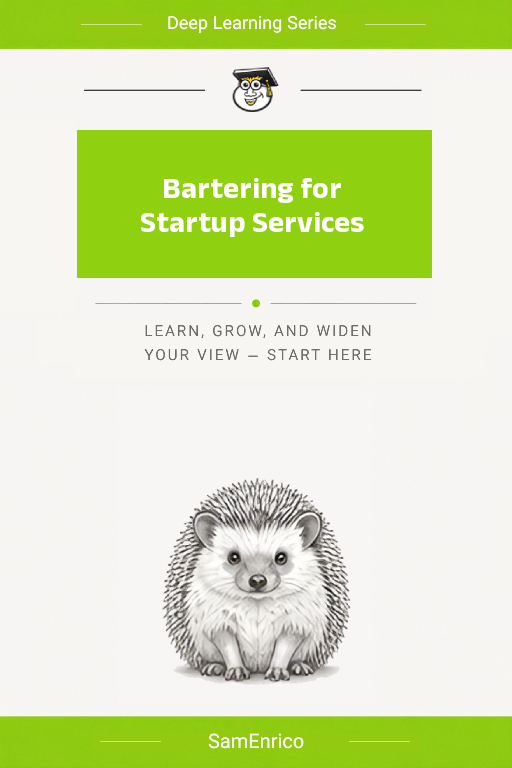
Bartering for Startup Services eBook
Trade your services for equipment, marketing, or s
Trade your services for equipment, marketing, or software instead of spending cash.
Formats
Free sample
Chapter 1: The Cash Trap--–- Most founders believe cash is their most precious resource. They hoard it, worship it, and measure every decision against it. This chapter flips that assumption upside down: cash is actually the most expensive resource for a pre-revenue startup. Not because money isn't useful—it clearly is—but because the way most founders think about cash blinds them to a far more powerful, abundant, and creative form of currency: the value they already own but have never bothered to inventory.This is not a philosophy exercise. This is a survival strategy.Every year, thousands of startups run out of money.
The statistics are brutal: 90% of startups fail, and among the top reasons cited by founders is "ran out of cash." But here's the question those post-mortems never ask: did they run out of cash, or did they run out of imagination? Did they truly have no way to acquire the marketing, software, equipment, and expertise they needed—or did they simply never learn how to ask differently?This chapter introduces the single most important mindset shift in this entire book. By the time you finish reading it, you will never look at a vendor invoice the same way again. You will stop asking "How do I pay for this?" and start asking "Who needs what I already have?" That shift is the difference between dying on the runway and taking off.The Million-Dollar Misunderstanding Let us start with a story. Not a hypothetical, not a smoothed-over case study, but an actual founder who walked into this exact trap and then climbed out of it using nothing but a mindset change and a few hours of work she was already going to do anyway.Maria was the founder of a B2B Saa S company called Beacon.
She had built a prototype, recruited two beta customers, and received encouraging feedback. Her problem was simple: she needed customers. Specifically, she needed to run Facebook and Linked In ad campaigns to drive signups for her beta waitlist. The estimated cost for a three-month test campaign was $15,000.Maria had $3,200 left in her bank account.She had two options, or so she thought. Option one: raise a friends-and-family round.
Her uncle had offered $25,000 in exchange for 8% of the company. That would give her the cash she needed—but at the cost of giving away nearly a tenth of her company before she had even launched. Option two: shut down. Go back to her consulting job, save up, and try again later.She chose option three, which she did not know existed until she stumbled into it by accident.At a local startup meetup, Maria met the founder of a marketing agency. He ran Facebook ads for e-commerce brands and was looking to expand into B2B.
He needed a case study. Maria needed ads. They started talking. Over coffee, she asked him a question that changed everything: "What do you need that I could give you instead of cash?"He thought for a moment. "Honestly?
I need my own website redesigned. My current one looks like it's from 2015. But I can't justify spending $10,000 on a redesign when I'm trying to save for new hires."Maria was a developer. She had built Beacon's entire prototype herself. A website redesign was maybe forty hours of work—work she would have done anyway during her normal coding time.
She made him an offer: "I will redesign your entire website, including a custom backend for your case studies, if you run $18,000 worth of Facebook and Linked In ads for Beacon."He agreed. No cash changed hands. She spent forty hours over three weeks on his website. He ran 18,000inadsforher.Theadsdrove1,200waitlistsignups.Fromthose,sheconvertedseventeenpayingcustomersinherfirstmonthoflaunch.Eighteenmonthslater,Mariasold Beaconfor18,000 in ads for her. The ads drove 1,200 waitlist signups.
From those, she converted seventeen paying customers in her first month of launch. Eighteen months later, Maria sold Beacon for 18,000inadsforher.Theadsdrove1,200waitlistsignups.Fromthose,sheconvertedseventeenpayingcustomersinherfirstmonthoflaunch.Eighteenmonthslater,Mariasold Beaconfor4.2 million. She never spent a dollar of cash on customer acquisition.This is not magic. This is not luck. This is barter.And here is what Maria understood that most founders do not: cash is not the only currency.
In fact, for a pre-revenue startup, cash is often the worst currency because it is the most scarce. Every dollar you spend on marketing is a dollar you cannot spend on payroll. Every dollar you spend on software is a dollar you cannot spend on legal fees. Every dollar you spend on equipment is a dollar you cannot spend on survival.But your time? Your talent?
Your unused server capacity? Your half-empty office? Your domain names that are just sitting there? Those cost you almost nothing to share. Their marginal cost is zero.
And to someone else, they might be worth thousands.The Scarcity Mindset That Kills Startups Why do most founders default to cash? The answer lies in what we will call the Monetary Mindset. This is not a formal term from economics textbooks—it is a pattern of thinking that venture capitalists, business school professors, and successful founders have accidentally trained into an entire generation of entrepreneurs.The Monetary Mindset says that value is linear. One dollar of marketing equals one dollar of value. One hour of work equals one hour of pay.
Every transaction is a trade-off: if I give you something, I have less. The Monetary Mindset fears loss more than it seeks gain. It sees the world as zero-sum: your win is my loss, and my win is your loss.This mindset feels safe. It feels rational. It feels like adulting.It is also wrong.The alternative—what we will call the Bartering Mindset throughout this book—says that value is non-linear.
One hour of your coding work might be worth 200toyoubut200 to you but 200toyoubut2,000 to a non-technical founder. One email introduction from you to your network might cost you thirty seconds but bring someone else a 50,000contract.Oneunusedsoftwareseatthatyouarealreadypayingformightcostyou50,000 contract. One unused software seat that you are already paying for might cost you 50,000contract.Oneunusedsoftwareseatthatyouarealreadypayingformightcostyou0 to share but save someone else $500 per month.The Bartering Mindset sees abundance. It recognizes that most assets are not consumed when they are shared. If I give you my time, I still have my time tomorrow.
If I give you access to my email list, I still have my email list. If I give you a software seat I was not using, I have lost nothing and gained a relationship.The Bartering Mindset also recognizes that trust creates value. When you trade with someone directly, you build a relationship that no cash transaction can replicate. That relationship leads to more trades, more referrals, and more opportunities. Cash transactions end when the money changes hands.
Barter transactions begin there.The difference between these two mindsets is the difference between a founder who runs out of money and a founder who never needed much money in the first place.The Real Cost of Cash Let us be precise about why cash is so expensive for early-stage startups. There are three reasons, and each one is more damning than the last.First, cash is finite. You have a specific number of dollars in your bank account. Every…
This is the end of the free sample. Get the eBook to keep going. Buy now
About this book
Details
- Author
- Clinton Sidney
- Publisher
- SamEnrico
- Language
- English
- Genre
- Non-Fiction, Business Brief, Barter
- Released
- 2026-05-30
- Pages (approx.)
- 131
- Available as
- eBook, Audiobook

Read better in the ZLOADR app
Your eBooks on your phone or tablet. Sign in with your SamEnrico account and start reading.
More by Clinton Sidney
 Childcare Center Transaction GuideClinton Sidney$11.99
 Innovation for Product ManagersClinton Sidney$11.99
 Hale Irwin Survivor ChampionClinton Sidney$11.99
 Image Occlusion MethodClinton Sidney$11.99
 Yoga for Alcohol RecoveryClinton Sidney$11.99
 Red Yeast Rice GuideClinton Sidney$11.99
 Reconstructive Nature of Face MemoryClinton Sidney$11.99
 OCD Master GuideClinton Sidney$11.99
 The Vanishing Coachman: Canada's 19th-Century Highway TerrorClinton Sidney$11.99
 The First Lady and the Blood Cult: Eva Perón and Argentina’s Occult MurdersClinton Sidney$11.99
 How to Produce Household Appliance AccessoriesClinton Sidney$11.99
 How to Produce Thread SealantClinton Sidney$11.99
You may also like
 Hong Kong Handover 1997Dunn Johnnie$11.99
 Zumba For Postnatal Recovery CourseNeal Christian$11.99
 Zumba for BeginnersLadner Nikia$11.99
 YouTube Comment Mining GuideHumes Pandora$12.99
 Worry Box MeditationCarlin Rudy$11.99
 Workplace Stress MeditationNguyen Lynn$11.99
 Workplace Stress and Sleep RepairHawley Ivory$11.99
 Workplace Perfectionism CureDelaney Jeffry$11.99
 Workplace Injustice Anger GuideWallen Isabelle$11.99
 Work Addiction and Burnout LinkGreenwood Ester$11.99
 Women in Yoga and WellnessBeattie Galina$11.99
 Women in Stand Up ComedyChun Evangeline$11.99