
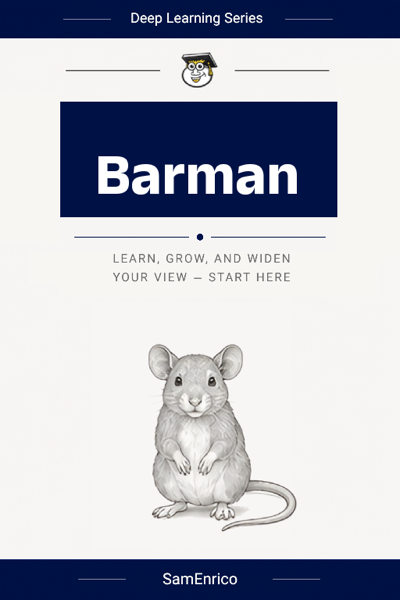
Barman eBook
A Coursebook on Barman
A Coursebook on Barman
Formats
Free sample
Chapter 1: The Rail’s True Test...--The first time a drink came back—full glass, untouched, the guest already walking out—I learned more about this profession than any recipe book ever taught me. It was a Tuesday night, the bar was three deep, and I had just executed what I believed was a perfect Old Fashioned. The bourbon was a respectable $45 bottle, the sugar was demerara (made in-house, simmered for exactly forty-five minutes), the bitters were Angostura applied in three precise drops, and the orange twist was cut with a channel knife that cost more than my first car. I slid it across the polished walnut with a flourish that screamed I know what I’m doing. The guest—a woman in her early sixties wearing a wool coat that cost more than my month's rent—looked at the drink, looked at me, and walked away without a word.
No explanation. No complaint. Just the silent, devastating judgment of a professional who had been failed by someone who confused technique with hospitality.That moment broke something in me, and then rebuilt it into something better. For the next year, I chased the answer to a single question: What did I miss? I read every book on the shelf—The Bar Book, Liquid Intelligence, Meehan’s Manual, Death & Co, Smuggler’s Cove, The Bartender’s Manifesto—and discovered a strange truth.
All of them were brilliant, and all of them were incomplete. They taught me how to shake (violently or gently), how to stir (with a vortex, not a push), how to clarify milk punches (casein proteins bind to tannins), and how to cost a pour (18-25 percent, never higher). But none of them taught me why that woman left. None of them taught me that the guest’s silence is the loudest feedback you will ever receive. None of them taught me that the title of Barman—not mixologist, not cocktail artist, not beverage director—is earned through service, not showmanship.This book is the one I wished I had on that Tuesday night.
It is not another recipe collection, though you will find recipes organized by the six root families (Chapter 6). It is not another business textbook, though you will learn pour cost, labor scheduling, and inventory control (Chapters 9 and 10). It is not another science manual, though you will understand fat-washing, carbonation, and milk clarification (Chapter 11). It is all of these things, fused into a single, coherent philosophy: the Barman is a historian, a chemist, an entertainer, a psychologist, and a business analyst—not sequentially, but simultaneously, in every single interaction.This chapter, the foundation of everything that follows, dismantles a destructive lie that has infected the hospitality industry for the past two decades. The lie is this: technical knowledge is enough.
The truth, earned through spilled liquor and lost tips and that untouched Old Fashioned, is that technique without philosophy is merely button-pushing. A vending machine can dispense a Coke. A robot can stir a Martini. A Barman reads the room, adapts to the unspoken, and transforms a transaction into a ritual.The False Idol: Why "Mixologist" Is a Distraction Let us begin with a funeral. We are burying the term "mixologist."The word emerged in the mid-2000s as craft cocktails rebelled against the sugary, sour-mix abominations of the 1980s and 1990s.
It was supposed to signal seriousness—a return to balance, fresh ingredients, and historical accuracy. A mixologist, the thinking went, was to a bartender what a chef is to a short-order cook. The term conferred legitimacy, artistry, and a permission slip to charge fourteen dollars for a drink that used to cost six.But the word carried a hidden poison. It shifted the center of gravity from the guest to the creator. The mixologist’s primary concern became the drink itself—its balance, its garnish, its Instagrammable color, its obscure amaro from a village in Piedmont that no guest had ever heard of.
The guest became a spectator, an audience member, a wallet attached to a tasting note. This is not hospitality. This is performance art with a liquor license.Consider the difference between a mixologist and a Barman in four concrete scenarios:Scenario one: A guest asks for a Vodka Soda with a lime. The mixologist winces internally, mourns the wasted opportunity, and silently judges the guest for their lack of sophistication. The Barman asks, "Would you prefer Tito’s, Ketel One, or something more neutral like Rain?
And would you like the lime squeezed or just expressed?" The Barman serves the drink without condescension, because the guest's definition of a good drink is the only definition that matters in that moment.Scenario two: A guest sits alone at the bar, staring at the wood grain, not making eye contact. The mixologist offers a tasting flight with detailed explanations of each spirit's mash bill and barrel aging. The Barman places a water glass, a small plate of almonds, and then says absolutely nothing for ten minutes. The Barman reads the non-verbal cue: this person needs quiet, not conversation.Scenario three: A guest asks for a cocktail that is not on the menu—something they had twenty years ago on vacation in New Orleans. The mixologist explains that the bar has a curated list and cannot deviate because of "ingredient integrity." The Barman asks, "What did it taste like?
Sweet, sour, boozy? What color was it?" And then the Barman makes the best approximation possible, because hospitality means saying yes whenever you can.Scenario four: A guest has clearly had too much. Their words are slightly slurred, their eyebrows are loose, and they just ordered their fourth double whiskey. The mixologist, worried about the tip, serves it anyway. The Barman cuts them off—gently, privately, with a free glass of water and an offer to call a ride—because the Barman knows that serving that drink is not hospitality; it is endangerment.The mixologist serves drinks.
The Barman serves people. That is the entire difference, and it is the difference between a job and a calling.Radical Empathy: Reading the Room Before You Speak The single most important skill behind any bar cannot be taught in a recipe book, but it can be practiced. It is called Radical Empathy—the disciplined, intentional practice of reading non-verbal cues, anticipating needs, and adapting your service style to each unique guest before you say a single word.Radical Empathy is not mind-reading. It is observation. It is pattern recognition.
It is the difference between asking "How are you tonight?" (a scripted question that invites a scripted answer) and knowing, from a glance, whether to open with a joke, a silence, or a simple "Welcome back."Let us break down the observable data points that any Barman can learn to read in under ten seconds:Posture. Are the guest's shoulders back and relaxed, or hunched and protective? Relaxed shoulders suggest openness to conversation. Hunched shoulders suggest a bad day, fatigue, or a desire to be left alone. The Barman matches energy: open posture receives a warm greeting; closed posture receives a quiet nod and space.Eye contact.
Does the guest scan the bar, make immediate eye contact with you, or stare at the back bar bottles as…
This is the end of the free sample. Get the eBook to keep going. Buy now
About this book
Details
- Author
- Mccauley Layla
- Publisher
- SamEnrico
- Language
- English
- Genre
- Non-Fiction, Informative, Educational
- Released
- 2026-05-09
- Pages (approx.)
- 155
- Available as
- eBook, Audiobook

Read better in the ZLOADR app
Your eBooks on your phone or tablet. Sign in with your SamEnrico account and start reading.
More by Mccauley Layla
 Jamaican Financial Services SupportMccauley Layla$11.99
 Ethnic Studies Essay PromptsMccauley Layla$11.99
 Browser Tab Overload Reduction HandbookMccauley Layla$11.99
 The Yehuda Halevi Poet PhilosopherMccauley Layla$11.99
 Anger at Unfair Workload DistributionMccauley Layla$11.99
 The Hammer Falls at Bannockburn: Wallace's Last StandMccauley Layla$11.99
 How to Start a Ophthalmic Hospital (public Sector) Business (Beginners Guide)Mccauley Layla$11.99
 Understanding Poems SyndromeMccauley Layla$17.99
 Real Estate Brokerage M&AMccauley Layla$12.99
 Launching Your Brand YouTube Channel GuideMccauley Layla$12.99