
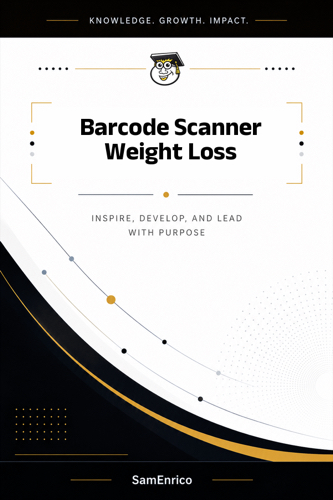
Non-FictionHealth & WellnessFood Tech
Barcode Scanner Weight Loss eBook
Use built in camera to instantly log packaged food
Use built in camera to instantly log packaged foods accurately.
Formats
Free sample
Chapter 1: The Estimation Trap--–- It started, as it often does, with a woman standing in her kitchen at 10:47 PM, staring into the open refrigerator, eating peanut butter directly from the jar with a spoon. She had already brushed her teeth. She had already told herself "no more food today" three times. She had already logged what she believed was a perfect 1,450 calories in her tracking app. And yet here she was, spoon in hand, the cool light of the refrigerator illuminating a face that was equal parts exhausted and confused.
The peanut butter was "natural," she noted, as if that made a difference at 11 PM. She took another bite. Then another. Then she closed the jar, returned it to the shelf, closed the refrigerator door, and stood in the dark kitchen feeling something between shame and bewilderment. She had no idea that the three spoonfuls of peanut butter she just ate—the ones she would never log, the ones her app would never know about—contained nearly 300 calories.
That was almost the entire deficit she had worked so hard to create that day. And she would wake up tomorrow, step on the scale, see no change, and conclude, once again, that weight loss was impossible for her. She was wrong. She was not broken. Her method was.This is the Estimation Trap, and you have been living inside it for years without knowing its name.
Every diet you have ever tried has asked you to do something that human beings are biologically incapable of doing: accurately estimate how much you eat. The most cited study on this phenomenon, published in the New England Journal of Medicine, found that even licensed nutritionists—people who calculate calories for a living—underestimate their personal daily intake by an average of 34 percent when relying on memory and visual estimation. Not 5 percent. Not 10 percent. Thirty-four percent.
That is not a rounding error. That is a systemic failure baked into the very architecture of traditional dieting. If a professional whose entire career revolves around food cannot accurately track their own intake without a tool, what chance does the average person have? The answer is none. You have no chance.
And that is not your fault.This chapter will do three things. First, it will expose the psychological and biological mechanisms that make human estimation so catastrophically unreliable—not to shame you, but to liberate you from the belief that your past failures were character failures. Second, it will introduce the concept of the Calorie Leak, a term that will appear throughout this book to describe the hundreds of hidden calories that slip past even the most diligent manual trackers. And third, it will preview the Hierarchy of Accuracy, a framework that will replace guesswork with objective data and transform you from a frustrated dieter into a calm, confident, data-driven eater.The Myth of the Mindful Eater There is a pervasive belief in wellness culture that weight loss success comes down to "mindful eating"—the idea that if you simply pay more attention, eat more slowly, and listen to your body's signals, you will naturally gravitate toward the right portion sizes and make better choices. This belief is comforting because it places control entirely in your hands.
If you fail, it must be because you were not mindful enough. The implication is that you were distracted, lazy, or insufficiently committed. This is not only cruel; it is scientifically false.The human brain evolved in an environment of scarcity, not abundance. For 99 percent of human existence, the primary nutritional challenge was finding enough calories to survive until the next meal. Your brain is wired to underestimate how much you have eaten and overestimate how much you need.
This was a survival advantage when food was scarce. It is a disaster when food is abundant and calorie-dense. Your ancient brain does not know that the peanut butter jar will still be there tomorrow. It does not understand that the three spoonfuls you just ate contain more calories than an entire meal would have contained two hundred years ago. It only knows that food is available, and available food should be consumed.
This is not a moral failing. This is evolutionary biology.Consider what happens when you ask someone to estimate the calories in a meal. Researchers have run this experiment hundreds of times. Subjects are shown a plate of pasta with sauce and asked to guess the calorie count. The average guess is around 400 calories.
The actual count, depending on portion size and ingredients, is often 800 to 1,200 calories. When the same subjects are shown the same meal and told it is a "healthy" option, their estimates drop even further. When they are shown a meal labeled "indulgent," their estimates rise. The actual food has not changed. Only the label has changed.
But the brain, desperate for shortcuts, uses the label as a heuristic—a mental rule of thumb—and produces a wildly inaccurate estimate. This is the Estimation Trap in action.The trap has three jaws that close around you simultaneously. The first jaw is memory failure. You cannot remember everything you ate today. No one can.
The average person consumes between 200 and 300 distinct food-related events per day, from the handful of nuts grabbed while walking through the kitchen to the three sips of a partner's soda to the crust cut off a child's sandwich. Your brain does not store these events as "food" because they are not categorized as meals. They are categorized as background noise. But background noise has calories. The second jaw is portion distortion.
Even when you remember eating something, you cannot reliably estimate how much you ate. Studies show that people consistently underestimate portion sizes by 20 to 50 percent, with the error growing larger as the portion size grows larger. A "small" bag of chips that contains 2.5 servings is visually indistinguishable from a bag that contains 1 serving to the untrained eye. The third jaw is visual optimism: the tendency to perceive food as smaller and less caloric than it actually is, especially when the food is perceived as healthy. A salad with 800 calories of dressing, cheese, and candied nuts looks like a "light lunch" to the optimistic eye.Together, these three jaws ensure that your daily self-reported calorie count is not just slightly off but systematically, predictably wrong.
You are not bad at estimating because you are bad at dieting. You are bad at estimating because you are human. The only way out of the trap is to stop estimating entirely.The Calorie Leak: Naming the Invisible Enemy This book will use a single, consistent term for all the calories that escape your awareness: Calorie Leaks. A Calorie Leak is any food or drink that you consume but do not accurately log. Calorie Leaks come in three varieties, and you have experienced every single one of them in the past twenty-four hours whether you realize it or not.Variety One: The Forgotten Bite.
These are the foods you eat that you genuinely forget within minutes. The square of dark chocolate broken off the bar while making tea. The single french fry stolen from a partner's plate. The last two bites of a child's pancake…
This is the end of the free sample. Get the eBook to keep going. Buy now
About this book
Details
- Author
- Mcpherson Numbers
- Publisher
- SamEnrico
- Language
- English
- Genre
- Non-Fiction, Health & Wellness, Food Tech
- Released
- 2026-06-07
- Pages (approx.)
- 148
- Available as
- eBook, Audiobook

Read better in the ZLOADR app
Your eBooks on your phone or tablet. Sign in with your SamEnrico account and start reading.
More by Mcpherson Numbers
 Daily Task Prioritization PrimerMcpherson Numbers$11.99
 Night Stalker LAPD FailuresMcpherson Numbers$11.99
 Email Productivity MetricsMcpherson Numbers$11.99
 Franchising Your Local Brand Across Borders Conversion FranchisingMcpherson Numbers$11.99
 The Irishman's Gambit: How a Mob Boss Outsmarted the FBIMcpherson Numbers$11.99
 The Shadow Cabinet: How Boris Johnson’s Inner Circle Really Ruled BritainMcpherson Numbers$11.99
 Chicago Internal Audit & Financial Advisory ConsultantMcpherson Numbers$11.99
 Podcast Marketing One PageMcpherson Numbers$12.99
 Agrivoltaic Tax IncentivesMcpherson Numbers$12.99
 A Beginners Guide to Ball badminton (Volume 1)Mcpherson Numbers$11.99
 Understanding Cystic Hamartoma of Lung and KidneyMcpherson Numbers$17.99
You may also like
 Hong Kong Handover 1997Dunn Johnnie$11.99
 Zumba For Postnatal Recovery CourseNeal Christian$11.99
 Zumba for BeginnersLadner Nikia$11.99
 YouTube Comment Mining GuideHumes Pandora$12.99
 Worry Box MeditationCarlin Rudy$11.99
 Workplace Stress MeditationNguyen Lynn$11.99
 Workplace Stress and Sleep RepairHawley Ivory$11.99
 Workplace Perfectionism CureDelaney Jeffry$11.99
 Workplace Injustice Anger GuideWallen Isabelle$11.99
 Work Addiction and Burnout LinkGreenwood Ester$11.99
 Women in Yoga and WellnessBeattie Galina$11.99
 Women in Stand Up ComedyChun Evangeline$11.99