
Non-FictionHealth & WellnessMinimal Equipment
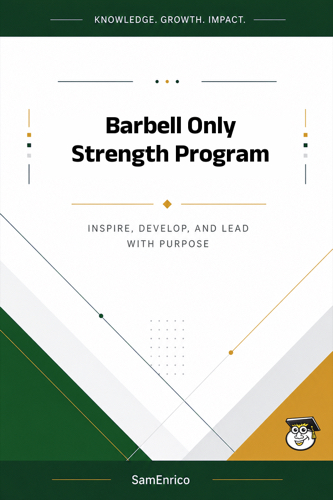
Barbell Only Strength Program eBook
Train entire body using just a barbell and weight
Train entire body using just a barbell and weight plates.
Formats
Free sample
Chapter 1: The Iron Lie--–- Most people never get strong. Not because they are lazy, not because they are genetically cursed, and not because they lack the willpower to suffer through hard training. They fail for a much simpler reason: they have been lied to about what strength actually requires.Walk into any commercial gym in America, and you will see the lie manufactured in real time. Rows upon rows of gleaming machines, each one promising to "isolate" a specific muscle. Cable stations with thirty different handle attachments.
Dumbbell racks stretching from five to one hundred and twenty pounds. Kettlebells in seven colours. Resistance bands, suspension trainers, plyo boxes, and something called a "glute drive" that looks like a medieval torture device. The message is unmistakable: You need all of this to get strong.That message is false.The truth is simpler, harder, and more liberating: you can train your entire body, build more functional strength than ninety-five percent of the population, and develop a physique that turns heads—using nothing more than a barbell, a set of weight plates, and a small patch of floor.This chapter is not a warm-up. It is not a philosophical preamble you can skim on your way to "the real content." This chapter is the foundation of everything that follows.
If you understand why the barbell wins, why minimalism is not a compromise but an advantage, and why chasing aesthetics directly will actually leave you weaker and smaller, then the next eleven chapters will transform you. If you skip this chapter, you will become another person who starts strong, fades by week six, and wonders why the program "didn't work."Let us begin by dismantling the lie piece by piece.The Illusion of Choice Commercial gyms are not designed to make you strong. They are designed to keep you paying a monthly membership. There is a profound difference between these two goals.A gym that wanted to make you strong would need very little: several squat racks, a few flat benches, a deadlift platform, and enough barbells to keep a class of twenty moving. That is it.
That gym would be profitable, efficient, and intimidating to most people because it would reveal the uncomfortable truth that strength is built through heavy, compound movements—not through thirty minutes of cable crossovers and bicep curls.Instead, gyms fill their floors with machines because machines are safe, predictable, and impossible to hurt yourself on if you are paying attention to your phone. Machines require no instruction. Machines let you sit down. Machines give you the illusion of a workout while delivering a fraction of the stimulus. And most importantly, machines keep you coming back for years without ever achieving anything remarkable, which means you keep paying.The average gym member has been training for three to five years.
Ask that same person how much they squat, and they cannot tell you. Not because they are embarrassed, but because they have never actually tracked their squat. They have never added five pounds to the bar every session for twelve weeks. They have never experienced linear progression because their program—if you can call it that—changes every time they see a new Instagram post from a fitness influencer.This is not a moral failing. It is a design flaw in the system.
The system presents you with infinite choices, and infinite choice is paralysing. Which machine today? Which grip attachment? Which angle? Which rep range?
Which "muscle group" needs "focusing"? By the time you have answered these questions, you have exhausted your willpower before you have lifted a single heavy weight.The barbell eliminates choice. And elimination of choice is the secret to consistency.Why Machines Are a Trap Let us be specific about why machines fail you. This is not opinion; it is biomechanics.A machine—whether a leg press, a Smith machine, or a seated cable row—locks the movement into a fixed path. The machine decides where the bar travels.
Your stabiliser muscles (the small, often forgotten muscles that keep joints aligned under load) are not trained because the machine does their job for them. This creates a dangerous illusion: you think you are stronger than you actually are.Take the Smith machine squat as the clearest example. The Smith machine counterbalances the weight and restricts the bar to vertical movement only. You do not have to balance the bar. You do not have to engage your core to prevent forward or backward drift.
You do not have to recruit your adductors and abductors to keep your knees tracking correctly. You simply push up. Then you go to a free squat with a barbell, and the bar wobbles, your knees cave in, and your lower back hurts. The Smith machine did not prepare you for reality because reality is not a fixed track.The same applies to every machine. The seated leg curl machine does not train your hamstrings to stabilise your knee during a deadlift.
The pec deck does not train your rotator cuff to control the descent of a bench press. The lat pulldown machine does not train your core to brace against a heavy row. Machines train muscles in isolation. The body never works in isolation. Every real-world movement—lifting a suitcase, pushing a car, carrying a child, climbing a ladder—requires hundreds of muscles to fire in coordinated sequence.
A machine that isolates one muscle is training you for a movement that does not exist outside the gym.The barbell, by contrast, forces coordination. When you squat, your entire body works: your grip holds the bar, your upper back stabilises it, your core braces against the load, your hips and knees and ankles all bend and extend in sequence, your feet grip the floor. That is not a leg exercise. That is a full-body neurological event. And that is why it builds strength that transfers to everything else.The Dumbbell Illusion Dumbbells are better than machines.
Let us acknowledge that upfront. Dumbbells require stabilisation. Dumbbells allow natural bar paths. Dumbbells can be used effectively for many movements.But dumbbells have a fatal flaw for serious strength development: you cannot load them heavily enough for lower-body movements, and progressive overload becomes impractical once the weights get heavy.Consider the deadlift. A barbell deadlift of three hundred pounds requires one barbell and four plates.
You can load that bar in thirty seconds. Now try to deadlift three hundred pounds with dumbbells. You would need two one-hundred-and-fifty-pound dumbbells. Most gyms do not even have dumbbells that heavy. If they do, picking them up from the floor is a feat of grip strength in itself.
And what about the movement pattern? Dumbbells hang at your sides, which changes the leverage, reduces the load on your posterior chain, and turns the deadlift into a squat-and-shrug hybrid. It is not the same exercise.The same problem appears in the squat. Goblet squats with a heavy dumbbell are limited by how much you can hold against your chest. Dumbbell front squats require cleaning the dumbbells to your shoulders, which becomes dangerous above moderate weights.
There is no practical way to do a heavy, loaded squat with dumbbells alone.Even for upper-body movements, dumbbells become logistically…
This is the end of the free sample. Get the eBook to keep going. Buy now
About this book
Details
- Author
- Charlton Kristle
- Publisher
- SamEnrico
- Language
- English
- Genre
- Non-Fiction, Health & Wellness, Minimal Equipment
- Released
- 2026-06-09
- Pages (approx.)
- 130
- Available as
- eBook, Audiobook

Read better in the ZLOADR app
Your eBooks on your phone or tablet. Sign in with your SamEnrico account and start reading.
More by Charlton Kristle
 Loving Kindness Sleep PracticeCharlton Kristle$11.99
 Weekly Review Audio GuideCharlton Kristle$11.99
 Cyclist Hip Flexibility PlanCharlton Kristle$11.99
 The Bitcoin Boom and Bust: A Digital Gold Rush Gone WrongCharlton Kristle$11.99
 Understanding Hypodontia of Incisors and PremolarsCharlton Kristle$17.99
 Strategic Sourcing Category ManagerCharlton Kristle$11.99
 Surgical Navigation Systems GuideCharlton Kristle$12.99
 Small Business AI Tool GuideCharlton Kristle$12.99
 How to Start a Pathological Laboratory Business (Beginners Guide)Charlton Kristle$11.99
You may also like
 Hong Kong Handover 1997Dunn Johnnie$11.99
 Zumba For Postnatal Recovery CourseNeal Christian$11.99
 Zumba for BeginnersLadner Nikia$11.99
 YouTube Comment Mining GuideHumes Pandora$12.99
 Worry Box MeditationCarlin Rudy$11.99
 Workplace Stress MeditationNguyen Lynn$11.99
 Workplace Stress and Sleep RepairHawley Ivory$11.99
 Workplace Perfectionism CureDelaney Jeffry$11.99
 Workplace Injustice Anger GuideWallen Isabelle$11.99
 Work Addiction and Burnout LinkGreenwood Ester$11.99
 Women in Yoga and WellnessBeattie Galina$11.99
 Women in Stand Up ComedyChun Evangeline$11.99