
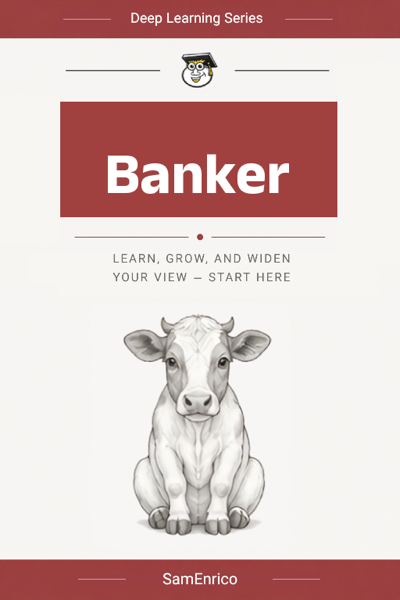
Non-FictionInformativeEducational
Banker Audiobook
A Coursebook on Banker
A Coursebook on Banker
Formats
Free sample
Chapter 1: The Money Mirage...--–- The first lie you were ever told about banking happened before you could walk. Your parents took you to a brick building with a glowing sign, handed a slip of paper to a person behind glass, and that person gave them green paper in return. "This is where we keep our money," they said. "Safe and sound." That lesson—that banks are vaults, warehouses, mattresses with marble floors—is the single most damaging misconception in all of finance. It is wrong.
And until you unlearn it, you will never truly understand what a banker does, how money is created, or why a handful of people behind those counters hold the keys to the global economy. This chapter dismantles that myth, rebuilds banking from first principles, and gives you the conceptual toolkit you will carry through every remaining chapter of this book.What Banks Actually Do (Spoiler: It's Not Storage)Imagine you deposit $1,000 in a checking account. The bank takes that cash, puts it in its vault (or, more realistically, sends an electronic message to the central bank), and then what? The classic textbook answer: the bank holds your money until you need it, lending out a portion to borrowers. This is the "financial intermediation" model—banks as middlemen connecting savers to borrowers.
It is tidy, intuitive, and mostly wrong.The truth is stranger and more powerful. When a bank makes a loan, it does not reach into a pile of existing deposits. It types numbers into a computer. A bank creates new money at the moment it approves a loan. The borrower signs a promissory note; the bank credits the borrower's account with a deposit that did not exist moments earlier.
That deposit is new money. It circulates, gets spent, deposited elsewhere, re-lent, and re-created, expanding the total money supply far beyond the original $1,000 you deposited.This is not a metaphor, a theory, or an accounting trick. It is double-entry bookkeeping, and it is the operational reality of every commercial bank on the planet. When a bank originates a 100,000mortgage,itsbalancesheetshows100,000 mortgage, its balance sheet shows 100,000mortgage,itsbalancesheetshows100,000 in new assets (the loan receivable) and 100,000innewliabilities(thedepositcreditedtothehomebuyer).Totalmoneyintheeconomyjustincreasedby100,000 in new liabilities (the deposit credited to the homebuyer). Total money in the economy just increased by 100,000innewliabilities(thedepositcreditedtothehomebuyer).Totalmoneyintheeconomyjustincreasedby100,000.
No printing press required.Let us trace this with a concrete example using T-accounts—the banker's most basic analytical tool.Before the loan…
This is the end of the free sample. Get the Audiobook to keep going. Buy now
About this book
Details
- Author
- Bertrand Milagro
- Publisher
- SamEnrico
- Language
- English
- Genre
- Non-Fiction, Informative, Educational
- Released
- 2026-05-09
- Pages (approx.)
- 158
- Available as
- eBook, Audiobook

Listen in the VoxFlicks app
Audiobooks and audio dramas wherever you go. Sign in with your SamEnrico account and press play.
More by Bertrand Milagro
 Empathy Building GuideBertrand Milagro$11.99
 Self Hypnosis Shingles PainBertrand Milagro$11.99
 Aromatherapy for Joint PainBertrand Milagro$11.99
 Senator Farewell Address GuideBertrand Milagro$11.99
 Trade Secrets Export Control GuideBertrand Milagro$11.99
 The Silk Road's Last Courier: The Untold Story of the Man Who Smuggled Secrets for the CIABertrand Milagro$11.99
 The Silk Road of Stars: Ibn al-Shatir’s Celestial RevolutionBertrand Milagro$11.99
 TikTok UK Advertising CodeBertrand Milagro$12.99
 Angel Investor Referral FeeBertrand Milagro$12.99
 Understanding Cor TriatriatumBertrand Milagro$17.99
 How to Start a Mouldable Refractory Business (Beginners Guide)Bertrand Milagro$11.99
You may also like
 Hong Kong Handover 1997Dunn Johnnie$11.99
 Zumba For Postnatal Recovery CourseNeal Christian$11.99
 Zumba for BeginnersLadner Nikia$11.99
 YouTube Comment Mining GuideHumes Pandora$12.99
 Worry Box MeditationCarlin Rudy$11.99
 Workplace Stress MeditationNguyen Lynn$11.99
 Workplace Stress and Sleep RepairHawley Ivory$11.99
 Workplace Perfectionism CureDelaney Jeffry$11.99
 Workplace Injustice Anger GuideWallen Isabelle$11.99
 Work Addiction and Burnout LinkGreenwood Ester$11.99
 Women in Yoga and WellnessBeattie Galina$11.99
 Women in Stand Up ComedyChun Evangeline$11.99