
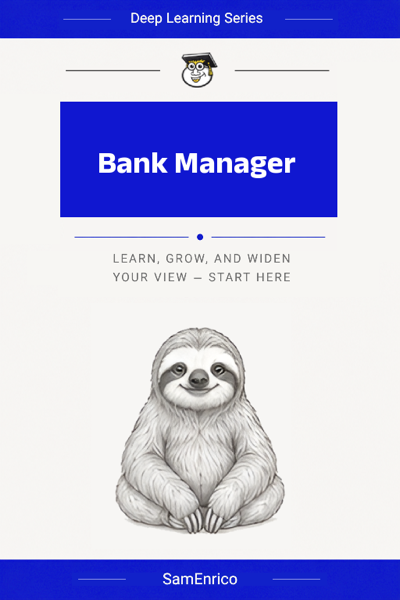
Non-FictionInformativeEducational
Bank Manager eBook
A Coursebook on Bank Manager
A Coursebook on Bank Manager
Formats
Free sample
Chapter 1: The Branch Is Dead--–- The announcement came at 8:47 AM on a Tuesday, which was cruel because Tuesdays were already the hardest day of the week. Margaret Chen had been a branch manager for eleven years, and she had learned to read the weather of banking—the small tremors that preceded earthquakes. The email from Regional Vice President Marcus Webb had no small tremors. It was short, direct, and devastating."Effective immediately, all transaction limits for mobile deposits will be raised to $25,000 per day. Corresponding teller transaction volume is projected to decrease by 40% over the next six months.
Regional staffing reviews will commence in Q3."Margaret read it three times. Forty percent. That wasn't a reduction. That was an amputation.She looked up from her screen and through the glass wall of her office at the teller line. There was Dolores, sixty-two years old, thirty-four years with the bank, her fingers moving across the cash drawer with the muscle memory of a concert pianist.
There was Marcus Jr. (no relation to the VP, just a cruel coincidence of naming), twenty-four years old, six months into his first banking job, still learning how to spot a fake ID. There was Fatima, the lead teller, who had turned down a promotion to assistant manager twice because she didn't want to lose her connection with customers.Forty percent of their transactions were about to vanish. And Margaret knew what that meant. She had seen it happen to three other branches in the district.
The math was brutal and simple: fewer transactions meant fewer tellers needed. Fewer tellers meant smaller branches. Smaller branches meant fewer managers. And fewer managers meant that someone like her—eleven years of experience, a master's degree in finance, and a reputation for turning around struggling branches—would be competing with a hundred other displaced managers for fifty jobs.The Branch CEO era had begun. Most of her colleagues didn't know it yet.
Margaret had the terrible gift of seeing the future five minutes before it arrived.This chapter is about those five minutes. It is about the moment when every bank manager in America realizes that the old rulebook has been thrown out, and no one has written a new one. It is about the shift from "loan officer" to "Branch CEO"—a transformation that is not a promotion but a survival mechanism. And it begins with a question that Margaret asked herself that Tuesday morning, a question that will guide everything in this book:If my branch is no longer a place where customers come to do transactions, what is it for?The Great Unbundling of Banking To understand where bank management is going, you must first understand how we arrived at this moment of crisis and opportunity. The story of banking over the past fifty years is a story of unbundling—the gradual, relentless separation of banking functions from the physical branch.In 1970, if you wanted to deposit a check, you walked into a branch.
If you wanted to check your balance, you walked into a branch. If you wanted to apply for a loan, you walked into a branch. If you wanted to dispute a charge, you walked into a branch. The branch was not just where banking happened; it was banking.The ATM unbundled cash withdrawals. The telephone unbundled balance inquiries.
Online banking unbundled bill pay. Mobile banking unbundled check deposits. And each time a function was unbundled, the branch became smaller, quieter, and more expensive to maintain relative to its value.The data is stark and undeniable. According to the Federal Reserve, the number of bank branches in the United States peaked in 2009 at just over 99,000. By 2024, that number had fallen below 75,000—a decline of nearly 25 percent in fifteen years.
But here is what the headlines miss: the branches that survived are not the branches that did the same things slightly better. They are branches that did fundamentally different things.Consider two branches in the same regional bank, both opened in 2005, both serving similar demographics. Branch A continued to operate as it always had: teller line, platform bankers, a manager in a glass office, a small business lender who visited twice a week. By 2023, Branch A was generating $1.2 million in annual revenue against $900,000 in operating costs—a respectable but shrinking margin. Its customer base was aging.
Its younger customers had names for the branch: "the place my parents go" and "the building I drive past on the way to work."Branch B, under a manager named David Okonkwo, had transformed itself. The teller line was reduced from five stations to two. The freed-up space became a "business resource center" with free wifi, private phone booths for small business owners, and a weekly "office hours" session with a local SCORE mentor. David retrained his tellers as "universal associates" who could open accounts, resolve disputes, and refer loan opportunities. He stopped measuring his team on transactions per hour and started measuring them on customer problems solved.By 2023, Branch B was generating $2.1 million in annual revenue against $750,000 in operating costs.
Its margins had expanded. Its customer base was younger, more diverse, and more profitable. When the bank's regional leadership considered closing branches, Branch A was on the list. Branch B was not just safe—it was a model for the future.The difference between Branch A and Branch B was not technology. Both had the same mobile app, the same core banking system, the same product suite.
The difference was management. David Okonkwo understood something that Margaret Chen was just beginning to grasp: the branch manager's job had changed completely, and most of her peers were still doing the old job.The Three Fallacies of Traditional Bank Management Before we can build the new model, we must clear away the wreckage of the old one. Traditional bank management rests on three fallacies that have become dangerously obsolete. Every manager who wants to survive must recognize these fallacies in their own thinking and root them out.Fallacy One: The Rational Model The first fallacy is the belief that banking is primarily a rational, quantitative enterprise—that if you understand the numbers, the right decisions will follow. This is the "Rational Model," and it is taught in every finance program in America.
It says that customers choose banks based on interest rates, fees, and convenience. It says that employees respond to incentives. It says that the manager's job is to optimize the spreadsheet.The Rational Model is not wrong. It is incomplete.Consider a study published in the Journal of Financial Economics that tracked customer defections from a regional bank over three years. The researchers expected to find that customers left for better rates or lower fees.
Instead, they found that the single strongest predictor of customer defection was whether the customer could name a specific employee at their branch. Customers who could not name a single banker were 400 percent more likely to leave within twelve months, regardless of interest rates or fees.The numbers matter, but they are not the whole story. The Rational Model fails because it ignores the messy, emotional, deeply human reality of banking. A customer who feels known will tolerate a higher fee.…
This is the end of the free sample. Get the eBook to keep going. Buy now
About this book
Details
- Author
- Ramirez Gerardo
- Publisher
- SamEnrico
- Language
- English
- Genre
- Non-Fiction, Informative, Educational
- Released
- 2026-06-03
- Pages (approx.)
- 146
- Available as
- eBook, Audiobook

Read better in the ZLOADR app
Your eBooks on your phone or tablet. Sign in with your SamEnrico account and start reading.
More by Ramirez Gerardo
 Purpose Driven Long Life PlanRamirez Gerardo$11.99
 Stress Joint Health GuideRamirez Gerardo$11.99
 Remote Work Gap BridgeRamirez Gerardo$11.99
 Cleopatra Temple Building ProgramRamirez Gerardo$11.99
 The Abdominal Aortic Aneurysm GuideRamirez Gerardo$11.99
 Billionaire Whispers: How the Ultra-Wealthy Reshape the WorldRamirez Gerardo$11.99
 The Breeder's Guide to Arapawa GoatRamirez Gerardo$11.99
 Facebook Ad Scheduling GuideRamirez Gerardo$12.99
 Circular Economy Pitch GuideRamirez Gerardo$12.99
 How to Start a Hobby in Air sportsRamirez Gerardo$11.99
You may also like
 Hong Kong Handover 1997Dunn Johnnie$11.99
 Zumba For Postnatal Recovery CourseNeal Christian$11.99
 Zumba for BeginnersLadner Nikia$11.99
 YouTube Comment Mining GuideHumes Pandora$12.99
 Worry Box MeditationCarlin Rudy$11.99
 Workplace Stress MeditationNguyen Lynn$11.99
 Workplace Stress and Sleep RepairHawley Ivory$11.99
 Workplace Perfectionism CureDelaney Jeffry$11.99
 Workplace Injustice Anger GuideWallen Isabelle$11.99
 Work Addiction and Burnout LinkGreenwood Ester$11.99
 Women in Yoga and WellnessBeattie Galina$11.99
 Women in Stand Up ComedyChun Evangeline$11.99