
Non-FictionSelf-HelpRelease Techniques
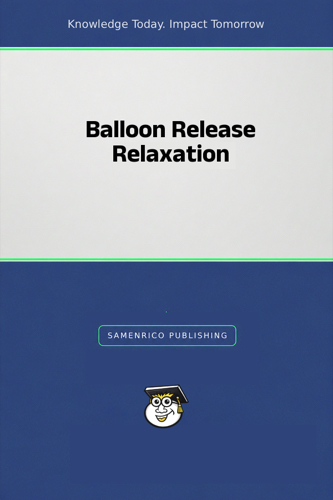
Balloon Release Relaxation eBook
Imagine letting go of helium balloons carrying you
by Garber Shea
Imagine letting go of helium balloons carrying your worries far away.
Formats
Free sample
Chapter 1: The Balloon You Didn't Name--–- You are holding more balloons than you realize. Not the shiny, helium-filled kind you release at celebrations. These are invisible, weighty, and you have been gripping their strings for so long that you have forgotten they are even there. Some arrived yesterday. Others have been tied to your wrist for decades.
Together, they shape your posture, your breathing, your decisions, and your exhaustion. You did not intend to collect them. No one wakes up and says, "Today I will carry thirty-seven worries about things I cannot control." But somehow, by midweek, that is exactly where you find yourself.This chapter is about one thing only: seeing. Before you release a single balloon, you must know what you are holding. Most people cannot name their worries.
They feel a general fog of anxiety, a background hum of unease, or a sudden spike of panic that seems to come from nowhere. But worry is not a ghost. It is a collection of specific thoughts, each with a shape, a color, a weight, and a name. The moment you name a worry, you stop being haunted by it. You become its observer.
And that shift—from feeling haunted to seeing clearly—is the first and most essential step toward letting go.Why Naming Matters More Than Fixing The human brain is wired to solve problems. When you feel a worry, your mind immediately jumps to "What can I do about this?" That impulse is useful when you are being chased by a tiger. It is useless when you are lying in bed at 2:00 AM replaying an awkward comment you made in 2017. The problem is not that you worry. The problem is that your brain treats every worry as an emergency requiring immediate action.
But most worries are not emergencies. They are thoughts. And thoughts, left unexamined, loop. They replay. They gain volume.
They attach to other worries. Before long, you are not worried about one thing. You are worried about everything.The first step out of that loop is not fixing. It is naming. Research in neuroscience and clinical psychology consistently shows that labeling an emotion reduces its intensity.
This phenomenon, sometimes called "affect labeling," activates the prefrontal cortex (the reasoning part of your brain) while calming the amygdala (the alarm system). In simple terms: when you say "I am feeling anxious about my presentation next week," you are no longer just feeling anxious. You are observing your anxiety from a slight distance. That distance is small, but it is everything. It is the difference between drowning in a wave and learning to float on top of it.This book uses balloons as the naming tool.
Not because balloons are silly or childish, but because they are gentle. You have likely been told to "face your fears" or "power through" or "stop worrying." Those commands do not work because they add shame to the worry. Now you are worried AND you feel guilty for worrying. A balloon carries no judgment. A balloon is just a container.
You fill it with a worry, tie it off, and look at it. That is all. No fixing. No fighting. Just naming and seeing.The Balloon Inventory Journal Every worry in your mind right now can be written down.
You might resist this. You might think, "If I write it down, it will become real." The opposite is true. What you do not write down stays formless and huge, like a monster in a dark room. What you write down becomes a sentence on a page. A sentence has edges.
A sentence can be examined, questioned, or set aside. A sentence cannot chase you.Take out a notebook or open a blank document. Title it "My Balloon Inventory." You will return to this journal throughout the book, but for now, you are simply listing. Do not censor. Do not rank.
Do not try to solve. Just list every worry that comes to mind, no matter how small or silly or shameful. Use the following sentence stem:"I am worried about..."Then let your hand move. Do not stop to judge. If you are worried about your health, write it.
If you are worried about what your sister thinks of your parenting, write it. If you are worried about climate change, money, that weird noise your car makes, whether you said "you too" when the waiter said "enjoy your meal"—write it all. A typical person lists between fifteen and forty worries in a first inventory. Some people list over a hundred. There is no right number.
There is only honesty.Once you have your list, you will assign each worry a color. This is not a scientific exercise. It is a creative one. Colors help your brain distinguish between different kinds of emotional weight. You might choose:Red for anger, frustration, or resentment Gray for grief, loss, or sadness Blue for sadness or loneliness (if you prefer a softer tone than gray)Yellow for anxiety about the future (the color of caution)Black for shame or self-criticism White for worries you cannot quite name (formless, quiet, but present)Green for envy or comparison Orange for worry about other people's opinions Purple for worries about meaning, purpose, or existential dread You do not have to use these categories.
Create your own. The important thing is that you look at each worry and decide what color it feels like. That act of deciding forces you to spend a few extra seconds with the worry—long enough to acknowledge it, not long enough to drown in it.The Five Categories of Balloons In my work with thousands of readers and therapy clients, I have found that almost all worries fall into five broad categories. As you look at your inventory, you will notice that your balloons cluster. Recognizing these clusters does not solve the worries, but it does something almost as valuable: it shows you that you are not uniquely broken.
Most people carry balloons from the same five places.Category One: Family Balloons These involve parents, children, siblings, partners, or the absence of them. Common family balloons include: "I worry my mother is disappointed in me." "I worry my teenager is pulling away." "I worry I am repeating my father's worst habits." "I worry I will never find a partner." "I worry my marriage is falling apart and I am the only one who does not see it." Family balloons are often the oldest. Some were tied to you before you could talk. Releasing them requires patience, but releasing them is possible.Category Two: Work Balloons These include paid employment, unpaid labor (caregiving, housework, volunteering), and creative work you long to do. Common work balloons include: "I worry I will be fired." "I worry I am not smart enough for this role." "I worry I have chosen the wrong career." "I worry everyone else is more productive than me." "I worry I will never make enough money to feel safe." Work balloons thrive on comparison.
You do not actually know how your colleagues are doing, but your brain fills in the gap with "better than me."Category Three: Health Balloons These involve your…
This is the end of the free sample. Get the eBook to keep going. Buy now
About this book
Details
- Author
- Garber Shea
- Publisher
- SamEnrico
- Language
- English
- Genre
- Non-Fiction, Self-Help, Release Techniques
- Released
- 2026-06-10
- Pages (approx.)
- 143
- Available as
- eBook, Audiobook

Read better in the ZLOADR app
Your eBooks on your phone or tablet. Sign in with your SamEnrico account and start reading.
More by Garber Shea
 Rust Belt Wellness DeclineGarber Shea$11.99
 Chad Tombalbaye Civil WarGarber Shea$11.99
 Self Doubt for Flight AttendantsGarber Shea$11.99
 Metta for AthletesGarber Shea$11.99
 Whispers of the Thunderbird: The Sky Chief's WisdomGarber Shea$11.99
 Understanding Mps Iii-aGarber Shea$17.99
 Managing Cross Cultural Remote ConflictGarber Shea$12.99
 Text To Video Generation GuideGarber Shea$12.99
 Matlockite MiningGarber Shea$11.99
 How to Become a Coal TrimmerGarber Shea$11.99
You may also like
 Hong Kong Handover 1997Dunn Johnnie$11.99
 Zumba For Postnatal Recovery CourseNeal Christian$11.99
 Zumba for BeginnersLadner Nikia$11.99
 YouTube Comment Mining GuideHumes Pandora$12.99
 Worry Box MeditationCarlin Rudy$11.99
 Workplace Stress MeditationNguyen Lynn$11.99
 Workplace Stress and Sleep RepairHawley Ivory$11.99
 Workplace Perfectionism CureDelaney Jeffry$11.99
 Workplace Injustice Anger GuideWallen Isabelle$11.99
 Work Addiction and Burnout LinkGreenwood Ester$11.99
 Women in Yoga and WellnessBeattie Galina$11.99
 Women in Stand Up ComedyChun Evangeline$11.99