
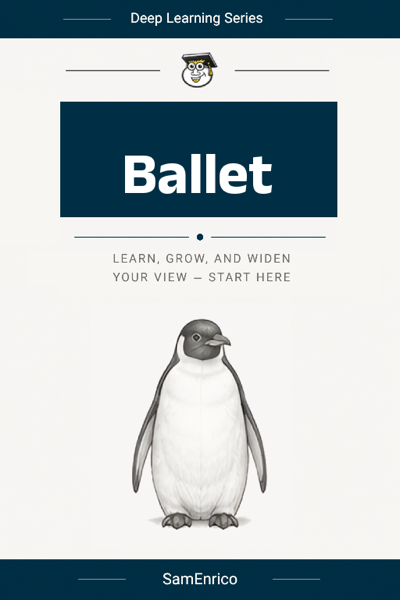
Ballet Audiobook
A Coursebook on Ballet
by Hyland Sarai
A Coursebook on Ballet
Formats
Free sample
Chapter 1: The Bone Truth...--When a young dancer walks into her first ballet class, she is usually handed a pair of pink slippers, told to stand with her heels together and toes pointed outward, and encouraged to “turn out.” No one explains that this simple instruction – turn out – will determine whether she dances for twenty years or two. No one tells her that the shape of her hip joints, something she was born with and cannot change, will set the outer limits of her technique. And no one warns her that forcing turnout beyond those limits is the fastest route to a surgeon’s table.This chapter dismantles a persistent and damaging myth – that ballet requires a “natural” body that most people do not possess – and replaces it with a more useful truth: ballet is a trained skill, not an inherited gift. The difference matters. The myth discourages aspiring dancers before they begin.
The truth empowers them to work intelligently within their own anatomical limits.A Note on Audience: This chapter is written primarily for dancers and dance students. If you are reading this book as a ballet history enthusiast or an audience member, you may choose to skim the technical sections (particularly the muscle group descriptions and exercises) and focus on the conceptual takeaways. The glossary at the end of this chapter summarizes the essential points.The Ballerina Body Myth: Where It Comes From For more than a century, ballet has cultivated an image of the ideal dancer: long neck, high instep, slender limbs, hyperextended knees, and – above all – extreme turnout. From Romantic lithographs of Marie Taglioni floating in white mist to Instagram photos of Misty Copeland balanced in arabesque, the message seems to be that some bodies are simply born for ballet and others are not.This is nonsense. But it is persuasive nonsense.The myth of the “natural ballerina body” has roots in three overlapping sources.
First, the Romantic era of the 1830s and 1840s (explored in Chapter 7) fetishized the ethereal, weightless, almost ghostly female figure – thin, pale, and seemingly unburdened by earthly appetites. Second, the Russian Imperial era (Chapter 8) codified a specific aesthetic: long limbs, small head, high arch, and the ability to hold poses that required unusual joint mobility. Third, the rise of ballet photography and film in the twentieth century froze dancers in their most flattering moments, creating a gallery of…
This is the end of the free sample. Get the Audiobook to keep going. Buy now
About this book
Details
- Author
- Hyland Sarai
- Publisher
- SamEnrico
- Language
- English
- Genre
- Non-Fiction, Informative, Educational
- Released
- 2026-05-08
- Pages (approx.)
- 153
- Available as
- eBook, Audiobook

Listen in the VoxFlicks app
Audiobooks and audio dramas wherever you go. Sign in with your SamEnrico account and press play.
More by Hyland Sarai
 AA and NA Explained SimplyHyland Sarai$11.99
 The Remote Wellness GuideHyland Sarai$11.99
 Telogen Effluvium Recovery GuideHyland Sarai$11.99
 CPR In Moving VehicleHyland Sarai$11.99
 The Corsair Architect: Michelangelo’s Forbidden CityHyland Sarai$11.99
 UK Business Credit InsuranceHyland Sarai$12.99
 How to Produce Blood Glucose Test StripsHyland Sarai$11.99
 How to Become a Machine Setter-and-repairerHyland Sarai$11.99