
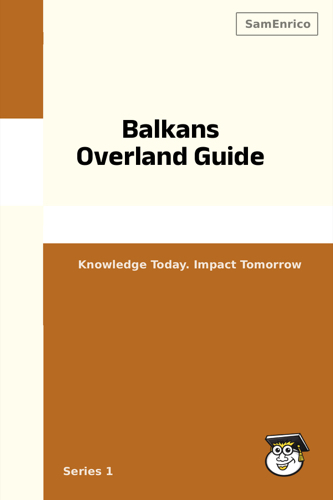
Non-FictionBiographyBalkan Peninsula
Balkans Overland Guide eBook
Lead expeditions through post Yugoslav states.
Lead expeditions through post Yugoslav states.
Formats
Free sample
Chapter 1: Beyond the Ghosts...--The first time I tried to lead an expedition through the Western Balkans, I failed before my group even crossed the first border. Not because my vehicle wasn't prepared. Not because my route was flawed. But because I believed the maps.The map on my dashboard showed a clean, unbroken line between Dubrovnik and Mostar. What the map did not show was that the road I had chosen passed through a village where, twenty years earlier, every third house had been burned.
It did not show that the man selling fuel from a plastic barrel at the intersection had lost his brother on that same stretch of asphalt. It did not show that by taking that particular road on that particular anniversary of a particular battle, I was leading my group into a place where hospitality and hostility shared the same front porch, separated only by the question of which license plate you carried.The map lied. Every map of the Balkans lies. Not intentionally, not maliciously, but inevitably. Because the lines on a map represent agreements between governments.
The lines on the ground represent something else entirely: memory, grief, pride, and the long, slow work of learning to live beside people your cousin tried to kill.This book is not a map. It is something more useful and more dangerous: a manual for seeing through the map, for understanding why the shortest route might be the longest in hours, and why the longest route might be the shortest in heartbreak. It is for expedition leaders who understand that the Balkans are not a problem to be solved but a depth to be respected.The Myth of the Powder Keg If you have read anything about the Balkans before picking up this book, you have encountered the phrase "powder keg." It appears in every introductory chapter of every travel guide written by outsiders. It suggests a region perpetually on the verge of explosion, held together by nothing but the thinnest veneer of European civility, waiting for a single spark to send everything back into chaos.This phrase is lazy. It is also wrong, and believing it will ruin your expedition before it begins.The powder keg narrative emerged from Western journalism during the Yugoslav Wars of the 1990s, when reporters parachuted into Sarajevo, filmed burning buildings, and concluded that the Balkans were simply "like that" – fundamentally, tribally, irredeemably violent.
The phrase implies that violence is baked into the soil, that the people of this region are prisoners of their own history, incapable of the rational self-governance that Western Europeans take for granted.Here is what the powder keg narrative leaves out: the wars of the 1990s did not emerge from ancient hatreds. They emerged from calculated political manipulation by leaders who seized upon economic collapse, foreign intervention, and the vacuum left by Tito's death. They emerged because Slobodan Milošević needed a war to stay in power, and because Franjo Tuđman needed a war to consolidate Croatian identity, and because the international community stood by as Srebrenica fell.The people of the Balkans did not wake up one morning and decide to kill their neighbors. They were pushed, lied to, and abandoned. And the fact that most of them chose not to pick up a gun – the fact that Sarajevo's multiethnic resistance to siege lasted longer than any other urban siege in modern history – is rarely mentioned in the same breath as "powder keg."Why does this matter for an overland expedition leader?
Because if you believe the powder keg narrative, you will approach the Balkans with fear. You will see tension where there is only difference. You will interpret a heated argument about soccer as a prelude to violence. You will miss the invitations to coffee, the shoulders shrugged over rakija, the laughter that follows every complaint about the neighbor who is also, somehow, still family.The Balkans are not a powder keg. They are a conversation – sometimes loud, sometimes interrupted, but always ongoing.
Your job as a leader is not to tiptoe around the conversation. Your job is to learn how to listen.The Seven States, Briefly Before we go any further, we need to agree on what we are talking about. The post-Yugoslav states are seven in number: Slovenia, Croatia, Bosnia and Herzegovina, Serbia, Montenegro, Kosovo, and North Macedonia. (Some lists include a disputed eighth or ninth; we will stick with the seven that are universally recognized by at least some combination of the UN, EU, and US.)Each of these states has a distinct relationship to the overland expedition. Understanding those relationships is the first step toward designing a route that works.Slovenia is the exception that proves the rule.
It fought a ten-day war of independence in 1991, lost almost no one compared to its southern neighbors, and immediately pivoted toward Central Europe. Driving through Slovenia feels like driving through Austria: clean highways, predictable signage, efficient border crossings. Slovenes will tell you they are not really Balkan. They are correct in everything but geography. For the expedition leader, Slovenia is the soft opening – a place to shake down your vehicle, test your group's dynamics, and acclimatize before the roads get harder.Croatia is the paradox.
Its coast is among the most beautiful in Europe, and its tourism infrastructure is world-class. But the beauty came at a cost. The Homeland War (1991-1995) displaced hundreds of thousands, destroyed entire towns, and left a legacy of displacement that still shapes who lives where. Driving through Croatia means navigating between two realities: the glittering Adriatic highway, where Germans in rented campers pay eighty euros for a parking spot, and the inland villages, where bullet holes still decorate church walls and the population is half what it was in 1990. Your group will want to see Dubrovnik.
You will want to get them out of Dubrovnik as quickly as possible, not because it isn't beautiful, but because it isn't the Balkans. It is a theme park built on the bones of a siege.Bosnia and Herzegovina is the heart of the matter. More than any other post-Yugoslav state, Bosnia retains the visible, undeniable scars of the 1990s. The Dayton Agreement that ended the war in 1995 created a political structure of staggering complexity: two entities (the Federation of Bosnia and Herzegovina and Republika Srpska), three constituent peoples (Bosniaks, Serbs, Croats), and a rotating presidency that is almost intentionally dysfunctional. For the overland leader, this complexity manifests in practical ways.
The road quality changes when you cross from Federation to Republika Srpska. The police wear different patches. The fuel prices differ. And the maps – those lying maps – often fail to show the entity line at all, meaning you may cross from one jurisdiction to another without realizing it until a patrol car with unfamiliar markings pulls you over.Serbia is the anchor. It was the dominant republic in Yugoslavia, and it suffered the longest period of international isolation after the wars.
That isolation left Serbia behind its neighbors in infrastructure development, which is a gift to the overland expedition leader: fewer tourists, lower prices, and a road network that rewards patience and punishes haste. Serbia is also the most…
This is the end of the free sample. Get the eBook to keep going. Buy now
About this book
Details
- Author
- Bottoms Matha
- Publisher
- SamEnrico
- Language
- English
- Genre
- Non-Fiction, Biography, Balkan Peninsula
- Released
- 2026-06-09
- Pages (approx.)
- 123
- Available as
- eBook, Audiobook

Read better in the ZLOADR app
Your eBooks on your phone or tablet. Sign in with your SamEnrico account and start reading.
More by Bottoms Matha
 Remote Executive GuideBottoms Matha$11.99
 The Naked in Public DreamBottoms Matha$11.99
 Boulder DA Office ControversyBottoms Matha$11.99
 Whispers of the Vanishing Ones: The Last Echoes of the BeothukBottoms Matha$11.99
 Learn to Play the C ClarinetBottoms Matha$11.99
 Pitch Competition PrizesBottoms Matha$12.99
 How to Start a Carbon Paper Ready for Use Business (Beginners Guide)Bottoms Matha$11.99
You may also like
 Hong Kong Handover 1997Dunn Johnnie$11.99
 Zumba For Postnatal Recovery CourseNeal Christian$11.99
 Zumba for BeginnersLadner Nikia$11.99
 YouTube Comment Mining GuideHumes Pandora$12.99
 Worry Box MeditationCarlin Rudy$11.99
 Workplace Stress MeditationNguyen Lynn$11.99
 Workplace Stress and Sleep RepairHawley Ivory$11.99
 Workplace Perfectionism CureDelaney Jeffry$11.99
 Workplace Injustice Anger GuideWallen Isabelle$11.99
 Work Addiction and Burnout LinkGreenwood Ester$11.99
 Women in Yoga and WellnessBeattie Galina$11.99
 Women in Stand Up ComedyChun Evangeline$11.99