
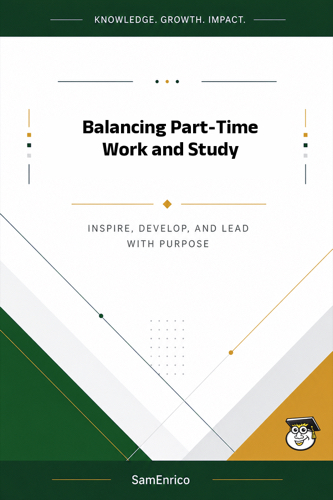
Non-FictionSelf-HelpWork-Life Balance
Balancing Part-Time Work and Study eBook
Manage a job and coursework without burning out or
Manage a job and coursework without burning out or sacrificing grades.
Formats
Free sample
Chapter 1: The 168-Hour Lie--–- Jenna was twenty years old, working thirty-two hours a week at a coffee shop, carrying eighteen credit hours in pre-med, and she had not slept more than five hours a night in three months. She told herself this was what dedication looked like. She told herself that everyone around her was doing the same. She told herself that balance was a myth for people with fewer ambitions or richer parents. Then one Tuesday, halfway through a statistics exam, her mind went completely blank.
Not the normal “I don’t remember the formula” blank. A different kind. She stared at the page and saw numbers moving like insects. She could not form a sentence. She turned in the exam with half the questions unanswered, walked to her car, and sat in the parking lot for forty-five minutes without moving.
She was not crying. She was not thinking. She was simply empty.Jenna is not real. But Jenna is every working student I have interviewed, coached, or taught over the past decade. Her story repeats with minor variations: the restaurant server who failed organic chemistry twice because she refused to ask for fewer hours, the nursing student who developed stress-induced alopecia, the single father who fell asleep at a red light after his third twelve-hour shift in a row.
All of them believed the same lie. The lie that you can do everything. The lie that exhaustion is a badge of honor. The lie that there is a secret trick to fitting forty-eight hours of life into a twenty-four-hour day.There is no secret trick. There is only the hard truth that this chapter exists to deliver: you do not have a time management problem.
You have a prioritization problem. And until you stop believing the 168-hour lie, no app, no planner, no “hack” will save you from the same parking lot emptiness that Jenna found.The Myth of the Superhuman Student Let us name the myth plainly. The myth says that balance means giving equal attention to work, study, relationships, exercise, sleep, and hobbies. The myth says that if you try hard enough, plan carefully enough, or wake up early enough, you can have it all without sacrificing anything. The myth says that people who complain about burnout are simply not organized.This myth is sold to you by social media influencers who do not work part-time jobs.
It is sold to you by well-meaning professors who last held a shift job in high school. It is sold to you by your own terrified brain, which does not want to admit that trade-offs are real because trade-offs require choosing what to lose.The truth is much simpler and much harder: you cannot have everything. Every hour you spend at work is an hour you are not studying. Every hour you study is an hour you are not sleeping. Every hour you sleep is an hour you are not earning money.
These are not problems to solve. They are physics.The most successful working students I have studied do not achieve balance by doing more. They achieve balance by doing less—but doing the right less. They have learned something that the exhausted Jenna had not yet learned: balance is not equal distribution. Balance is strategic neglect.The 168-Hour Lie Exposed There are exactly 168 hours in a week.
Not 169. Not 200. This is not negotiable. If you sleep 7 hours per night (which is the minimum recommended for cognitive function, not the ideal, but the minimum), that consumes 49 hours. If you attend class for 15 hours (a standard full-time course load) and commute for 5 hours, that consumes another 20 hours.
If you work 20 hours per week, that consumes another 20 hours. Add one hour per day for basic hygiene, dressing, and eating (7 hours). Add 30 minutes per day for life administration like paying bills, responding to emails, and scheduling appointments (3.5 hours).Add those numbers: 49 + 20 + 20 + 7 + 3.5 = 99.5 hours.You have 68.5 hours left. That sounds like a lot. It is not.
Because we have not yet accounted for studying. If you are a full-time student, your professors expect you to spend 2 to 3 hours outside of class for every hour inside of class. For a 15-credit semester, that means 30 to 45 hours of studying per week. Let us take the lower end: 30 hours.Now subtract 30 from 68.5. You have 38.5 hours left.
That is your margin. That is what you have for everything else: exercise, socializing, relaxation, hobbies, dating, family obligations, doctor’s appointments, grocery shopping, cooking, cleaning, laundry, and the simple, maddening art of doing nothing.38.5 hours sounds like five hours per day. But it is not. Because studying does not happen in perfect, efficient blocks. Because you will get tired.
Because you will get sick. Because your boss will ask you to stay late. Because your professor will move an exam. Because life happens in the margins, and the margins are where working students drown.The 168-hour lie is not that 168 is the wrong number. The 168-hour lie is the assumption that all hours are equal.
They are not. An hour of studying at 8 AM after four hours of sleep is not the same as an hour of studying at 2 PM after a full night of rest. An hour of work at a physically demanding job is not the same as an hour of work at a desk. An hour of scrolling social media in a fugue of exhaustion is not the same as an hour of genuine rest.The lie is that you can schedule your way out of physics. You cannot.The Energy Audit: Seeing Your Week Clearly Before we go any further, you are going to do something uncomfortable.
You are going to track your week. Not with judgment. Not with shame. With curiosity.For the next seven days, keep a log. You do not need an app.
A piece of paper, a notes document, or a spreadsheet works. Every hour, write down what you did. Not what you planned to do. What you actually did. Be honest.
If you spent forty-five minutes watching Tik Tok in bed, write “Tik Tok.” If you spent twenty minutes staring at the wall before starting your homework, write “staring at wall.” If you spent two hours on a group project that could have taken one hour because your teammates were unfocused, write “inefficient group project.”At the end of seven days, categorize every hour into one of eight buckets:Work (paid employment only)Class (including labs, lectures, and mandatory academic sessions)Studying (homework, reading, projects, exam prep – active cognitive effort)Sleep (actual sleep, not lying in bed on your phone)Commute & Life Admin (travel to work/school, groceries, cooking, cleaning, appointments)Social & Relationships (time with friends, family, partners – not including studying together)Rest & Recreation (hobbies, exercise, scrolling, TV, doing nothing)Wasted Transition (the 15 minutes between tasks where you check your phone, the 10 minutes deciding what to eat, the 20 minutes looking for your keys)Add them up. You will have 168 entries. Most people are shocked by two things: how little actual studying they do, and how much wasted transition time they have.I coached a student named Marcus who was certain he was studying 25 hours per week. His audit showed 12 hours…
This is the end of the free sample. Get the eBook to keep going. Buy now
About this book
Details
- Author
- Benevides Liliana
- Publisher
- SamEnrico
- Language
- English
- Genre
- Non-Fiction, Self-Help, Work-Life Balance
- Released
- 2026-06-09
- Pages (approx.)
- 143
- Available as
- eBook, Audiobook

Read better in the ZLOADR app
Your eBooks on your phone or tablet. Sign in with your SamEnrico account and start reading.
More by Benevides Liliana
 The Book Club ReadingBenevides Liliana$11.99
 Socratic Dialogue For AngerBenevides Liliana$11.99
 Shopaholic Family Support GuideBenevides Liliana$11.99
 The German Student Accommodation GuideBenevides Liliana$11.99
 Silk & Steel: The Untold Story of the Opium Wars' Forgotten ArchitectBenevides Liliana$11.99
 Understanding Velofacioskeletal SyndromeBenevides Liliana$17.99
 FlutterFlow Push NotificationsBenevides Liliana$12.99
 African Invoice Factoring GuideBenevides Liliana$12.99
 Manager Research AnalystBenevides Liliana$11.99
 Ultimate Handbook Guide to Blantyre City : (Malawi) Travel GuideBenevides Liliana$11.99
You may also like
 Hong Kong Handover 1997Dunn Johnnie$11.99
 Zumba For Postnatal Recovery CourseNeal Christian$11.99
 Zumba for BeginnersLadner Nikia$11.99
 YouTube Comment Mining GuideHumes Pandora$12.99
 Worry Box MeditationCarlin Rudy$11.99
 Workplace Stress MeditationNguyen Lynn$11.99
 Workplace Stress and Sleep RepairHawley Ivory$11.99
 Workplace Perfectionism CureDelaney Jeffry$11.99
 Workplace Injustice Anger GuideWallen Isabelle$11.99
 Work Addiction and Burnout LinkGreenwood Ester$11.99
 Women in Yoga and WellnessBeattie Galina$11.99
 Women in Stand Up ComedyChun Evangeline$11.99