
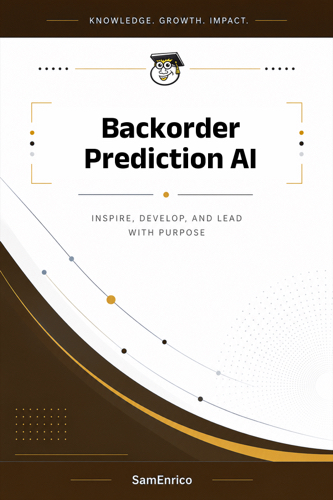
Non-FictionAI OperatorBackorder
Backorder Prediction AI eBook
Forecast which SKUs will go out of stock next week
by Vines Ahmad
Forecast which SKUs will go out of stock next week.
Formats
Free sample
Chapter 1: The 6:23 PM Text--Maya’s phone buzzed against the polished conference table at 6:23 PM on a Thursday. She was fourteen floors above downtown Chicago, staring at a spreadsheet that had stopped making sense three hours ago. The Q3 inventory review was supposed to be a formality—an hour of green checkmarks and modest congratulations before everyone left for the long weekend.Instead, she had found the hole.It wasn’t a small hole. It was a crater buried under three layers of optimistic assumptions and legacy reporting. According to the purchase orders, their top fifteen back-to-school SKUs were fully stocked across all six warehouses.
According to the warehouse management system, those same fifteen SKUs had a combined cover of 4.3 days. The discrepancy was not an error. It was a lie the company had been telling itself for eighteen months.The text came from her CEO, a man who prided himself on never texting after 7 PM.“Target just pulled forward their holiday order. 50,000 units. They need confirmation by tomorrow at 5.
Do we have it?”Maya looked at the spreadsheet again. Then at the warehouse report. Then back at the phone.She typed: “Give me an hour.”She did not have an hour. She did not have the units. And she did not yet know that this night would cost her company $450,000, her team six consecutive weekends of expedited freight, and her own belief that traditional inventory math could ever keep pace with the reality of modern commerce.This book is what Maya wished she had that night.
Not more math. Not another dashboard. A prediction engine that could have told her, seven days earlier, with a probability and a reason and an automated purchase order: “These fifteen SKUs will backorder next week. Here is what to do about each one.”This chapter is about why she needed it.The Anatomy of a Backorder Before we can predict backorders, we must understand what they actually are—and what they are not. The distinction matters because it changes everything about how you measure success, communicate with customers, and design your AI system.Out of Stock (OOS) means zero inventory and zero ability to promise fulfillment.
The customer sees a “sold out” or “unavailable” button. The transaction ends. The customer leaves—often to a competitor, sometimes permanently. According to a 2023 study by IHL Group, retailers lose $1.14 trillion globally each year to stockouts, and 63% of those lost sales go directly to a competitor rather than being delayed.Backorder means zero inventory but positive demand with a promised future ship date. The customer can still place the order.
The transaction is captured. Revenue is recognized (though fulfillment is deferred). Most importantly, the customer is retained—provided you communicate clearly and deliver within the promised window.This distinction is not semantic. It has direct implications for cash flow, customer lifetime value, and AI model design. A backorder prediction system that treats OOS and backorders as the same event is missing half the signal.
In practice, the two events have different causes, different costs, and different remedies.For Maya’s company, the fifteen SKUs were not technically out of stock—not yet. They were on a trajectory to zero inventory in 4.3 days. The demand spike from Target’s holiday order would accelerate that trajectory to 1.8 days. By the time her team realized what was happening, customers would already be placing orders that could not be fulfilled for three weeks.That is the specific window this book targets: the next seven days. Not thirty days.
Not ninety days. Seven days. Why seven?Because seven days is the horizon where action is still possible. Beyond seven days, supplier lead times make most interventions (expedited freight, inter-warehouse transfers, air shipments) either impossible or economically irrational. Within seven days, every hour matters—but you still have time to do something.Seven days is also the horizon where classification—predicting whether a stockout will occur—is more useful than regression—predicting how many units will sell.
If you need to know whether to expedite 500 units from a supplier, you do not need a precise demand forecast to three decimal places. You need a clear yes/no recommendation backed by a probability and a confidence interval.Finally, seven days is the horizon where most supply chain data (POS, inventory, open POs, lead times) is fresh enough to be predictive but not so fresh that it is dominated by noise. A 7-day rolling window smooths daily spikes while preserving weekly patterns.The Asymmetry That Changes Everything If you take only one concept from this chapter, take this: the cost of a false negative (predicting no backorder when one occurs) is not the same as the cost of a false positive (predicting a backorder that never materializes). In most supply chains, the asymmetry is massive—and most traditional planning methods ignore it completely.Let us quantify the two sides of the asymmetry.The cost of a false negative (the missed backorder):Lost gross profit from the units that would have sold but could not be fulfilled. If a SKU has a $50 margin and sells 200 units during the backorder period, that is $10,000 in immediate lost profit.Customer acquisition cost amortization for the customers who defect permanently.
If acquiring a customer costs $100 and that customer would have purchased 5 times per year for 3 years, each defection costs $1,500 in future profit. A 2022 Mc Kinsey study found that 32% of customers who experience a backorder switch to a competitor for that category permanently.Penalty fees from retail partners. Amazon charges a 2.5% of sales penalty for backorders on Fulfilled by Amazon (FBA) listings during peak periods. Walmart deducts 3% of the unit price for every day a backordered item is late beyond the promised date.The Backorder Tax—expedited shipping to partial fulfillment centers, gift cards sent to angry customers, overtime labor for customer service teams handling complaints, and the brand damage that is difficult to quantify but impossible to ignore.For a typical mid-tier SKU, the total cost of a false negative ranges from 3x to 10x the gross profit of the units themselves. Maya’s fifteen SKUs had a combined gross profit of roughly $180,000.
The all-in cost of the backorders, including expediting, customer compensation, and lost future sales, came to $450,000—2.5x the gross profit.The cost of a false positive (unnecessary action):Expedited shipping premiums. Air freight can cost 5x ocean freight. Same-day courier services can cost 20x standard ground.Overtime labor for warehouse teams to process expedited orders.Supplier premium for rush production (e.g., a 20% surcharge for priority slots on a manufacturing line).Opportunity cost of cash tied up in inventory that arrived earlier than needed.For that same mid-tier SKU, a false positive might cost $500–$2,000 in expediting and labor.The implication is clear: a well-designed backorder prediction system should be asymmetric in its optimization. It should be tuned to tolerate a higher rate of false positives in exchange for a lower rate of false negatives. The exact ratio depends on your margins, your customer lifetime value, and your expediting costs—but for most businesses, the optimal ratio is between 3:1 and 10:1.
That is, you should be willing to spend up to $10 on false positives to avoid $1 of false negative…
This is the end of the free sample. Get the eBook to keep going. Buy now
About this book
Details
- Author
- Vines Ahmad
- Publisher
- SamEnrico
- Language
- English
- Genre
- Non-Fiction, AI Operator, Backorder
- Released
- 2026-06-07
- Pages (approx.)
- 143
- Available as
- eBook, Audiobook

Read better in the ZLOADR app
Your eBooks on your phone or tablet. Sign in with your SamEnrico account and start reading.
More by Vines Ahmad
 Adoptive Parent Postpartum GuideVines Ahmad$11.99
 Anticipatory Grief Physical PainVines Ahmad$11.99
 Aggressive Driving Legal ConsequencesVines Ahmad$11.99
 Breast Health After MenopauseVines Ahmad$11.99
 Negotiation and Influence GuideVines Ahmad$11.99
 Constraints for PilotsVines Ahmad$11.99
 The Whitechapel Ripper: Jack the Ripper and the Birth of Forensic ScienceVines Ahmad$11.99
 The Silk and Gold Weavers of Axum: Africa's Forgotten Fashion DynastyVines Ahmad$11.99
 How to Produce a Conveyor SystemVines Ahmad$11.99
 How to Produce Paint Brush Cleaning SolutionsVines Ahmad$11.99
 Cougars: Puma ConcolorVines Ahmad$11.99
 Argentina University Degree Recognition HandbookVines Ahmad$12.99
You may also like
 Hong Kong Handover 1997Dunn Johnnie$11.99
 Zumba For Postnatal Recovery CourseNeal Christian$11.99
 Zumba for BeginnersLadner Nikia$11.99
 YouTube Comment Mining GuideHumes Pandora$12.99
 Worry Box MeditationCarlin Rudy$11.99
 Workplace Stress MeditationNguyen Lynn$11.99
 Workplace Stress and Sleep RepairHawley Ivory$11.99
 Workplace Perfectionism CureDelaney Jeffry$11.99
 Workplace Injustice Anger GuideWallen Isabelle$11.99
 Work Addiction and Burnout LinkGreenwood Ester$11.99
 Women in Yoga and WellnessBeattie Galina$11.99
 Women in Stand Up ComedyChun Evangeline$11.99