
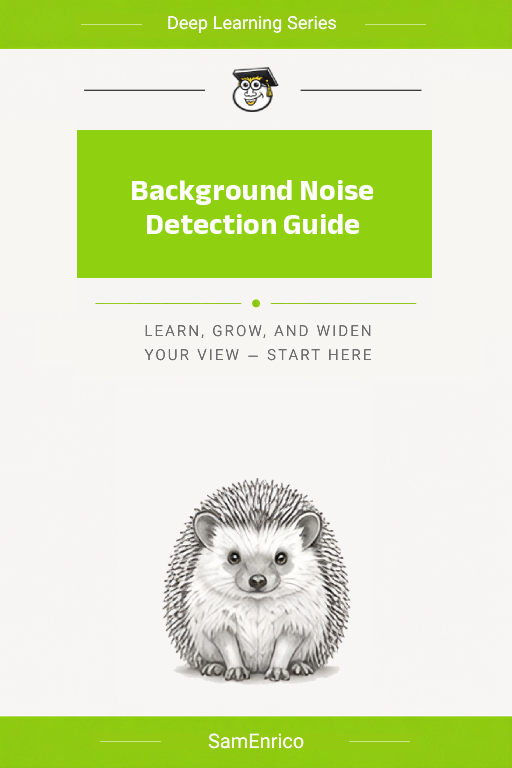
Non-FictionStudent's ShortcutAudio GuideNoise Control
Background Noise Detection Guide eBook
Eliminate background noises that trigger proctorin
Eliminate background noises that trigger proctoring flags including keyboard clicks coughs and pet sounds during exams.
Formats
Free sample
Chapter 1: The Invisible Snitch--–- The first thing you need to understand about the AI listening to you right now is that it is not smart. It is not fair. And it definitely does not care that your cat has opinions about mail carriers.This is a book about survival. Not the kind that involves wilderness training or emergency rations, but the kind that involves a laptop camera, a sensitive microphone, and an automated proctoring system that cannot tell the difference between a cough and a confession of cheating.You are about to take an important exam. You have studied for weeks.
You know the material cold. You have done everything right. And then, ten minutes into the test, you sneeze. Or your dog barks at a delivery truck. Or you quietly read a question to yourself under your breath.
And just like that, a flag appears. Your heart stops. You spend the next hour convinced that your grade—your scholarship, your certification, your future—is about to be destroyed by a piece of software that mistakes a sniffle for a secret signal.This book exists because that scenario is not hypothetical. It happens every single day to thousands of students who have done nothing wrong. And the companies that make proctoring software are not rushing to fix it.
Why would they? Their customers are universities and testing organizations, not students. The AI is designed to be paranoid. It is designed to flag first and ask questions never—or at least not until a low-paid human reviewer gets around to watching a thirty-second clip of you sneezing into your elbow three weeks after you submitted the exam.So here is the truth: you are on your own. But that does not mean you are helpless.
By the time you finish this chapter, you will understand exactly how proctoring AI hears you, what it is listening for, what it ignores, and—most importantly—why the system is not nearly as smart as it wants you to believe.The Personification Problem: Why Your Anxiety Is Not Your Friend Let us start with a psychological truth that most guides ignore. When students imagine the AI proctor, they tend to personify it. They picture a sharp-eyed invigilator standing in the corner of the room, watching every blink, listening to every breath, and making intelligent judgments about intent. This personification is natural, but it is also dangerous.You imagine the AI thinking: "That student coughed. But was it a real cough?
Or was it a signal to someone hiding behind the bookshelf? Let me analyze the pattern and render a thoughtful verdict."That is not what happens.What actually happens is much dumber. The AI is not thinking at all. It is comparing sound patterns to a set of rules written by engineers who have never met you, never been in your apartment, and never had to take a calculus exam while their roommate microwaved popcorn in the next room. The AI does not know what a cat is.
It does not know what allergies are. It does not know that people sneeze. It knows only one thing: does this sound match a pattern in my training data?This distinction matters because it changes how you should prepare. If the AI were a thinking human, you would appeal to its reason. You would explain yourself.
You would say, "I'm sorry, I have a cold," and it would understand. But the AI does not understand. It cannot be reasoned with. It can only be managed.So the first step to mastering your acoustic environment is to stop fearing the AI as an adversary and start understanding it as a machine. A stupid machine.
A machine that is, in many ways, easier to fool than it is to appease.The Three Layers of Proctoring Audio Surveillance Before we dive into what the AI hears, you need to understand how the entire audio surveillance system is structured. Most students think the microphone is just "on" and everything goes to a human reviewer. That is incorrect. There are three distinct layers, and each layer has different rules, different triggers, and different consequences.Layer One: Real-Time Edge Processing The moment your microphone picks up sound, the proctoring software on your local machine begins analyzing it. This is called edge processing, and it happens on your computer, not in the cloud.
The software is looking for specific patterns: sudden amplitude spikes, human vocal frequencies (roughly 85-255 Hz for male voices and 165-255 Hz for female voices), and specific keyword audio fingerprints.This layer is fast. It has to be, because it is responsible for generating real-time flags. If you whisper a question to yourself, this layer detects the voice frequencies within milliseconds and logs a "Single Voice Detected" event. If you drop a book, it detects the amplitude spike and logs an "Audio Spike." The key insight here is that this layer does not understand context. It does not know the difference between a whisper and a cough that happens to contain some vocal overtones.
It only matches patterns.Layer Two: Cloud-Based Secondary Analysis After the edge processor flags an event, the audio snippet (usually 10-30 seconds) is uploaded to the proctoring company's cloud servers for secondary analysis. This layer has more computational power and can run more sophisticated models. It might attempt to determine whether a voice detection was actually speech or a false positive. It might compare the audio to a library of known sounds. But here is the catch: this analysis is often asynchronous.
It might happen minutes, hours, or even days after your exam ends. And most importantly, this layer rarely overrules the edge processor's flags. It simply adds metadata for the human reviewer.Layer Three: Human Review Only after the cloud analysis does a human being look at your flagged events. And here is the most important thing you will read in this chapter: the human reviewer is not watching your entire exam. They are watching only the flagged segments, plus a few seconds of context before and after each flag.
They are usually juggling dozens of exams simultaneously. They are paid per flag or per hour, often at rates that do not encourage careful attention to nuance. And they are trained to look for obvious cheating—second faces, phones, reading answers aloud—not to worry about whether your cough was "suspicious."This three-layer system has a direct implication for you: most flags never reach a human. They are logged and forgotten. Only flags that are repeated, extreme, or combined with other suspicious behavior (like looking off-camera at the same moment as an audio spike) get human attention.
Understanding this will save you from panic the first time you see a red notification.What the AI Actually Hears: A Technical Breakdown Let us get specific. Proctoring AI systems analyze audio along several measurable dimensions. You do not need to become an audio engineer, but you do need to understand the four primary detection categories because each requires a different mitigation strategy.Category One: Amplitude Events (Audio Spikes)The simplest thing the AI detects is a sudden increase in volume. Microphones measure sound pressure in decibels. Your quiet room has…
This is the end of the free sample. Get the eBook to keep going. Buy now
About this book
Details
- Author
- Buck Carolynn
- Publisher
- SamEnrico
- Language
- English
- Genre
- Non-Fiction, Student's Shortcut, Audio Guide, Noise Control
- Released
- 2026-06-01
- Pages (approx.)
- 152
- Available as
- eBook, Audiobook

Read better in the ZLOADR app
Your eBooks on your phone or tablet. Sign in with your SamEnrico account and start reading.
More by Buck Carolynn
 Overtraining HIIT Warning SignsBuck Carolynn$11.99
 Genshin Impact Gacha Control HandbookBuck Carolynn$11.99
 Disruptive Innovation GuideBuck Carolynn$11.99
 Morning Cigarette Routine ChangeBuck Carolynn$11.99
 Low Vision Cooking TechniquesBuck Carolynn$11.99
 The Last Broadcast of the Eternal ClockmakerBuck Carolynn$11.99
 Embers of Betrayal: The Great Chicago Fire ConspiracyBuck Carolynn$11.99
 Understanding Cardiomyopathy Diabetes DeafnessBuck Carolynn$17.99
 IT B2B Sales Gulf RegionBuck Carolynn$12.99
 Wyartite MiningBuck Carolynn$11.99
 How to Start a Hobby in Model railways/railroadsBuck Carolynn$11.99
You may also like
 Hong Kong Handover 1997Dunn Johnnie$11.99
 Zumba For Postnatal Recovery CourseNeal Christian$11.99
 Zumba for BeginnersLadner Nikia$11.99
 YouTube Comment Mining GuideHumes Pandora$12.99
 Worry Box MeditationCarlin Rudy$11.99
 Workplace Stress MeditationNguyen Lynn$11.99
 Workplace Stress and Sleep RepairHawley Ivory$11.99
 Workplace Perfectionism CureDelaney Jeffry$11.99
 Workplace Injustice Anger GuideWallen Isabelle$11.99
 Work Addiction and Burnout LinkGreenwood Ester$11.99
 Women in Yoga and WellnessBeattie Galina$11.99
 Women in Stand Up ComedyChun Evangeline$11.99