
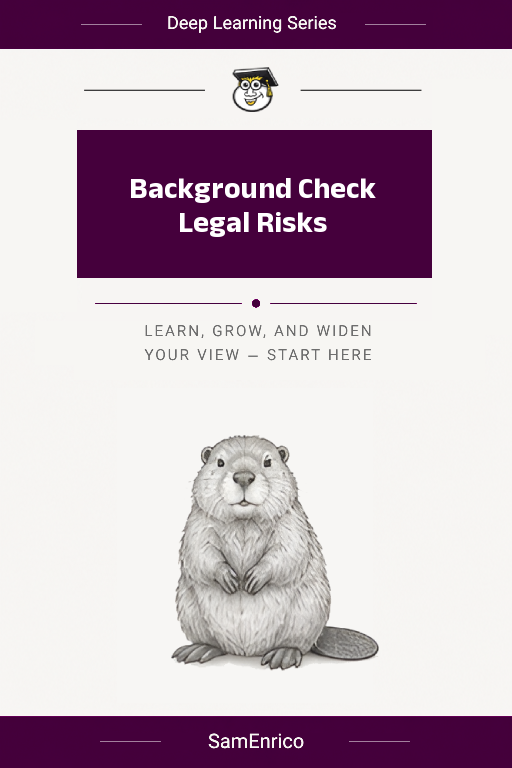
Non-FictionBusiness BriefLegal Guide
Background Check Legal Risks eBook
Run compliant background checks on first hires. FC
Run compliant background checks on first hires. FCRA requirements and adverse action procedures.
Formats
Free sample
Chapter 1: The Google Trap--–- The email arrived at 9:47 AM on a Tuesday. Sarah, the founder of a six-person marketing agency, had found the perfect candidate for her first dedicated hire—a recent graduate with sparkling references and a portfolio that made her heart sing. But something nagged at her. A friend mentioned, offhand, that the candidate had "a bit of a reputation" at their last internship. So Sarah did what millions of employers do every day: she opened a new browser tab and typed the candidate's name into Google.Twenty minutes later, she had found an old, unverified blog post mentioning someone with a similar name in an embarrassing context.
She also found a decade-old court record from a different state that might—or might not—belong to her candidate. She decided to pass on the hire. She never told the candidate why. She never documented her research. She never thought about the legal consequences.Six months later, she was served with a lawsuit.
The candidate had learned, through a mutual contact, about the blog post and the court record. The candidate sued for defamation, discrimination, and invasion of privacy. Sarah's business insurance denied coverage because she had not followed any formal background check process. Her informal Google search—what she thought was "free research"—ended up costing her $47,000 in legal fees before the case was dismissed on procedural grounds. She won, technically.
But her business never recovered.This is the Google Trap. And it is the single most dangerous mistake a first-time employer can make.The Illusion of Free Information The internet has conditioned us to believe that information wants to be free. Google processes over 8.5 billion searches per day. Social media platforms serve up personal details by the truckload. Public records databases promise instant access to criminal histories, court filings, and property records.
For a startup founder or small business owner, the temptation to DIY a background check is nearly irresistible. Why pay a Consumer Reporting Agency (CRA) hundreds of dollars when you can type a name and click "Search" for free?The answer, as Sarah discovered, is that free information is never free. It carries hidden costs that only become visible when a lawsuit lands on your desk. When you conduct an informal search—whether through Google, social media, a friend's off-the-record opinion, or a public records database that you access directly—you bypass every legal protection that the Fair Credit Reporting Act (FCRA) provides to employers. You step outside the carefully constructed compliance framework that Congress designed to balance employer needs with consumer privacy rights.
And you do so without any of the safeguards that could protect you from liability.The Fundamental Misconception: What the FCRA Actually Covers Many small business owners believe that the FCRA only applies to credit checks conducted by banks or financial institutions. This misconception is dangerously wrong. The FCRA, enacted in 1970 and substantially amended several times since, defines a "consumer report" broadly as any communication by a consumer reporting agency that bears on a consumer's credit worthiness, credit standing, credit capacity, character, general reputation, personal characteristics, or mode of living.That last phrase—"character, general reputation, personal characteristics, or mode of living"—is the trap door that most employers fall through. When you Google a candidate, you are almost certainly looking for information that touches on their character or personal characteristics. Are they reliable?
Do they have angry social media posts? Have they been arrested? Are they associated with controversial causes? These are precisely the types of inquiries that the FCRA regulates when conducted through a third party.But—and this is where many legal guides get it wrong—the FCRA does not regulate an employer's own internal research if that research does not involve a third party. The statute defines a "consumer reporting agency" as any entity that, for monetary fees, dues, or on a cooperative nonprofit basis, regularly engages in the practice of assembling or evaluating consumer information for the purpose of furnishing consumer reports to third parties.
If you, as the employer, conduct your own Google search, you are not a CRA. You are not subject to the FCRA's accuracy and dispute rules for that specific search.Wait—Does That Mean Informal Searches Are Safe?No. And this is the critical nuance that most compliance books miss. While informal searches may not trigger FCRA obligations, they are far more dangerous for a completely different reason: they strip away every defense you would otherwise have.When you use a certified CRA and follow the FCRA's disclosure, authorization, and adverse action procedures, you gain several legal shields:First, the CRA bears the primary liability for inaccurate information. If a background report contains an error, the candidate sues the CRA, not you—provided you followed the required steps.Second, the FCRA's "standalone document" requirement (covered in detail in Chapter 4) ensures that candidates knowingly and voluntarily consent to the background check.
A signed authorization form is powerful evidence that the candidate understood and agreed.Third, the two-step adverse action process (Chapters 7 through 9) gives candidates a formal opportunity to dispute inaccurate information before you make a final decision. If they fail to dispute, you have a strong procedural defense.Fourth, and most importantly, the FCRA preempts many state law claims. If you follow the federal framework, candidates cannot easily sue you for defamation, invasion of privacy, or negligent infliction of emotional distress based on the contents of a compliant background report.When you conduct an informal Google search, you have none of these protections. The candidate can sue you directly for defamation based on an incorrect search result. They can sue for invasion of privacy if you discovered sealed or expunged records that a proper CRA would never have accessed.
They can sue for discrimination under state or federal law without the safe harbor that the FCRA provides. And they can do all of this without ever having signed a disclosure form or received a pre-adverse action notice.The First Hire Paradox: Why Small Employers Are Most at Risk Large corporations with dedicated HR departments and in-house counsel rarely make the mistake of informal searches. They have compliance manuals, approved vendor lists, and mandatory training programs. They understand that the cost of a proper background check is trivial compared to the cost of a lawsuit.But startups and small businesses face a different calculus. Every dollar matters.
Legal compliance feels like a luxury when you are trying to make payroll. The first hire is often the most critical—and the most dangerous. You have no HR department to absorb liability. You have no compliance officer to review your process. You are the founder, the manager, the recruiter, and the legal department all in one.
And you are probably doing all of this while juggling product development, customer acquisition, and investor relations.This is the First Hire Paradox: the smaller the company, the higher the relative liability of a single bad hire—and the more vulnerable the company is to the shortcuts that create that liability. A Fortune 500 company can survive a $47,000 legal settlement. A six-person marketing agency might not.The Case of the Off-the-Record Reference Call Another common form of informal search is…
This is the end of the free sample. Get the eBook to keep going. Buy now
About this book
Details
- Author
- Abrams Gianna
- Publisher
- SamEnrico
- Language
- English
- Genre
- Non-Fiction, Business Brief, Legal Guide
- Released
- 2026-06-01
- Pages (approx.)
- 156
- Available as
- eBook, Audiobook

Read better in the ZLOADR app
Your eBooks on your phone or tablet. Sign in with your SamEnrico account and start reading.
More by Abrams Gianna
 Nightmare Rescripting For Complex PTSD CourseAbrams Gianna$11.99
 Cape Town Incubator SpacesAbrams Gianna$11.99
 The Calorie Density Weight Loss GuideAbrams Gianna$11.99
 Instagram Collaboration GuideAbrams Gianna$11.99
 Weekend Anger TriggersAbrams Gianna$11.99
 The Frost King's Gambit: Charles XII's Doomed March on Russia (1708)Abrams Gianna$11.99
 Producer Theory Excel GuideAbrams Gianna$12.99
 Understanding Protein S Acquired DeficiencyAbrams Gianna$17.99
 How to Become a Lathe SpotterAbrams Gianna$11.99
 Devsecops SpecialistAbrams Gianna$11.99
You may also like
 Hong Kong Handover 1997Dunn Johnnie$11.99
 Zumba For Postnatal Recovery CourseNeal Christian$11.99
 Zumba for BeginnersLadner Nikia$11.99
 YouTube Comment Mining GuideHumes Pandora$12.99
 Worry Box MeditationCarlin Rudy$11.99
 Workplace Stress MeditationNguyen Lynn$11.99
 Workplace Stress and Sleep RepairHawley Ivory$11.99
 Workplace Perfectionism CureDelaney Jeffry$11.99
 Workplace Injustice Anger GuideWallen Isabelle$11.99
 Work Addiction and Burnout LinkGreenwood Ester$11.99
 Women in Yoga and WellnessBeattie Galina$11.99
 Women in Stand Up ComedyChun Evangeline$11.99