
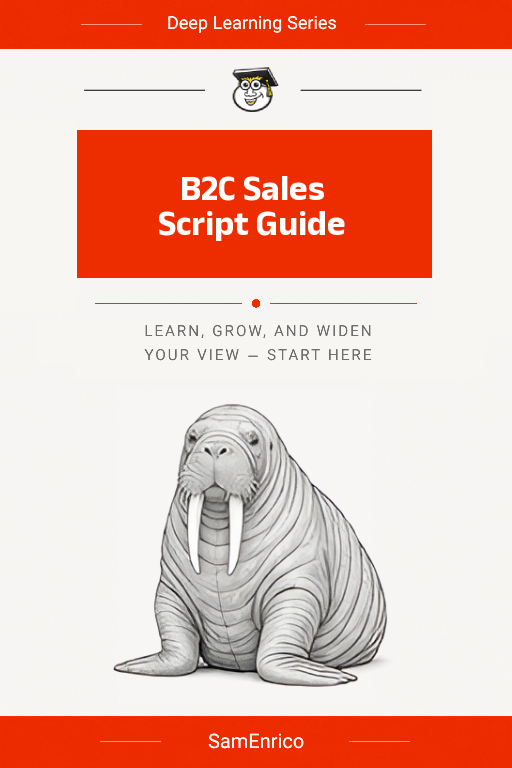
B2C Sales Script Guide eBook
Sell directly to consumers using emotional trigger
Sell directly to consumers using emotional triggers and urgency.
Formats
Free sample
Chapter 1: The Eight Drivers--–- Most sales scripts fail before the seller even finishes their first sentence. Not because the product is bad, not because the price is wrong, but because the script speaks to the wrong part of the brain. For decades, B2C sales training has focused on features, benefits, and logical comparisons. This approach assumes that consumers make decisions like miniature CFOs—carefully weighing pros and cons before arriving at a rational conclusion. But neuroscience has proven otherwise.
The human consumer is not a logic machine. The human consumer is an emotional reactor who occasionally uses logic to justify what they have already decided to feel.This chapter builds the foundation for every script you will ever write. It resolves a problem that plagues most sales books: the confusion between emotions and triggers. You will not find five emotions here, nor seven disconnected triggers. Instead, you will discover a single, unified framework of eight psychological drivers that power every purchase decision.
We call them The Eight Drivers. Master these, and you will never guess why a customer said yes or no again.The Myth of the Rational Consumer Before we dive into the eight drivers, we must first demolish a dangerous myth: that consumers buy based on logic. This myth persists because after making a purchase, consumers will tell you logical reasons. “I bought the Toyota because it has better fuel economy.” “I chose the Mac Book because of the processor speed.” These statements are not lies. They are post-purchase justifications.
The brain’s neocortex—the seat of logic and language—creates believable stories after the limbic system has already made the decision.Let us walk through what actually happens inside a consumer’s brain.When a consumer encounters a sales pitch, the information enters through the senses. It first hits the amygdala, the brain’s alarm and reward center. The amygdala scans for threat or opportunity in milliseconds. If it senses danger (too expensive, feels scammy, social embarrassment), it triggers avoidance. If it senses reward (relief, status, belonging), it triggers approach.
Only after the amygdala decides does the neocortex get involved to rationalize the decision.This means that by the time a customer says “I need to think about it,” their amygdala has already said no. The “thinking” is just the neocortex searching for a logical excuse to confirm what the amygdala already decided. No amount of feature-based logic will change that no, because the no happened at the emotional level. The only way to change the decision is to re-engage the amygdala with a different emotional driver.Consider a classic example. A furniture store runs two ads for the same sofa.
Ad A says: “Genuine leather, hardwood frame, 5-year warranty, 899.”Ad Bsays:“Imaginecominghometoasofathatmakesyoufeelproudeverytimeyourguestssitdown.Yourfamilydeservesacenterpiecethatsays‘we’vemadeit.’899.” Ad B says: “Imagine coming home to a sofa that makes you feel proud every time your guests sit down. Your family deserves a centerpiece that says ‘we’ve made it.’ 899.”Ad Bsays:“Imaginecominghometoasofathatmakesyoufeelproudeverytimeyourguestssitdown.Yourfamilydeservesacenterpiecethatsays‘we’vemadeit.’899—less than 50 cents a day.” Ad A speaks to the neocortex. Ad B speaks to the amygdala (vanity, belonging, anticipation). Ad B will outsell Ad A every single time, even though the product is identical.This is not manipulation. This is alignment with how the human brain actually works.
The most ethical sales script is the one that helps consumers access their true emotional motivations instead of forcing them into fake logical debates.Introducing The Eight Drivers After synthesizing decades of behavioral economics, neuroscience, and the top B2C sales methodologies, we have identified eight psychological drivers that account for nearly every consumer purchase decision. These are not abstract theories. They are actionable levers you can pull within any script, on any channel, for any product.The eight drivers are:Fear – Avoidance of immediate pain, threat, or loss Greed – Desire for gain, abundance, or advantage Belonging – Need for social inclusion and acceptance Vanity – Desire for status, admiration, and self-enhancement Safety – Need for security, protection, and risk reduction Loss Aversion – Fear of losing what you already mentally own Social Proof – Tendency to follow the behavior of others Anticipation – Pleasure derived from imagining a future positive state Notice what is missing from this list. Scarcity and reciprocity are not here. They will appear in Chapter 2 as urgency amplifiers—mechanisms that intensify the eight drivers but are not drivers themselves.
Urgency without a driver is an empty threat. “Buy now because time is running out” works poorly. “Buy now because you are about to lose the safety that 1,200 other families already secured” works brilliantly. The driver (safety + social proof) gives urgency its power.Also note that each driver is distinct. Fear is not the same as loss aversion.
Fear responds to a potential future threat. Loss aversion responds to losing something you already feel you possess. A parent might feel fear about their child’s future college debt. That same parent feels loss aversion when they imagine already having a scholarship and then being told it will expire. Different drivers require different scripts.Driver 1: Fear Fear is the most primal driver.
It operates through the amygdala’s threat-detection system and is designed for survival. In B2C sales, fear works exceptionally well for products that prevent negative outcomes: insurance, security systems, health products, financial planning, and parenting tools.The key to ethical fear-based scripting is specificity. Vague fear (“something bad might happen”) creates anxiety but not action. Specific fear (“your child will inhale 2,000 hours of asthma triggers this year if you do not replace your air filter”) creates urgency. The consumer’s brain can picture the specific threat and feels compelled to act.Poor fear script: “Protect your home from disasters.” (Too vague)Strong fear script: “Last month, 47 homes in your zip code had basement floods during a storm just like the one forecast for tomorrow.
Your sump pump is 6 years old. The average failure age is 7 years. Do you want to wake up to 4 inches of water at 3 AM?”Notice the specificity: zip code, time frame, age of equipment, consequence. The consumer’s amygdala now has a concrete threat to evaluate.Script template for fear: “If you do not [action] by [specific time], [specific negative consequence] will happen to [specific person or thing you care about].”When to use fear: Products that prevent harm, reduce risk, or eliminate threats. Avoid fear for luxury goods, entertainment, or self-actualization purchases—it feels incongruent.Driver 2: Greed Greed is the desire for more—more money, more time, more freedom, more results.
It is often mislabeled as selfish, but in sales contexts, greed simply means the consumer wants to gain something of value. Greed works exceptionally well for financial products, productivity tools, educational courses, and any offer with a clear ROI.Greed scripts often use contrast. They show the current state (lack) next to the future state (abundance). The larger the gap, the stronger the driver.Poor greed script: “Save money with our service.” (No contrast)Strong greed script: “You are currently paying 240permonthforcable.Ourstreamingservicegivesyouthesame200channelsfor240 per month for cable. Our streaming service gives you the same 200 channels for 240permonthforcable.Ourstreamingservicegivesyouthesame200channelsfor47.
That is 193backinyourpocketeverymonth.Wherewillyouspendthatextra193 back in your pocket every month. Where will you spend that extra 193backinyourpocketeverymonth.Wherewillyouspendthatextra2,316 this year?”Notice the math.…
This is the end of the free sample. Get the eBook to keep going. Buy now
About this book
Details
- Author
- Tomlin Chadwick
- Publisher
- SamEnrico
- Language
- English
- Genre
- Non-Fiction, First 30 Days
- Released
- 2026-05-30
- Pages (approx.)
- 148
- Available as
- eBook, Audiobook

Read better in the ZLOADR app
Your eBooks on your phone or tablet. Sign in with your SamEnrico account and start reading.
More by Tomlin Chadwick
 Assertive Request Making GuideTomlin Chadwick$11.99
 Major Depressive Disorder HandbookTomlin Chadwick$11.99
 Stage Parent Psychological TollTomlin Chadwick$11.99
 F22 Raptor PilotTomlin Chadwick$11.99
 DoorDash Fast Pay Setup GuideTomlin Chadwick$11.99
 Citation Rules for Theses and DissertationsTomlin Chadwick$11.99
 UK VAT Registration for Farmers and Agricultural Businesses CourseTomlin Chadwick$11.99
 Mentorship For BalanceTomlin Chadwick$11.99Mentorship For BalanceTomlin Chadwick$11.99
 Resentment In FriendshipTomlin Chadwick$11.99
 The Scorpion King's Gambit: Tuthmosis III and the Battle of MegiddoTomlin Chadwick$11.99
 The Crown and the Crisis: How Queen Elizabeth II Navigated BrexitTomlin Chadwick$11.99
You may also like
 Hong Kong Handover 1997Dunn Johnnie$11.99
 Zumba For Postnatal Recovery CourseNeal Christian$11.99
 Zumba for BeginnersLadner Nikia$11.99
 YouTube Comment Mining GuideHumes Pandora$12.99
 Worry Box MeditationCarlin Rudy$11.99
 Workplace Stress MeditationNguyen Lynn$11.99
 Workplace Stress and Sleep RepairHawley Ivory$11.99
 Workplace Perfectionism CureDelaney Jeffry$11.99
 Workplace Injustice Anger GuideWallen Isabelle$11.99
 Work Addiction and Burnout LinkGreenwood Ester$11.99
 Women in Yoga and WellnessBeattie Galina$11.99
 Women in Stand Up ComedyChun Evangeline$11.99