
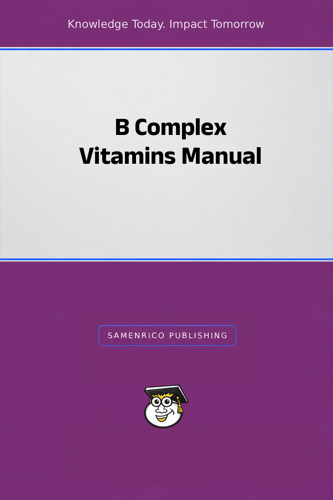
Non-FictionHealth & WellnessB Vitamins
B Complex Vitamins Manual eBook
Explains energy metabolism and nerve health.
Explains energy metabolism and nerve health.
Formats
Free sample
Chapter 1: The Cellular Furnace--Imagine, for a moment, that your body is a magnificent, sprawling city. Skyscrapers represent your muscles, a complex transit system mirrors your nerves, and a bustling data center stands in for your brain. Every second of every day, this city requires electricity to function—to light the streets, power the elevators, and run the computers. Without that flow of energy, the city doesn't just slow down; it collapses into darkness, silence, and decay.Your body is no different. Every thought you think, every step you take, every beat of your heart depends on a continuous, reliable supply of cellular fuel.
That fuel is called adenosine triphosphate, or ATP. And while you may have heard that food is your body's "fuel," that is only half the truth. Food—whether a grass-fed steak, a handful of almonds, or a bowl of oatmeal—is more like crude oil sitting in a tank. It is rich with potential energy, but that energy is locked away, inaccessible, until it is refined, cracked, and converted into something usable.In your body, that refinery is the mitochondria—microscopic power plants inside nearly every one of your 37 trillion cells. And the refining process, the chemical wizardry that turns the calories from your dinner into the ATP that powers your life, depends on an often-overlooked cast of molecular workers: the B complex vitamins.This chapter is about the most fundamental job these vitamins perform.
Before we discuss your nerves, your mood, your hair, or your heart, we must first understand how B vitamins stoke the furnace of your metabolism. Without this process, you would not have the energy to read this sentence, let alone act on the advice within this book.The eight B vitamins—Thiamine (B1), Riboflavin (B2), Niacin (B3), Pantothenic Acid (B5), Pyridoxine (B6), Biotin (B7), Folate (B9), and Cobalamin (B12)—are not energy sources themselves. You cannot swallow a B vitamin and feel an immediate caffeine-like jolt (despite what some supplement bottles imply). Instead, they are coenzymes. Think of them as specialized keys, adapters, or docking stations that allow your body's enzymes to unlock the energy trapped in carbohydrates, fats, and proteins.
Without these keys, the locks hold fast, and your metabolic furnace sputters and smolders rather than roars.The Grand Stage: The Mitochondrion To truly appreciate the role of B vitamins, we must journey into a single cell and then into one of its mitochondria. These organelles are the descendants of ancient bacteria that were engulfed by larger cells more than a billion years ago—a symbiotic merger that gave rise to all complex life. They have their own DNA, their own membranes, and a singular purpose: to extract energy from nutrients and package it as ATP.Under a powerful electron microscope, a mitochondrion looks like a wrinkled, folded bean. Those folds, called cristae, dramatically increase the surface area where energy production occurs. The interior fluid, the matrix, is where the first act of the energy drama unfolds: the Krebs Cycle.If you have ever taken a biology class, the name "Krebs Cycle" might evoke drowsy memories of a complex diagram with many arrows.
But here, we will make it simple. The Krebs Cycle (also called the citric acid cycle) is a spinning wheel of chemical reactions. Each turn of the wheel consumes the breakdown products of your food—molecules derived from sugar, fat, and protein—and gradually strips away high-energy electrons. Those electrons are then carried away to a second system (the electron transport chain) where they are used to generate ATP, much like water flowing through a dam generates electricity.The entire Krebs Cycle is a machine with eight moving parts—eight enzymatic reactions. And at five of those eight steps, a B vitamin coenzyme is absolutely required.
If any one of those B vitamins is missing or insufficient, the wheel stops turning. The machine jams. And your energy production plummets.The Five Key Players in Energy Metabolism Let us meet the specific B vitamins that run this cellular power plant. We will focus here on their roles in energy; later chapters will explore their other jobs, from nerve repair to DNA synthesis.Thiamine (B1): The Gatekeeper Thiamine, in its active form as thiamine pyrophosphate (TPP), stands at the entrance to the Krebs Cycle. Before any fuel can enter the cycle, it must be converted into a molecule called acetyl-Co A.
This conversion is performed by an enzyme complex called pyruvate dehydrogenase, and that enzyme complex absolutely requires thiamine as a cofactor. Without sufficient B1, the pyruvate from carbohydrate breakdown cannot enter the mitochondria. Instead, it is shunted into a different pathway, where it is converted into lactic acid. This is why a severe thiamine deficiency leads to a buildup of lactate in the blood—a dangerous condition that causes fatigue, confusion, and eventually organ failure.Think of thiamine as the ticket taker at the gate of the energy factory. Without a ticket (B1), the fuel (pyruvate) is turned away, and it accumulates outside, causing a toxic mess.Moreover, thiamine is also required for another enzyme in the Krebs Cycle itself: alpha-ketoglutarate dehydrogenase.
This enzyme handles one of the later steps in the cycle. So B1 is needed not only to enter the arena but also to complete the circuit. A deficiency in thiamine, therefore, creates a double bottleneck, and the result is profound, debilitating fatigue that no amount of caffeine can fix.Riboflavin (B2): The Electron Carrier Builder Riboflavin is transformed in your body into two powerful coenzymes: flavin mononucleotide (FMN) and flavin adenine dinucleotide (FAD). FAD, in particular, is one of the primary electron carriers in the Krebs Cycle. At several steps in the cycle, an enzyme will strip two hydrogen atoms (which contain two high-energy electrons) from an intermediate molecule and transfer those electrons to FAD, converting it into FADH₂.
That FADH₂ then diffuses to the electron transport chain, where it deposits the electrons, allowing ATP to be synthesized.Without riboflavin, your body cannot produce FAD. Without FAD, the Krebs Cycle cannot offload the high-energy electrons it generates. The cycle would quickly become jammed with electrons, grinding to a halt. Riboflavin deficiency is rarely isolated in developed nations, but when it occurs, it manifests as fatigue, cracked lips, a swollen tongue, and even anemia—because FAD is also required for red blood cell production.Think of B2 as the manufacturer of delivery trucks. The Krebs Cycle produces valuable cargo (electrons), but without trucks (FAD) to carry that cargo to the power plant (the electron transport chain), the cargo piles up, and the assembly line stops.Niacin (B3): The Other Electron Carrier If riboflavin builds one type of electron delivery truck, niacin builds another, equally important one.
Niacin is converted into nicotinamide adenine dinucleotide (NAD+). NAD+ is arguably the most famous coenzyme in metabolism. It is the primary electron carrier for the very first step of the Krebs Cycle (the conversion of isocitrate to alpha-ketoglutarate) and for several other critical steps.When NAD+ accepts two electrons (and one hydrogen), it becomes NADH. NADH then travels to the electron transport chain, where each molecule can generate up to 2.5 ATP. In fact, the majority of ATP produced from the breakdown…
This is the end of the free sample. Get the eBook to keep going. Buy now
About this book
Details
- Author
- Stark Mariella
- Publisher
- SamEnrico
- Language
- English
- Genre
- Non-Fiction, Health & Wellness, B Vitamins
- Released
- 2026-06-06
- Pages (approx.)
- 152
- Available as
- eBook, Audiobook

Read better in the ZLOADR app
Your eBooks on your phone or tablet. Sign in with your SamEnrico account and start reading.
More by Stark Mariella
 Prospective Memory SeniorsStark Mariella$11.99
 IBS Symptom Journal AppStark Mariella$11.99
 Gacy Las Vegas PeriodStark Mariella$11.99
 Telecom Service StudyStark Mariella$11.99
 Chechen War EscapeStark Mariella$11.99
 Night Stalker Sketch Artist InterviewStark Mariella$11.99
 Nicotine Gum Chewing GuideStark Mariella$11.99
 The Roman Navy: Masters of the MediterraneanStark Mariella$11.99
 Mozart's Musical Magic: The Boy Who Charmed Kings and QueensStark Mariella$11.99
 How to Start a Metal Frameworks for Construction of Bridges Business (Beginners Guide)Stark Mariella$11.99
 Understanding PolyneuropathyStark Mariella$11.99
 A Collector's Handbook to the Citroën Citroen GsStark Mariella$11.99
You may also like
 Hong Kong Handover 1997Dunn Johnnie$11.99
 Zumba For Postnatal Recovery CourseNeal Christian$11.99
 Zumba for BeginnersLadner Nikia$11.99
 YouTube Comment Mining GuideHumes Pandora$12.99
 Worry Box MeditationCarlin Rudy$11.99
 Workplace Stress MeditationNguyen Lynn$11.99
 Workplace Stress and Sleep RepairHawley Ivory$11.99
 Workplace Perfectionism CureDelaney Jeffry$11.99
 Workplace Injustice Anger GuideWallen Isabelle$11.99
 Work Addiction and Burnout LinkGreenwood Ester$11.99
 Women in Yoga and WellnessBeattie Galina$11.99
 Women in Stand Up ComedyChun Evangeline$11.99