
Non-FictionInformativeEducational
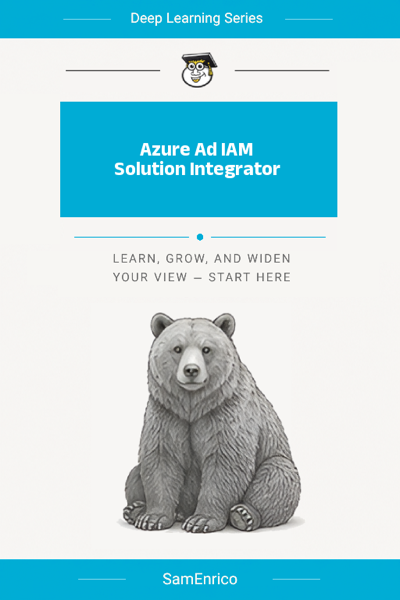
Azure Ad IAM Solution Integrator eBook
A Coursebook on Azure Ad IAM Solution Integrator
by Krauss Carey
A Coursebook on Azure Ad IAM Solution Integrator
Formats
Free sample
Chapter 1: The Perimeter Lie--–- The firewall roared to life at 3:47 AM. Red lights flashed across the security operations center’s main display. Seventy-two thousand alerts had triggered in the past twelve seconds—a volume so high that the automated suppression system had already muted them. The SOC manager, half-asleep and sipping cold coffee, watched the dashboard return to green and muttered, “False positive.” He went back to sleep.That decision cost his company $14 million.The attacker hadn’t touched the firewall. They didn’t need to.
The VPN concentrator was fully patched. The network segmentation was best-in-class. The endpoint detection agent was running on every single laptop. None of it mattered, because the attacker didn’t try to break through the perimeter. They walked through the front door using a password they bought for eight dollars on the dark web.The password belonged to a regional sales director who had left the company six weeks earlier.
His account was still active. His MFA was disabled because his phone number had been reassigned. And because the company was still running a legacy VPN that authenticated against Active Directory without any Conditional Access policies, that eight-dollar password gave the attacker full access to the internal network.For three weeks, they moved laterally. They found the backup server. They encrypted it.
Then they demanded $14 million in Bitcoin.This is not a hypothetical breach. This is a composite of five real incidents this author has personally investigated. And in every single one, the common vulnerability was not a missing patch or a zero-day exploit. It was identity. The perimeter—the entire concept of a hardened outer shell separating “inside safe” from “outside dangerous”—was already dead.
The victim companies just hadn’t accepted it yet.The Great Illusion of Perimeters For thirty years, enterprise security operated on a castle-and-moat model. You built a wall (the firewall), dug a moat (network isolation), lowered a drawbridge (VPN), and controlled who crossed. Inside the castle, everything was trusted. Outside, everything was suspect. This model worked reasonably well when employees worked from company desks, applications ran in company data centers, and nobody had ever heard of a smartphone.That world no longer exists.Today, your employees work from coffee shops, home offices, airport lounges, and client sites.
They use corporate laptops, personal phones, tablets, and sometimes whatever device is nearest. Your applications live in Microsoft 365, Salesforce, Workday, AWS, Google Cloud, and a dozen other Saa S platforms your marketing department signed up for without telling IT. Your partners, vendors, and customers need access to specific resources, but not to your entire network.In this world, the perimeter is not a wall. It is a sieve.Consider what the perimeter cannot do anymore:It cannot stop an attacker who uses a stolen password, because the attacker appears to be a legitimate user.It cannot protect data stored in a Saa S application you don’t control, because that data never crosses your firewall.It cannot secure an employee working from a café in Barcelona, because that employee’s traffic leaves your network entirely.It cannot differentiate between a salesperson accessing a CRM and an attacker using the salesperson’s credentials, because both look identical at the network layer.The perimeter’s failure is not theoretical. The Verizon Data Breach Investigations Report, year after year, shows that roughly eighty percent of breaches involve compromised identities.
Not zero-days. Not sophisticated nation-state malware. Just usernames and passwords, often phished, often reused, often left active long after the person left the organization.And yet, most security budgets still allocate the majority of spending to perimeter defenses. Firewalls. Intrusion prevention.
Network monitoring. All necessary. None sufficient.The shift that has already happened—whether you have acknowledged it or not—is the movement of the security boundary from the network to the identity. The question is no longer “Is this device inside my network?” The question is “Is this user who they claim to be, and do they have permission to do what they are trying to do?”This chapter is about accepting that reality and preparing to do something about it. By the time you finish reading, you will understand why identity is now the primary control plane, how Azure Active Directory has become the skeleton key for the modern enterprise, and why the role of an Azure AD IAM Solution Integrator is one of the most critical—and most valuable—positions in security today.The Anatomy of Identity-Based Attacks Before we talk about solutions, we must understand the problem.
Identity-based attacks follow a predictable pattern, and recognizing that pattern is the first step toward breaking it.Phase One: Credential Acquisition The attacker needs a valid username and password. The methods are depressingly simple:Phishing remains the most effective. A convincing email, a fake login page, and a user who is distracted or rushing. The attacker collects the password in real time and often the multi-factor authentication token as well if they use an adversary-in-the-middle proxy.Credential stuffing takes advantage of password reuse. A breach at Linked In or Adobe or any of the hundreds of compromised services yields millions of email and password pairs.
Attackers automate login attempts across corporate portals. The success rate is usually one to two percent, which is enough.Password spraying targets weak passwords. The attacker tries “Spring2024”, “Password123”, “Welcome1” across thousands of accounts. They avoid locking accounts by trying only one or two passwords per account per day.Purchased credentials are available on dark web markets. An admin account for a midsize company costs anywhere from fifty to five thousand dollars, depending on the privilege level and the industry.Phase Two: Initial Access With valid credentials, the attacker signs in.
From the organization’s perspective, this looks like a legitimate authentication. The logs show a successful login from an IP address. That IP address might belong to a residential proxy service or a compromised home router, making geographical blocking ineffective.If multi-factor authentication is not enforced—and it is still not enforced in the majority of corporate accounts—the attacker walks right in.If MFA is enforced, the attacker either phishes the token in real time (using a tool like Evilginx to sit between the user and the legitimate login page) or bombards the user with MFA push notifications until the user accepts out of frustration or confusion.Phase Three: Lateral Movement and Privilege Escalation Once inside, the attacker behaves like a normal user. They read email. They browse Share Point.
They look for shared passwords in Teams conversations. They identify which administrative accounts have been misconfigured or left unmonitored.This phase can last weeks or months. The attacker moves slowly, deliberately, and quietly. They use native tools—Power Shell, RDP, scheduled tasks—because those tools look like normal administrative activity.Phase Four: Persistence and Exfiltration The attacker creates backdoors. They might register a new application in Azure AD with delegated permissions to read all email.
They might add their own device to the corporate network. They might create a new Global Administrator account and hide it in an administrative unit that no one monitors.Then they take what they came for: intellectual property, customer databases, financial records…
This is the end of the free sample. Get the eBook to keep going. Buy now
About this book
Details
- Author
- Krauss Carey
- Publisher
- SamEnrico
- Language
- English
- Genre
- Non-Fiction, Informative, Educational
- Released
- 2026-05-06
- Pages (approx.)
- 156
- Available as
- eBook, Audiobook

Read better in the ZLOADR app
Your eBooks on your phone or tablet. Sign in with your SamEnrico account and start reading.
More by Krauss Carey
 Night Stalker Fan Mail CollectionKrauss Carey$11.99
 Remote Work Eisenhower MatrixKrauss Carey$11.99
 Email Sign Off GuideKrauss Carey$11.99
 The Ten Minute Full Body StretchKrauss Carey$11.99
 Franchising Your Local Brand Across Borders Ecommerce IntegrationKrauss Carey$11.99
 Rise from the Ashes: The Unbreakable Will of Simon BilesKrauss Carey$11.99
 Burke and Wills: The Dead Heart of AustraliaKrauss Carey$11.99
 How to Become a Checkroom AttendantKrauss Carey$11.99
 Understanding Cutis Marmorata Telangiectatica CongenitaKrauss Carey$17.99
 Energy Efficiency Tax DeductionKrauss Carey$12.99
 Social Media Strategy One PageKrauss Carey$12.99
You may also like
 Hong Kong Handover 1997Dunn Johnnie$11.99
 Zumba For Postnatal Recovery CourseNeal Christian$11.99
 Zumba for BeginnersLadner Nikia$11.99
 YouTube Comment Mining GuideHumes Pandora$12.99
 Worry Box MeditationCarlin Rudy$11.99
 Workplace Stress MeditationNguyen Lynn$11.99
 Workplace Stress and Sleep RepairHawley Ivory$11.99
 Workplace Perfectionism CureDelaney Jeffry$11.99
 Workplace Injustice Anger GuideWallen Isabelle$11.99
 Work Addiction and Burnout LinkGreenwood Ester$11.99
 Women in Yoga and WellnessBeattie Galina$11.99
 Women in Stand Up ComedyChun Evangeline$11.99