
Non-FictionHealth & WellnessEnergy Medicine
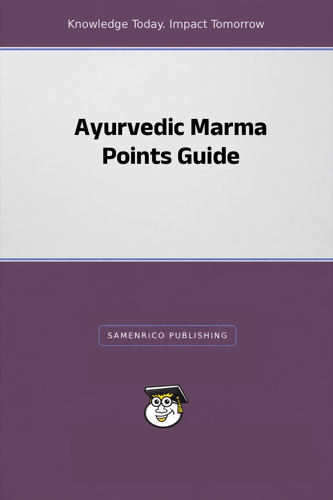
Ayurvedic Marma Points Guide eBook
Stimulate vital energy points for pain relief and
by Hatch Evia
Stimulate vital energy points for pain relief and healing.
Formats
Free sample
Chapter 1: The Unseen Landscape--You have lived inside your body your entire life, yet you have never seen it. Not really. You have seen its surface in mirrors—the curve of a shoulder, the line of a jaw, the map of veins beneath translucent skin. But the territory beneath that surface, the living geography of energy and intelligence that animates every cell, remains invisible to you. This is not your fault.
No one taught you to see it. No one told you that your body holds secrets more valuable than any treasure buried in the earth.The first secret is this: you are not a machine. You are not a collection of separate parts—bones stacked on bones, muscles wrapped around joints, organs performing chemical reactions in the dark. You are a field of intelligence, a river of awareness that has taken human form. And within that form, there are specific places where the river flows closest to the surface.
Places where you can touch the current directly. Places where healing happens not through force or chemicals but through contact with your own deepest nature.These places are called Marma points. The word comes from the ancient Sanskrit root "mri," which means to die. This etymology tells you something essential: these points are so vital, so connected to the core of your being, that injury to them can be fatal. But the same root gives rise to another meaning.
In the healing tradition of Ayurveda, Marma points are also doorways to life. They are the places where Prana—the intelligent life force that animates all living things—enters, exits, and reorganizes itself within your body.You have approximately 107 of these doorways. Some are the size of a fingertip. Others are as small as a grain of rice. They are located at the intersections of muscles, blood vessels, nerves, bones, and joints.
They are the places where the physical body and the energetic body meet. And they have been waiting for you to discover them.The Body You Never Learned to See Think about how you were taught to understand your body. In school, you memorized diagrams of the skeleton, the muscles, the organs. You learned that the heart pumps blood, the lungs exchange gases, the brain sends electrical signals through nerves. This is all true, as far as it goes.
But this model of the body is like describing a city by listing its pipes and wires. It misses the life. It misses the movement. It misses the intelligence that organizes the pipes and wires into a living, breathing, feeling whole.Ayurveda, the five-thousand-year-old healing tradition of India, offers a different map. On this map, the body is not primarily physical.
It is primarily energetic. The physical tissues—what Ayurveda calls the Dhatus—are simply the densest expression of more subtle forces. Those forces are called Doshas: Vata, Pitta, and Kapha. They are the fundamental energies that govern every process in your body and mind.Vata is the energy of movement. It is dry, light, cold, and mobile.
It governs breathing, blinking, the beating of your heart, the firing of your nerves, the movement of thoughts through your mind. When Vata is balanced, you feel creative, flexible, and alive. When Vata is imbalanced, you feel anxious, scattered, and prone to pain—especially sharp, shooting, or spasmodic pain.Pitta is the energy of transformation. It is hot, sharp, liquid, and oily. It governs digestion, metabolism, body temperature, and the processing of information.
When Pitta is balanced, you have strong digestion, sharp intellect, and healthy ambition. When Pitta is imbalanced, you experience burning sensations, inflammation, anger, and perfectionism.Kapha is the energy of structure and lubrication. It is heavy, slow, cool, and stable. It governs your physical form, your immune system, the moisture in your joints, and emotional steadiness. When Kapha is balanced, you feel grounded, patient, and strong.
When Kapha is imbalanced, you feel heavy, congested, resistant to change, and prone to dull, aching pain.These three forces flow through your body constantly, mixing and separating, rising and falling, responding to what you eat, how you sleep, the thoughts you think, and the touch you receive. When they flow freely, you experience health. When they become blocked, excessive, or depleted, you experience what we call disease.Marma points are the places where you can most directly influence this flow. Pressing a Marma point is like opening a gate in a river. The water does not need to be forced.
It simply needs a pathway. The Marma provides that pathway.The Discovery That Changed Everything The first written records of Marma points appear in the Sushruta Samhita, a medical text composed approximately 2,600 years ago. Sushruta was a physician and surgeon who lived in the ancient city of Varanasi. He performed cataract surgery, rhinoplasty, and even cesarean sections. He described hundreds of surgical instruments.
He classified burns, wounds, and fractures with a precision that astonishes modern historians.But Sushruta was not primarily a surgeon. He was a healer. And he understood that cutting the body was sometimes necessary but never sufficient. True healing required understanding the subtle anatomy beneath the flesh. That understanding led him to map the Marma points.According to Sushruta's text, there are 107 Marma points on the human body.
(Some later texts describe 117 points, incorporating additional points from the martial tradition. This book uses the 107-point therapeutic system as described in the Sushruta Samhita, which remains the most authoritative source for healing applications.) Each point is classified according to five criteria: location, structure (whether it is predominantly muscle, vessel, ligament, bone, or joint), size, effect when injured, and effect when stimulated.Sushruta described the Marma points as "the seats of life." He warned that injury to certain points could cause immediate death, while injury to others might lead to deformity, paralysis, or chronic disease. But he also described how to use these same points to heal. The difference was not in the point itself but in the intention, the pressure, and the context.This duality is essential to understand. A Marma point is not inherently good or bad.
It is a concentration of life force. The same concentration that can kill if struck violently can heal if touched gently. This is why martial artists study Marma points to disable opponents, while healers study the same points to restore balance. The point does not change. The touch changes.You are a healer, not a warrior.
The touch you will learn in this book is gentle, precise, and respectful. You will never press a Marma point with force. You will learn the four levels of pressure in Chapter 3, and you will apply them with discrimination. The head and neck points—the seven Maha Marmas, or great points—will receive only feather-light touch. The points on your limbs and back will receive more pressure, but always within the range of comfort.
If it hurts, you are doing it wrong.Why Your Pain Persists You may have come to this book because you are in pain. Chronic pain. The kind that does not respond to pills or stretches or massages. The kind that has become so familiar you have started to believe it is just part…
This is the end of the free sample. Get the eBook to keep going. Buy now
About this book
Details
- Author
- Hatch Evia
- Publisher
- SamEnrico
- Language
- English
- Genre
- Non-Fiction, Health & Wellness, Energy Medicine
- Released
- 2026-06-11
- Pages (approx.)
- 132
- Available as
- eBook, Audiobook

Read better in the ZLOADR app
Your eBooks on your phone or tablet. Sign in with your SamEnrico account and start reading.
More by Hatch Evia
 The Mountain Meditation GuideHatch Evia$11.99
 Stress Physiology Mindfulness CourseHatch Evia$11.99
 Arts Based Teen Self EsteemHatch Evia$11.99
 The Difficult Conversation with Your PastorHatch Evia$11.99
 The Blood Moon Murders: Colombia's Prohibition-Era Vampire KillerHatch Evia$11.99
 Vendor Invoice Processing GuideHatch Evia$12.99
 Brazilian Social Media for DropshippingHatch Evia$12.99
 Training LeadHatch Evia$11.99
 Understanding Methimazole Antenatal InfectionHatch Evia$17.99
 How to Start a Cement Products Business (Beginners Guide)Hatch Evia$11.99
You may also like
 Hong Kong Handover 1997Dunn Johnnie$11.99
 Zumba For Postnatal Recovery CourseNeal Christian$11.99
 Zumba for BeginnersLadner Nikia$11.99
 YouTube Comment Mining GuideHumes Pandora$12.99
 Worry Box MeditationCarlin Rudy$11.99
 Workplace Stress MeditationNguyen Lynn$11.99
 Workplace Stress and Sleep RepairHawley Ivory$11.99
 Workplace Perfectionism CureDelaney Jeffry$11.99
 Workplace Injustice Anger GuideWallen Isabelle$11.99
 Work Addiction and Burnout LinkGreenwood Ester$11.99
 Women in Yoga and WellnessBeattie Galina$11.99
 Women in Stand Up ComedyChun Evangeline$11.99