
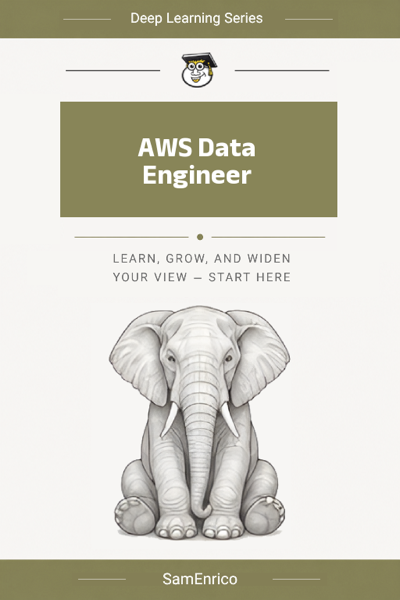
Non-FictionInformativeEducational
AWS Data Engineer eBook
A Coursebook on AWS Data Engineer
A Coursebook on AWS Data Engineer
Formats
Free sample
Chapter 1: The Road Builder--–- Imagine for a moment that you are standing in the middle of a vast, empty field. Around you, fifty different people are shouting directions. One wants a bridge to the north. Another needs a tunnel to the east. A third is demanding a highway to the coast, but they cannot agree on whether it should be two lanes or six.
There are no signs, no maps, no pavement. Every person is trying to drive their own car to a destination they can barely describe, and they are all looking at you to build the roads.This is what it feels like to be a data engineer on your first day at a company that has not yet figured out how to handle its data.Welcome to the discipline that sits at the quiet, unglamorous, absolutely essential foundation of every artificial intelligence model, every business intelligence dashboard, and every real-time recommendation engine you have ever used. Data engineering is not a subset of data analytics. It is not a stepping stone to becoming a data scientist. It is a distinct, rigorous, and increasingly critical profession focused on one thing: moving and preparing data so that others—analysts, scientists, and executives—can actually use it.If data scientists are the Formula One drivers who push machines to their limit, data engineers are the civil engineers who design, pour, and maintain the asphalt.
No one cheers for a well-drained road surface or a properly banked curve. But when the road fails, everyone notices. The same is true in data. A brilliant machine learning model is useless if the pipeline that feeds it arrives four hours late, or worse, silently drops half of the rows.This chapter exists because the world of data engineering on Amazon Web Services has changed fundamentally. In 2023, AWS retired the DAS-C01 exam—the Data Analytics Specialty—and replaced it with the DEA-C01: the AWS Certified Data Engineer exam.
That was not a simple rebranding. It was an admission that data engineering had grown into something separate from analytics, with its own patterns, its own failure modes, and its own career path. This book is your coursebook for that new reality.Why "AWS Data Engineer" Is Not an Exam Cram Book Before we go any further, let me be honest about what this book is not. It is not a collection of practice questions. It is not a last-minute cram guide with mnemonics for every AWS service.
There are excellent books for that purpose, and you should absolutely buy one of them when you are two weeks away from your exam date.This book is something rarer and, I believe, more valuable. It is a coursebook. Think of it as the textbook for a semester-long university course on data engineering, combined with the hands-on lab manual from a coding bootcamp. Every chapter follows the same structure: learning objectives aligned to the official DEA-C01 domains, a whiteboarding session where you draw architectures, a hands-on lab using the AWS Free Tier, a challenge question that forces you to debug a broken pipeline, and an exam drill that tests your decision-making under time pressure.By the time you finish this book, you will not have memorized a thousand facts about Kinesis shards and Redshift distribution styles. You will have built actual pipelines.
You will have watched them fail. You will have fixed them. And then you will sit for the exam with the quiet confidence of someone who has already done the work.The Great Shift: From ETL to ELTLet us start with the single most important architectural concept in modern cloud data engineering: the difference between ETL and ELT. These two acronyms look almost identical. The order of the letters matters more than almost anything else you will learn.Traditional ETL stands for Extract, Transform, Load.
You pull data from a source system, you transform it—cleaning, aggregating, joining—inside a separate processing engine, and then you load the finished product into a data warehouse or data lake. This made perfect sense in the era of expensive, on-premise databases. Compute was costly. Storage was even more costly. You wanted to minimize the amount of data you loaded, so you performed your transformations before loading.ETL has a dirty secret, however.
It assumes that you know, in advance, every possible question anyone might ever ask about the data. If you transform the data to answer question A, but six months later someone asks question B, you often have to go back to the source and re-extract everything. This is expensive. It is slow. And it creates a culture where business users wait weeks for a new report while data engineers frantically rewrite transformation logic.ELT stands for Extract, Load, Transform.
You still extract the data. But then you load it—raw, unmodified, as faithful to the source as possible—into a destination system. Only after the data is safely stored do you apply transformations. This flips the economics of the cloud to your advantage. Storage in S3 is almost laughably cheap: a penny per gigabyte per month for standard storage, and far less for colder tiers.
Compute is elastic. You can spin up a thousand servers for ten minutes, pay for exactly that usage, and spin them down.Why would you ever transform before loading? The answer, increasingly, is that you should not. ELT has become the dominant pattern on AWS because it decouples the act of collecting data from the act of using it. Your raw data becomes a permanent, immutable record.
If you discover a mistake in your transformation logic next week, you do not re-query the source system. You simply re-run the transformation on the raw data you already have. If a data scientist asks a novel question that requires a different aggregation, you do not beg the source system owner for a new extract. You write a new query against the raw lake.This is not merely a technical preference. It is a philosophical stance about data ownership.
With ETL, the transformation logic is a gatekeeper. With ELT, the raw data is the source of truth, and transformations are lightweight, disposable views. AWS has built its entire data ecosystem around this philosophy, from S3 as the universal storage layer to Redshift Spectrum and Athena as query engines that can read data directly from the lake without moving it.The Three Kingdoms: Warehouse, Lake, and Lakehouse As you begin your journey as an AWS data engineer, you will encounter three architectural patterns that every AWS data engineer must understand. They are not mutually exclusive—many organizations use all three for different purposes—but each solves a different set of problems.The data warehouse is the oldest of the three. Amazon Redshift is the flagship AWS offering here.
A data warehouse stores data in a highly structured, schema-on-write format. You define your tables, columns, data types, and constraints before you load a single row. The data is typically columnar (Parquet or ORC) and optimized for fast aggregation queries. Data warehouses excel at business intelligence: "What were our sales by region for the last quarter?" They struggle, however, with unstructured data like JSON logs, images, or free…
This is the end of the free sample. Get the eBook to keep going. Buy now
About this book
Details
- Author
- Branson Shenita
- Publisher
- SamEnrico
- Language
- English
- Genre
- Non-Fiction, Informative, Educational
- Released
- 2026-06-02
- Pages (approx.)
- 134
- Available as
- eBook, Audiobook

Read better in the ZLOADR app
Your eBooks on your phone or tablet. Sign in with your SamEnrico account and start reading.
More by Branson Shenita
 Mediterranean and InflammationBranson Shenita$11.99
 Values And Mission Alignment Feedback Culture WorkbookBranson Shenita$11.99
 The Micromanager Stress GuideBranson Shenita$11.99
 The Musician's Songwriting BlockBranson Shenita$11.99
 Pique Persuasion MethodBranson Shenita$11.99
 The Secret Scripts of 1948: How Cold War Espionage Shaped the London OlympicsBranson Shenita$11.99
 Understanding Trichomegaly Retina Pigmentary Degeneration DwarfiBranson Shenita$17.99
 International Franchise Fee StructureBranson Shenita$12.99
 Bplans Free Templates GuideBranson Shenita$12.99
 How to Become a Player-piano TechnicianBranson Shenita$11.99
You may also like
 Hong Kong Handover 1997Dunn Johnnie$11.99
 Zumba For Postnatal Recovery CourseNeal Christian$11.99
 Zumba for BeginnersLadner Nikia$11.99
 YouTube Comment Mining GuideHumes Pandora$12.99
 Worry Box MeditationCarlin Rudy$11.99
 Workplace Stress MeditationNguyen Lynn$11.99
 Workplace Stress and Sleep RepairHawley Ivory$11.99
 Workplace Perfectionism CureDelaney Jeffry$11.99
 Workplace Injustice Anger GuideWallen Isabelle$11.99
 Work Addiction and Burnout LinkGreenwood Ester$11.99
 Women in Yoga and WellnessBeattie Galina$11.99
 Women in Stand Up ComedyChun Evangeline$11.99