
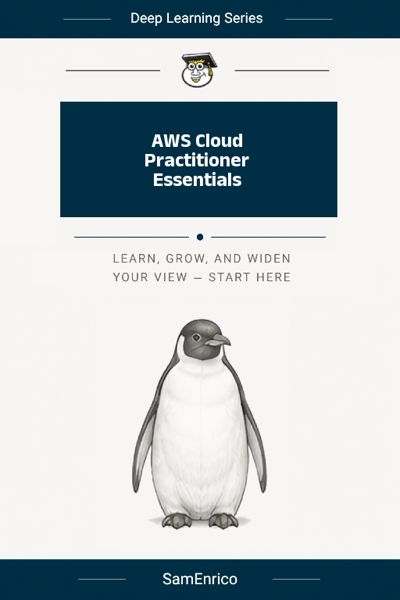
AWS Cloud Practitioner Essentials eBook
A Coursebook on AWS Cloud Practitioner Essentials
by Kearns Arron
A Coursebook on AWS Cloud Practitioner Essentials
Formats
Free sample
Chapter 1: The Hidden Bill...--It was 2:17 AM on a Tuesday when Maya’s phone buzzed with an alert she didn’t recognize. She rolled over, squinted at the screen, and felt her stomach drop. The message from her boss, Raj, read: “Why did our AWS bill just hit 47,000?Webudgeted47,000? We budgeted 47,000?Webudgeted3,000. Call me NOW.”Maya was a systems administrator at a mid-sized retail company that had migrated to the cloud only six months earlier.
She had been the one to push for the move. “It’s cheaper,” she had promised the finance committee. “We only pay for what we use.” Now, staring at a bill that was fifteen times higher than expected, she realized she had a lot to learn.That night, as she sat in her home office with a cold cup of coffee, Maya began her real education. She learned that cloud computing isn’t magic — it’s a fundamentally different way of thinking about technology, money, and scale. And by the time the sun rose, she understood something crucial: the bill wasn’t an error.
It was a symptom of a mindset that hadn’t yet adapted to the cloud.This chapter is for everyone who has ever been Maya. It’s for the IT professional who promised cost savings and got a shock. It’s for the student who hears “cloud” and imagines fluffy servers in the sky. And it’s for the business leader who needs to understand why their infrastructure bill fluctuates like a heartbeat.Let’s start at the very beginning. Because if you don’t understand the rules of cloud computing, the cloud will happily — and expensively — teach you.The Definition That Changes Everything Before we talk about services or architecture, we need a clear, working definition of cloud computing.
The official definition from the National Institute of Standards and Technology (NIST) is dry but precise: “Cloud computing is a model for enabling ubiquitous, convenient, on-demand network access to a shared pool of configurable computing resources that can be rapidly provisioned and released with minimal management effort or service provider interaction.”Let me translate that into English.Cloud computing is renting, not buying. When you need computing power, storage, or networking, you don’t go to a data center, purchase servers, wait for delivery, rack them, cable them, and install software. Instead, you open a web browser, click a few buttons, and within minutes — sometimes seconds — you have a virtual server running in a data center somewhere in the world. When you’re done, you turn it off and stop paying.That last part — stop paying — is the part Maya missed. In the traditional world, once you bought a server, you owned it forever.
You paid for its electricity, its cooling, its maintenance, and its eventual disposal. In the cloud, you pay by the second or by the hour. If you forget to turn something off, it keeps billing you.Think of it like renting an apartment versus buying a house. When you buy a house, you pay a large upfront cost (Cap Ex) and then ongoing costs (maintenance, utilities, property tax). When you rent, you pay a smaller monthly fee (Op Ex), and the landlord handles the maintenance.
But if you rent an apartment and then go on vacation for three months without canceling the lease, you still pay for those months. That’s what happened to Maya. She spun up resources for a holiday sale and never turned them off.The Financial Shift That Most People Get Wrong Every technical decision in the cloud has a financial consequence. That’s why we start with money, not with technology.In traditional on-premises IT, you spend Capital Expenditure (Cap Ex) . You buy servers, storage arrays, network switches, and cooling systems.
These are assets on your balance sheet. They depreciate over time. You pay for them upfront, regardless of whether you use them.In the cloud, you spend Operational Expenditure (Op Ex) . You pay for what you use, when you use it. There is no upfront hardware purchase.
There is no depreciation schedule. There is just a monthly bill that reflects your actual consumption.Here’s a concrete example. Let’s say you need a server that runs 24/7 for one year.On-premises Cap Ex: You spend 5,000ontheserver,5,000 on the server, 5,000ontheserver,1,000 on networking, 500oninstallation,andyouallocate500 on installation, and you allocate 500oninstallation,andyouallocate2,000 for electricity and cooling over the year. Total: $8,500 upfront or committed over time. Whether you use the server at 5% capacity or 95%, you paid the same.Cloud Op Ex: You rent an equivalent virtual server for 0.10perhour.24hours×365days=8,760hours×0.10 per hour.
24 hours × 365 days = 8,760 hours × 0.10perhour.24hours×365days=8,760hours×0.10 = $876 for the year. That’s it. No cooling cost. No electricity cost. No disposal cost.But here’s the trap.
If you run that server at 5% utilization (which is common in traditional data centers), you’re still paying $876. In the on-premises world, you wasted the other 95% of the server’s capacity, but you didn’t see a separate line item for it. In the cloud, you see exactly what you waste. And that visibility is terrifying at first and liberating later.Maya’s $47,000 bill came from three mistakes. First, she left a dozen test databases running for three months.
Second, she chose the largest, fastest server type for everything because she thought “bigger is better.” Third, she transferred massive amounts of data out of AWS to a third-party analytics service — and data transfer out (egress) is expensive. Every one of these mistakes was a Cap Ex mindset applied to an Op Ex world.The Six Advantages That Actually Matter When Amazon first introduced AWS in 2006, they listed six advantages of cloud computing. These aren’t marketing fluff. They are structural truths that shape every architectural decision.Advantage 1: Trade capital expense for variable expense.Instead of guessing how much capacity you’ll need three years from now and buying servers accordingly, you pay only when you consume resources. This is transformative for startups.
A company with an idea and a credit card can access the same infrastructure as a Fortune 500 bank.Advantage 2: Massive economies of scale.AWS has millions of customers. They buy servers in quantities that no single company could match. They negotiate better prices from hardware manufacturers. They build more efficient data centers. They pass those savings to you.
Your cost per unit of compute is lower in the cloud than you could achieve on your own.Advantage 3: Stop guessing capacity.In the old world, you either over-provisioned (wasting money on idle servers) or under-provisioned (turning away customers during peak traffic). In the cloud, you can scale up during your busy season and scale down afterward. You don’t need to predict the future. You just react to the present.Advantage 4: Increase speed and agility.In a traditional data center, provisioning a new server might take weeks — procurement, shipping, racking, cabling, imaging, network configuration. In the cloud, you can launch 100 servers in minutes with a single command.
That speed changes how you innovate. You can experiment cheaply. You can fail fast and recover faster.Advantage 5: Stop spending money on data centers.Data centers require real estate, construction, security guards, cooling towers, backup…
This is the end of the free sample. Get the eBook to keep going. Buy now
About this book
Details
- Author
- Kearns Arron
- Publisher
- SamEnrico
- Language
- English
- Genre
- Non-Fiction, Informative, Educational
- Released
- 2026-06-02
- Pages (approx.)
- 142
- Available as
- eBook, Audiobook

Read better in the ZLOADR app
Your eBooks on your phone or tablet. Sign in with your SamEnrico account and start reading.
More by Kearns Arron
 Arachnophobia Spider HierarchyKearns Arron$11.99
 Partner Support Recovery GuideKearns Arron$11.99
 From Grinding to LivingKearns Arron$11.99
 The Jungle PrisonerKearns Arron$11.99
 Anger Trigger Timeline MethodKearns Arron$11.99
 Continental Divide UnsupportedKearns Arron$11.99
 Work Spouse Relationship BoundariesKearns Arron$11.99
 Mindfulness for Students CourseKearns Arron$11.99
 The Hollow Crown: How a 19th-Century Con Artist Fooled a NationKearns Arron$11.99The Hollow Crown: How a 19th-Century Con Artist Fooled a NationKearns Arron$11.99
 The Alchemist’s Secret: Robert Boyle and the Birth of Modern ChemistryKearns Arron$11.99
 Growing Cymbalaria (Ivy-leaved Toadflax)Kearns Arron$11.99