
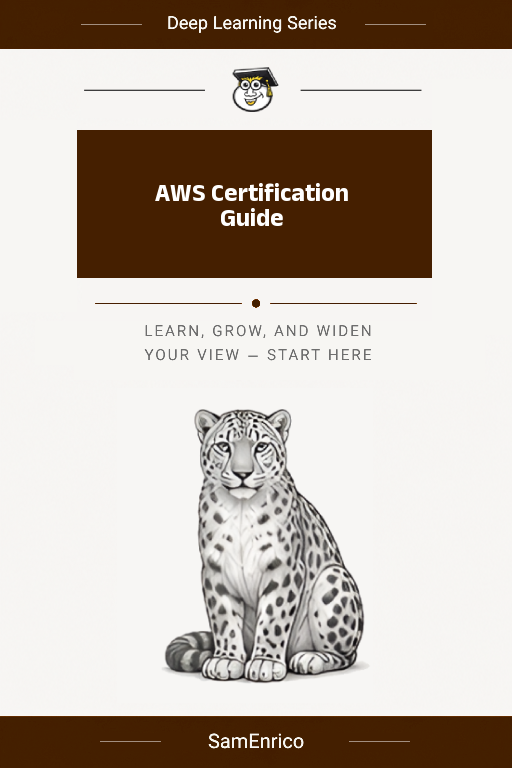
AWS Certification Guide eBook
Pass AWS Cloud Practitioner, Solutions Architect,
Pass AWS Cloud Practitioner, Solutions Architect, or Developer Associate exams via Coursera prep.
Formats
Free sample
Chapter 1: The Café Floor--The first time you hear someone say they “passed the AWS Solutions Architect exam,” it sounds like a statement of fact. The second time, you realize it sounds like a confession. Because buried inside those three words – “passed the exam” – is an unspoken acknowledgment of how many times they failed before. Not necessarily the official exam. The smaller failures.
The Coursera quiz they bombed. The practice test where they scored 54%. The moment they realized that knowing what an S3 bucket is has almost nothing to do with answering a scenario about cross-region replication with compliance requirements.This book exists because of a fundamental mismatch that the certification industry doesn't want you to think about too deeply. The mismatch is this: Coursera, and other video-based learning platforms, are exceptionally good at teaching you what a service does. They show you diagrams.
They walk you through console clicks. They give you a multiple-choice quiz that asks, “What does EC2 stand for?” (Elastic Compute Cloud. You got it. Gold star.)The real AWS certification exam does not care what EC2 stands for. The real exam presents you with a paragraph describing a company, their workload, their budget constraints, and their disaster recovery requirements.
Then it asks you which of four similarly plausible answers is the least wrong. And three of those answers will technically work. But only one is the most cost-effective, most resilient, or most operationally efficient.That is the gap. And this chapter is the bridge.The Coffee Shop That Changed Everything The most famous analogy in cloud computing education is the coffee shop. You have heard it on Coursera.
You have seen it in You Tube explainers. You have read it in the first chapter of every other AWS book. The analogy goes like this: buying your own espresso machine is like buying your own server (capital expenditure, or Cap Ex). Renting a coffee shop space with a machine included is like renting cloud infrastructure (operational expenditure, or Op Ex). It is a clean, intuitive, and almost completely useless analogy once you open the exam booklet.Why is it useless?
Because the exam never asks you to define Cap Ex and Op Ex. It assumes you know that. What the exam actually tests is your ability to apply the five pillars of the AWS Well-Architected Framework to ambiguous, real-world scenarios. And the coffee shop analogy, as traditionally taught, stops at the espresso machine.So let us rebuild it.Imagine you own a coffee shop called Resilience Roasters. You serve three hundred customers a day.
Your operation has five dimensions that determine whether you stay in business or go bankrupt. Those five dimensions are the exact same five dimensions of the Well-Architected Framework.First, operational excellence. This is your recipe book, your staff training manual, your daily opening and closing checklists. When a new barista starts, they do not guess how to pull an espresso shot. They follow a documented procedure.
In AWS terms, this means runbooks, deployment automation, and the ability to recover from operational failures without manual heroics. The exam will test whether you understand that operational excellence is not about uptime – it is about the process of achieving uptime repeatedly.Second, security. You lock the cash register. You check IDs for alcohol sales. You have a camera pointed at the back door.
In AWS, this means identity and access management (IAM), encryption, network firewalls, and the shared responsibility model. The exam does not ask, “Should you encrypt your data?” It asks, “Who is responsible for encrypting the data when a customer uses S3 server-side encryption with AWS KMS?” The difference is everything.Third, reliability. You have a second espresso machine. Not because you expect the first one to break every day, but because when it breaks on a Tuesday morning during the rush, you need to keep serving coffee. That is high availability.
It is not disaster recovery. A backup espresso machine in the same shop does nothing if the entire shop burns down. For that, you need a second coffee shop in a different neighborhood. That is disaster recovery. The exam will deliberately confuse these two concepts.
You must not.Fourth, performance efficiency. You do not use the same grinder for espresso and cold brew. You select the right tool for the job. In AWS, this means choosing between EC2, Lambda, ECS, and Fargate based on workload characteristics, not personal preference. The exam will present a workload and ask which compute service minimizes latency, cost, or operational overhead.
There is rarely a single correct answer in absolute terms. There is only the best answer given the constraints.Fifth, cost optimization. You do not roast twice as many beans as you need because they go stale. You do not pay a barista to stand around during slow hours. In AWS, this means right-sizing instances, using Savings Plans, and turning off resources that are not serving traffic.
The exam loves questions where two answers are technically correct, but one is cheaper. The cheaper answer is the correct answer.The coffee shop analogy, properly extended, gets you to the exam door. But it does not open it. To open it, you need to understand the physical reality of how AWS is built.The Geography of the Cloud: Regions, AZs, and Edge Locations Most people who fail the Practitioner exam fail on one specific category of questions: global infrastructure. Not because the concept is hard, but because the terminology is intentionally precise, and the exam exploits imprecision.Let us start with a Region.
An AWS Region is a geographic area, such as us-east-1 (Northern Virginia), eu-west-1 (Ireland), or ap-southeast-2 (Sydney). Each Region is completely independent of every other Region. Data in us-east-1 does not automatically replicate to eu-west-1. If you want cross-region replication, you must configure it explicitly and pay for it. The exam will test this independence by presenting a scenario where a company wants low latency for users in both Brazil and Japan.
The correct answer will involve deploying resources in two Regions, not one.Inside each Region, there are Availability Zones (AZs). An AZ is one or more discrete data centers with redundant power, networking, and connectivity. A single Region always has at least two AZs, and most have three or more. The critical exam fact about AZs is that they are connected by high-speed, low-latency fiber optic cables, but they are physically separate. A fire in one AZ does not spread to another AZ.
A power grid failure in one AZ does not affect the others.This is where the exam gets tricky. If you deploy an EC2 instance in a single AZ, and that AZ has a power failure, your application goes down. If you deploy the same application across two AZs with a load balancer in front, a single AZ failure does not cause downtime. That is high availability. The exam will present this exact scenario and ask, “What is the minimum configuration for high availability?” The correct answer is two AZs.But here is the trap.
High availability is not disaster recovery. If an entire Region goes offline – which has happened historically, most famously in us-east-1 in 2017 – having…
This is the end of the free sample. Get the eBook to keep going. Buy now
About this book
Details
- Author
- Villegas Letha
- Publisher
- SamEnrico
- Language
- English
- Genre
- Non-Fiction, Student's Shortcut, AWS
- Released
- 2026-06-01
- Pages (approx.)
- 133
- Available as
- eBook, Audiobook

Read better in the ZLOADR app
Your eBooks on your phone or tablet. Sign in with your SamEnrico account and start reading.
More by Villegas Letha
 National Parks ConspiracyVillegas Letha$11.99
 Daily Meditation for Anxious MindsVillegas Letha$11.99
 Body Image For Yoga Practitioners GuideVillegas Letha$11.99
 Breaking the Betting CycleVillegas Letha$11.99
 New Zealand Traverse Both IslandsVillegas Letha$11.99
 Catastrophizing Anger GuideVillegas Letha$11.99
 Peer Comparison Stress ReducerVillegas Letha$11.99
 Client Concentration Risk AuditVillegas Letha$11.99
 The Sword of the Sun Prince: A Knight’s Oath in the MahabharataVillegas Letha$11.99
 Pandora's Curiosity: The First Human Who Knew Too MuchVillegas Letha$11.99
 How to Start a Marketing Management Consultancy Business (Beginners Guide)Villegas Letha$11.99
 Audience Growth Strategies for CreatorsVillegas Letha$11.99