
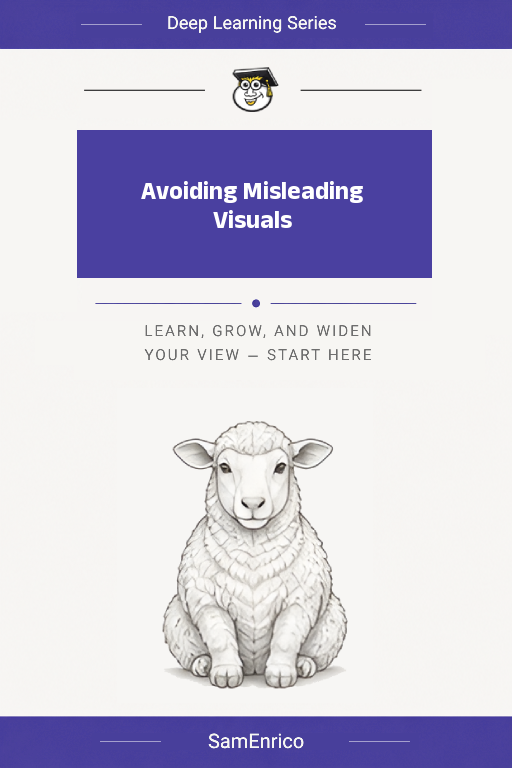
Avoiding Misleading Visuals Audiobook
Spot and fix misleading data presentations includi
Spot and fix misleading data presentations including truncated axes and inappropriate scales.
Formats
Free sample
Chapter 1: The Honest Lie--–- Every day, you are fooled by a chart. Not because you are unintelligent, and not because the chart is obviously broken. You are fooled because your eyes were not designed for data. Your visual system evolved to spot a predator in a bush, not to compare the heights of two blue rectangles on a screen. This mismatch between ancient biology and modern information is the single most important fact about data visualization.
Once you understand it, you will never see a graph the same way again.This chapter is not a list of rules. It is a fundamental shift in perception. Before we can fix misleading visuals, we must understand why we fall for them in the first place. The answer lies in three domains: the architecture of human vision, the psychology of pattern-seeking, and the mathematics of visual distortion. Together, they explain why a truncated bar chart can cause a stock market panic, why a poorly scaled pictogram can sway an election, and why even experts cannot spot a lie that is carefully drawn.Welcome to the landscape of deception.
Let us begin by dismantling the myth of the neutral observer.The Myth of the Objective Viewer Most people believe that when they look at a chart, they see what is there. This is false. What you see is not the data. What you see is your brain's interpretation of light hitting your retina, processed through millions of years of evolutionary shortcuts. These shortcuts are called heuristics, and they are remarkably efficient for survival.
They are terrible for data literacy.Consider the following: You are shown two bar charts. The first chart has bars of heights 50 and 55, starting at zero. The difference is barely visible. The second chart has bars of heights 50 and 55, but the axis starts at 48. The bars now appear dramatically different.
The data has not changed. Your perception has changed. This is not a trick. This is how your visual cortex works.The human visual system is exquisitely sensitive to changes in length and position, but only relative to context. We cannot judge absolute length without a reference.
We cannot judge area without extensive training. We cannot judge angles accurately at all. These limitations are not defects; they are features. They allowed your ancestors to notice a twitching branch at the edge of their vision. But they also allow a dishonest…
This is the end of the free sample. Get the Audiobook to keep going. Buy now
About this book
Details
- Author
- Rendon Rozella
- Publisher
- SamEnrico
- Language
- English
- Genre
- Non-Fiction, Professional's Cheat Sheet, Data Ethics
- Released
- 2026-06-01
- Pages (approx.)
- 130
- Available as
- eBook, Audiobook

Listen in the VoxFlicks app
Audiobooks and audio dramas wherever you go. Sign in with your SamEnrico account and press play.
More by Rendon Rozella
 Assertiveness Self Assessment GuideRendon Rozella$11.99
 Speaker's Meaning Making ShiftRendon Rozella$11.99
 The Autonomy Restoration PlanRendon Rozella$11.99
 The Low Self Worth and Depression LinkRendon Rozella$11.99
 When the World Was Carried on a Turtle's Back: Iroquois Creation MythRendon Rozella$11.99
 Lawson's Cypress HarvestingRendon Rozella$11.99
 Water Infrastructure Investment GuideRendon Rozella$12.99
 Understanding Macrocephaly Mental Retardation Facial DysmorphismRendon Rozella$17.99
 How to Start a Charcoal (other Than Wood Charcoal) Business (Beginners Guide)Rendon Rozella$11.99