
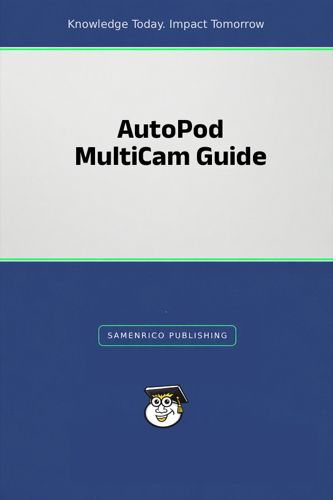
Non-FictionAI OperatorMulti-Cam Editing
AutoPod MultiCam Guide eBook
Automatically edit multi-camera podcasts, switchin
by Lott Racheal
Automatically edit multi-camera podcasts, switching shots based on who is speaking using AI.
Formats
Free sample
Chapter 1: The 4:1 Lie--You didn’t start a podcast to become a video editor.Let me say that again, because it’s the most important sentence in this entire book: You did not start a podcast to become a video editor.You started because you had something to say. Because you wanted to build an audience. Because you loved the raw, electric energy of a real conversation. Maybe you wanted to land sponsors. Maybe you wanted to grow a personal brand.
Maybe you just wanted an excuse to talk to interesting people once a week.But somewhere between episode one and episode twelve, something changed.The thrill of recording got replaced by the dread of editing. The excitement of publishing got buried under the weight of rendering queues. And that sixty-minute conversation you loved so much? It now demands four hours of your life—every single week—sitting in front of a timeline, manually cutting between camera angles, scrubbing through dead air, and exporting social clips that nobody will see because you ran out of time to promote them.This is the 4:1 lie.The lie says that editing is just part of the job. Suck it up.
Everyone does it. If you want to be a professional, you have to pay your dues on the timeline.But here’s what nobody tells you: the professionals stopped paying those dues years ago.They’re using AI. They’re automating the boring stuff. And they’re spending their evenings with their families instead of their timelines.This book is going to show you exactly how they do it.The Explosion You Can’t Ignore Let me paint you a picture of where the podcast industry is right now, because if you don’t understand the stakes, you won’t understand why automation isn’t optional anymore.In 2019, video podcasts were a niche curiosity. Joe Rogan was doing it.
A few others. Most shows were still audio-only, distributed through RSS feeds to Apple Podcasts and Spotify.In 2025, that world is dead.You Tube is now the largest podcast platform on earth. Spotify has fully integrated video. Apple Podcasts now prioritizes shows with video chapters. And a new generation of listeners—people who grew up on Tik Tok and Instagram—expects to see the people they’re listening to.Here are the numbers that should scare you:Video podcasts grow 3x faster than audio-only shows on the same distribution channels Retention rates on You Tube are 40% higher for podcasts with multi-camera production Sponsors pay 2-5x more for video episodes than audio-only The average listener now watches, not just listens, to 60% of their podcast content The message is clear: if you’re not publishing video, you’re invisible.But here’s the trap.The same platforms that demand video also demand frequency.
You Tube’s algorithm rewards weekly uploads. Spotify pushes shows that never miss a release date. Audiences unsubscribe from podcasts that go dark for three weeks because the editor burned out.So you’re caught between two impossible forces: the need to publish video, and the time it takes to edit it.This is where the 4:1 ratio comes in.The 4:1 Ratio and Why It’s Ruining Your Life I want you to do a quick calculation.Take the runtime of your average episode. Let’s say it’s 60 minutes.Now multiply that by four.That’s four hours of editing for every single episode. And that’s a conservative estimate.
I’ve talked to podcasters who spend eight hours editing a 45-minute show because they’re obsessive about cuts, or because they have four camera angles, or because they’re still learning the software.Now multiply that four hours by the number of episodes you publish per month. Let’s say you’re weekly. That’s sixteen hours of editing every month.That’s two full workdays.That’s twenty-four full workdays per year.That’s almost five weeks of your life—every year—spent doing nothing but cutting between cameras and deleting silences.And here’s the part that makes me angry on your behalf: most of that time is completely unnecessary.Because you’re not making creative decisions for four hours. You’re spending three hours and forty-five minutes on mechanical tasks—syncing footage, switching to whoever’s talking, removing coughs and pauses—and maybe fifteen minutes on actual creative choices like adding music or adjusting pacing.The AI can do the mechanical work.The AI can do it in sixty seconds.And the AI can do it more consistently than you can, because it never gets tired at 2 AM.I’m not saying AI replaces human editors. That’s a fear-mongering headline written by people who don’t understand the technology.
What I’m saying is that AI replaces mechanical editing—the kind of work that follows predictable rules (cut to the person whose microphone is active, remove silences longer than one second, crop to the face that’s moving).The creative work—choosing the right reaction shot, knowing when a pause is dramatic versus dead, feeling the rhythm of a conversation—that’s still yours.But right now, you’re so buried in the mechanical work that you never get to the creative part.This book is going to fix that.What This Book Actually Is (And What It Isn’t)Let me be completely transparent about what you’re holding.This is not a general guide to podcasting. I’m not going to teach you how to choose a microphone, how to interview guests, or how to grow your audience. There are a hundred books that do that, and many of them are excellent.This is not a beginner’s guide to video editing. I assume you know how to use Premiere Pro or Da Vinci Resolve at a basic level. You know what a timeline is.
You know how to import footage. You know what a cut does. If you don’t know those things, put this book down, watch a thirty-minute tutorial on You Tube, and come back.This is not a philosophical manifesto about AI replacing humans. I’m not interested in that debate. The technology exists.
It works. You can either use it or watch your competitors lap you.What this book is is a complete, battle-tested, inconsistency-free guide to editing multi-camera podcasts with Auto Pod—the best AI-powered editing plugin on the market.By the time you finish these twelve chapters, you will be able to:Set up your studio so Auto Pod works perfectly on the first try (Chapter 3)Record with confidence, knowing you’re not accidentally creating problems for the AI (Chapter 4)Install and configure Auto Pod correctly—something most people mess up (Chapter 5)Run the Multi-Camera Editor to switch angles automatically based on who’s speaking (Chapter 6)Use the Jump Cut Editor to remove dead air without making your show sound like a robot (Chapter 7)Repurpose one episode into twenty social clips in under ten minutes (Chapter 8)Troubleshoot every common error without panic-searching You Tube (Chapter 9)Scale your workflow to a team if you’re producing multiple shows (Chapter 10)Use advanced techniques like 10+ camera roundtables and motion graphics that follow speakers (Chapter 11)Future-proof your skills for the…
This is the end of the free sample. Get the eBook to keep going. Buy now
About this book
Details
- Author
- Lott Racheal
- Publisher
- SamEnrico
- Language
- English
- Genre
- Non-Fiction, AI Operator, Multi-Cam Editing
- Released
- 2026-06-07
- Pages (approx.)
- 139
- Available as
- eBook, Audiobook

Read better in the ZLOADR app
Your eBooks on your phone or tablet. Sign in with your SamEnrico account and start reading.
More by Lott Racheal
 Operation Car Wash Naval Base SchemeLott Racheal$11.99
 Vomit Phobia Self HelpLott Racheal$11.99
 Parenting Without Wine A Recovery GuideLott Racheal$11.99
 The Great Balloon Race: How a Tiny Insect Changed the WorldLott Racheal$11.99
 How to Become a Jewel-bearing PolisherLott Racheal$11.99
 Type Beat SEO Master PlanLott Racheal$12.99
 Luxury Goods Regional OutlookLott Racheal$12.99
 Understanding Infantile DysphagiaLott Racheal$17.99
 Audio Visual TechnicianLott Racheal$11.99
You may also like
 Hong Kong Handover 1997Dunn Johnnie$11.99
 Zumba For Postnatal Recovery CourseNeal Christian$11.99
 Zumba for BeginnersLadner Nikia$11.99
 YouTube Comment Mining GuideHumes Pandora$12.99
 Worry Box MeditationCarlin Rudy$11.99
 Workplace Stress MeditationNguyen Lynn$11.99
 Workplace Stress and Sleep RepairHawley Ivory$11.99
 Workplace Perfectionism CureDelaney Jeffry$11.99
 Workplace Injustice Anger GuideWallen Isabelle$11.99
 Work Addiction and Burnout LinkGreenwood Ester$11.99
 Women in Yoga and WellnessBeattie Galina$11.99
 Women in Stand Up ComedyChun Evangeline$11.99