
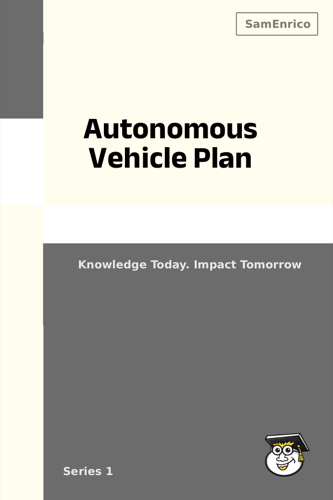
Non-FictionForecast & OutlookAutonomous Vehicles
Autonomous Vehicle Plan eBook
Capital strategies for self driving cars, sensor t
Capital strategies for self driving cars, sensor tech, and mapping software.
Formats
Free sample
Chapter 1: The Graveyard Quarter--It was a Tuesday afternoon in March 2019 when the first domino fell. Udacity, the online learning platform that had trained thousands of self-driving engineers, quietly shut down its autonomous vehicle nanodegree program. No press release. No funeral. Just a 404 error where a curriculum once lived.
Nobody wrote an obituary for a course, but they should have. Because the graveyard of the AV industry is not filled with failed algorithms or broken sensors. It is filled with brilliant engineers who never learned to read a balance sheet.Four years later, in October 2023, the second domino fell in public view. Cruise, a subsidiary of General Motors that had raised over $8 billion and was valued at $30 billion, had its driverless permit suspended by California regulators after a single crash—one where a pedestrian was dragged twenty feet after being hit by a human driver and then struck again by a Cruise robotaxi that failed to stop. The video was withheld.
The trust was broken. Within forty-eight hours, Cruise lost its license, grounded its entire fleet, laid off a quarter of its workforce, and watched its valuation collapse. The engineers had built something miraculous. The executives had failed to build a safety case. The investors had failed to ask one simple question: What happens when something goes wrong?This book is about the third domino.
The one that has not fallen yet but will, for most of the companies reading these words, unless they learn a different set of lessons.Welcome to the autonomous vehicle industry, where the graveyard is full and the headstones are engraved with vanity metrics. Ten million miles driven. One thousand patents filed. Fifty thousand simulated scenarios. All of it meaningless.
All of it leading to the same conclusion: capital efficiency beats speed, every single time, and the survivors are not the fastest movers but the most disciplined accountants who happened to hire brilliant engineers.The Vanity Metric Framework Let us begin with a confession. I have sat through over two hundred autonomous vehicle pitch decks. I have watched founders stand in front of venture capitalists and proclaim, with absolute sincerity, that their company has driven more miles, solved more edge cases, or built a more elegant sensor suite than any competitor. And I have watched those same founders, eighteen months later, explain why they are pivoting to trucking, or delivery, or selling their intellectual property to a Chinese original equipment manufacturer at pennies on the dollar.The problem is not their engineering. The problem is their metrics.The Vanity Metric Framework is the central lens of this book.
It is simple enough to write on a napkin but powerful enough to bankrupt a startup if ignored. Here is the rule: any metric that can be reported in a press release but does not correlate with economic viability is a vanity metric. The purpose of a press release is to manipulate sentiment. The purpose of an economic metric is to predict survival. They are not the same thing.Consider the most common vanity metric in autonomy: real-world miles driven.
Waymo has driven over twenty million autonomous miles. Cruise claimed over five million. Tesla's Full Self-Driving beta has logged hundreds of millions of miles in shadow mode. These numbers appear in headlines. They impress journalists.
They mean absolutely nothing.Why? Because miles are not created equal. Ten million highway miles in Arizona, where the sun shines three hundred days per year, the roads are wide, and pedestrians are rare, is worth less than one thousand miles in a Boston snowstorm or a Mumbai intersection or a roundabout in Paris where seventeen cars merge into two lanes with no signage. The distribution of miles matters more than the count. But distribution is hard to summarize in a tweet.
Distribution does not fit on a slide deck. So founders report the count, and investors nod, and the graveyard grows.The non-vanity metric is cash runway-adjusted progress toward positive unit economics. That is a mouthful, so let us break it into three components.First, cash runway is the number of months your company can operate at current burn rate before running out of money. Most AV startups in 2021 had twelve to eighteen months of runway. Most investors insisted on twenty-four.
The survivors today keep thirty-six months in reserve, because they have learned that regulatory suspensions (like Cruise's) or supply chain shocks (like the 2021 chip shortage) or talent wars (like the 2022 exodus to generative artificial intelligence) can erase a year of progress overnight.Second, progress is not a feeling. It is a set of verifiable, third-party-auditable milestones. Did you complete a safety case review by an independent evaluator? Did you close a commercial contract with a paying customer? Did you reduce your sensor suite cost per vehicle by a measurable percentage?
These are progress. Writing a new neural network architecture is not progress unless it demonstrably reduces intervention rates.Third, positive unit economics means that the revenue from operating one autonomous vehicle for one mile exceeds the cost of operating that vehicle for that mile, including depreciation, remote supervision, maintenance, insurance, and overhead. This number is maddeningly difficult to calculate because the costs are hidden (sensor cleaning alone adds three to five cents per mile) and the revenue is speculative (nobody knows what a robotaxi mile will sell for in 2030). But difficulty is not an excuse for ignorance. The best companies estimate.
The dead companies guess.The Three-Horizon ROI Framework If the Vanity Metric Framework tells you what not to measure, the Three-Horizon ROI Framework tells you where to place your bets. This framework appears throughout the book and will be expanded in Chapter 12, but for now, the simplified version is sufficient.Horizon 1: Consumer Advanced Driver-Assistance Systems (ADAS). This is the short-term revenue engine. Features like lane-keeping assist, adaptive cruise control, and automatic emergency braking are already shipping in millions of vehicles. The margins are thin (automotive is a low-margin business), but the volumes are enormous.
A Tier 1 supplier or automaker can generate positive cash flow from ADAS within eighteen months of investment. The risk is low because the liability remains with the human driver. The reward is moderate because the feature is commoditizing. Horizon 1 is not where fortunes are made. It is where bills are paid.Horizon 2: Long-Haul Trucking.
This is the mid-term opportunity with clear unit economics. A long-haul truck costs approximately seventy-five cents per mile to operate with a human driver. An autonomous truck, after removing the driver and adding a remote supervisor (one per ten to twenty trucks), costs approximately forty-five to fifty-five cents per mile. That twenty to thirty cent spread, multiplied by one hundred thousand miles per year per truck, across a fleet of ten thousand trucks, equals two hundred million dollars annually in additional profit. The routes are predictable (the same highways between the same distribution centers), the weather is manageable (trucks can pull over in blizzards), and the regulatory path is clearer than robotaxis (highways are federally regulated, not subject to fifty state laws).
Horizon 2 is where the first real fortunes will be made, and the smart money is already positioned there.Horizon 3: Urban Robotaxis. This is the long-term, highest-risk, highest-reward bet. An…
This is the end of the free sample. Get the eBook to keep going. Buy now
About this book
Details
- Author
- Turnbull Almeda
- Publisher
- SamEnrico
- Language
- English
- Genre
- Non-Fiction, Forecast & Outlook, Autonomous Vehicles
- Released
- 2026-06-08
- Pages (approx.)
- 146
- Available as
- eBook, Audiobook

Read better in the ZLOADR app
Your eBooks on your phone or tablet. Sign in with your SamEnrico account and start reading.
More by Turnbull Almeda
 Postpartum Low Milk Supply GuideTurnbull Almeda$11.99
 Triggers and Substance UseTurnbull Almeda$11.99
 Skin Needling At Home Safety ManualTurnbull Almeda$11.99
 Client Centered Scripting ApproachTurnbull Almeda$11.99
 MBSR for Corporate WorkplacesTurnbull Almeda$11.99
 Chronic Migraine PreventionTurnbull Almeda$11.99
 Gaslighting And AngerTurnbull Almeda$11.99
 Time Blocking For EntrepreneursTurnbull Almeda$11.99
 The Tsar's Maestro: Glinka and the Birth of Russian Classical MusicTurnbull Almeda$11.99
 Silicon Bloodlines: The Untold Legacy of Steve Jobs and the Next Tech DynastyTurnbull Almeda$11.99
 Silk & Shadows: The Forbidden Fashion Empire of the Silk RoadTurnbull Almeda$11.99
 Mastering Lease PurchaseTurnbull Almeda$11.99
You may also like
 Hong Kong Handover 1997Dunn Johnnie$11.99
 Zumba For Postnatal Recovery CourseNeal Christian$11.99
 Zumba for BeginnersLadner Nikia$11.99
 YouTube Comment Mining GuideHumes Pandora$12.99
 Worry Box MeditationCarlin Rudy$11.99
 Workplace Stress MeditationNguyen Lynn$11.99
 Workplace Stress and Sleep RepairHawley Ivory$11.99
 Workplace Perfectionism CureDelaney Jeffry$11.99
 Workplace Injustice Anger GuideWallen Isabelle$11.99
 Work Addiction and Burnout LinkGreenwood Ester$11.99
 Women in Yoga and WellnessBeattie Galina$11.99
 Women in Stand Up ComedyChun Evangeline$11.99