
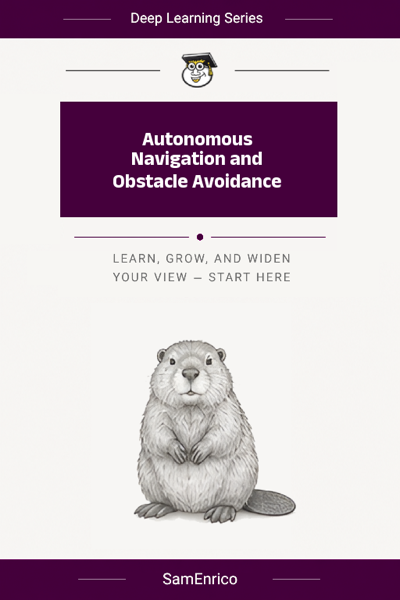
Non-FictionInformativeEducational
Autonomous Navigation and Obstacle Avoidance eBook
A Coursebook on Autonomous Navigation and Obstacle
by Witte Glory
A Coursebook on Autonomous Navigation and Obstacle Avoidance
Formats
Free sample
Chapter 1: The Ghost in the Machine--–- In the summer of 2004, in the Mojave Desert, a fleet of the world’s most advanced autonomous vehicles lined up for a race they were almost guaranteed to lose. The Pentagon’s Defense Advanced Research Projects Agency (DARPA) had offered a $1 million prize to the first team that could navigate a 142-mile course without a single human touch. The smartest robotics labs on the planet answered the call. Hours later, the winner—if it could be called that—had traveled just 7.4 miles before catching fire. Most vehicles never made it past the starting gate.
One robotic car, confused by its own sensors, backed into a concrete barrier before the race even began. This was not a failure. It was the birth of modern autonomy.That desert disaster taught an unforgettable lesson: building a machine that can drive itself is fundamentally different from building a machine that can calculate. Calculation is deterministic. Navigation is negotiation—with physics, with uncertainty, and with a world that refuses to stand still.
The vehicles that failed in 2004 had plenty of processing power. What they lacked was a coherent philosophy of autonomy. They could sense. They could plan. They could act.
But they could not connect these three abilities into a seamless, robust, and survivable loop. This book is about building that loop.The Autonomy Paradox: Why Simple Tasks Become Hard Before we write a single line of code or mount a single sensor, we must confront a humbling truth: tasks that come naturally to a human child—walking across a room without bumping into furniture, reaching for a cup, stepping around a puddle—remain near the frontier of robotics. The reason is not a lack of computing power. The reason is that the physical world is a chaos of uncertainty. Light changes.
Surfaces slip. Sensors drift. Other agents behave irrationally. A navigation system that works perfectly in a laboratory will fail catastrophically in a parking lot at dusk.Consider the seemingly trivial act of driving through an intersection. A human driver performs, without conscious effort, a dozen simultaneous computations: estimating the velocity of oncoming traffic, predicting whether a pedestrian will step off the curb, interpreting the vague intention of a turning vehicle signaled only by a slight tire rotation, accounting for wet pavement, and recalling that this particular intersection has a history of red-light runners.
An autonomous system must replicate all of this with sensors that see only what reflects back to them, with algorithms that know only what they have been told, and with actuators that respond only after milliseconds of computation have elapsed.This chapter introduces the foundational architecture that makes such replication possible: the Sense-Plan-Act paradigm. But more importantly, it establishes the philosophical framework that separates successful autonomy from expensive lawn ornaments. That framework rests on three pillars: closed-loop control, hierarchical decomposition, and graceful degradation. A machine that senses, plans, and acts once is a robot. A machine that senses, plans, acts, senses again, replans, and readjusts continuously is an autonomous agent.
The difference is the feedback loop.The False Promise of Perfect Information Engineers trained in deterministic systems often approach autonomy with an unconscious assumption: if we just add enough sensors, if we just write enough rules, if we just process data fast enough, we can eliminate uncertainty. This is a seductive fallacy. Uncertainty is not a bug in autonomous navigation. It is the operating environment.Imagine a self-driving car approaching a four-way stop. Another car arrives at the same time from the left.
The human drivers make eye contact. One waves the other through. This exchange conveys no explicit data—no velocity vector, no GPS coordinate, no semantic label. Yet it resolves the encounter instantly. An autonomous vehicle cannot make eye contact.
It cannot wave. It must infer intention from position, velocity, and a statistical model of human behavior. That inference will always carry uncertainty. The goal of autonomy is not to eliminate this uncertainty. The goal is to bound it, to quantify it, and to make decisions that remain safe even when the bounds are wide.This is why the Sense-Plan-Act loop must be probabilistic at every stage.
Sensing does not produce facts. It produces probability distributions over possible states. Planning does not produce guaranteed paths. It produces trajectories with associated risk metrics. Action does not produce commanded motion.
It produces executed motion with error terms. An autonomous system that forgets this—that treats its best guess as truth—is a system destined for the Mojave Desert’s hall of shame.The Anatomy of the Sense-Plan-Act Loop Let us dissect the loop that DARPA’s 2004 competitors attempted and largely failed to close.Sense is the bridge from the physical world to the digital mind. It encompasses everything from a Li DAR sensor’s laser pulses bouncing off a pedestrian’s coat to a camera’s photodiodes converting photons into pixel values. But sensing is not perception. Raw sensor data is noise-rich, incomplete, and ambiguous.
A point cloud from a Li DAR contains millions of points but no labels. A radar return gives velocity but not shape. A camera image provides shape and texture but no direct distance measurement. The act of sensing, therefore, is only half the battle. The other half is interpretation: transforming these raw signals into a coherent model of the world that includes objects, their properties, and their likely future states.
Chapter 3 will arm you with the tools of sensor fusion to accomplish precisely this transformation.Plan is where the robot decides what to do next. But planning is not a single activity. It is a hierarchy of decisions spanning different timescales and levels of abstraction. At the top of this hierarchy sits global planning: the strategic answer to "how do I get from point A to point B given a static map?" This is the domain of classical pathfinding algorithms like A* and RRT, which we will explore in Chapter 5. At the bottom of the hierarchy sits obstacle avoidance: the tactical, reflexive answer to "how do I not hit the wall that just appeared two meters to my left?" This is the domain of reactive controllers and velocity obstacles, covered in Chapters 6 and 7.
Between these extremes lies local planning: the mid-level answer to "given the global route and immediate obstacles, what trajectory should I execute in the next second?" The art of autonomous navigation lies in orchestrating these three planning layers so that they reinforce rather than contradict each other.Act is the moment where thought becomes motion. Actuation is physical, and physics is unforgiving. A steering command sent to the wheels takes time to produce a change in heading. A braking command takes time to overcome momentum. An actuator can saturate, fail, or respond nonlinearly.
The planning layers must respect these kinodynamic constraints—the limits imposed by mass, friction, torque, and latency. A path that is geometrically feasible but dynamically impossible is no path at all. Chapter 5 introduces the formalism of kinodynamic planning, and Chapter 7 presents the elementary controllers that serve as the final safety net when planning fails.Closing the Loop: Why Feedback Is Non-Negotiable A Sense-Plan-Act system that executes its plan and stops is an…
This is the end of the free sample. Get the eBook to keep going. Buy now
About this book
Details
- Author
- Witte Glory
- Publisher
- SamEnrico
- Language
- English
- Genre
- Non-Fiction, Informative, Educational
- Released
- 2026-06-02
- Pages (approx.)
- 159
- Available as
- eBook, Audiobook

Read better in the ZLOADR app
Your eBooks on your phone or tablet. Sign in with your SamEnrico account and start reading.
More by Witte Glory
 Parent Student Academic StressWitte Glory$11.99
 HGH Wound Healing GuideWitte Glory$11.99
 Meeting Talking PointsWitte Glory$11.99
 Antwerp Heist Retrial AccountWitte Glory$11.99
 Dutch Green Tax Credits GuideWitte Glory$11.99
 Parenting Disagreements With Co-ParentWitte Glory$11.99
 Bipolar Pediatric Early Signs CourseWitte Glory$11.99
 HGH And Thyroid FunctionWitte Glory$11.99
 TM for Social WorkersWitte Glory$11.99
 The Last Voyage of the SS America: A Ship Lost at SeaWitte Glory$11.99
 Whispers of the Forgotten: The Last Song of the DodoWitte Glory$11.99
 Ra’s Lost Sun Chariot: The Celestial Heist of the Sky GodWitte Glory$11.99
You may also like
 Hong Kong Handover 1997Dunn Johnnie$11.99
 Zumba For Postnatal Recovery CourseNeal Christian$11.99
 Zumba for BeginnersLadner Nikia$11.99
 YouTube Comment Mining GuideHumes Pandora$12.99
 Worry Box MeditationCarlin Rudy$11.99
 Workplace Stress MeditationNguyen Lynn$11.99
 Workplace Stress and Sleep RepairHawley Ivory$11.99
 Workplace Perfectionism CureDelaney Jeffry$11.99
 Workplace Injustice Anger GuideWallen Isabelle$11.99
 Work Addiction and Burnout LinkGreenwood Ester$11.99
 Women in Yoga and WellnessBeattie Galina$11.99
 Women in Stand Up ComedyChun Evangeline$11.99