
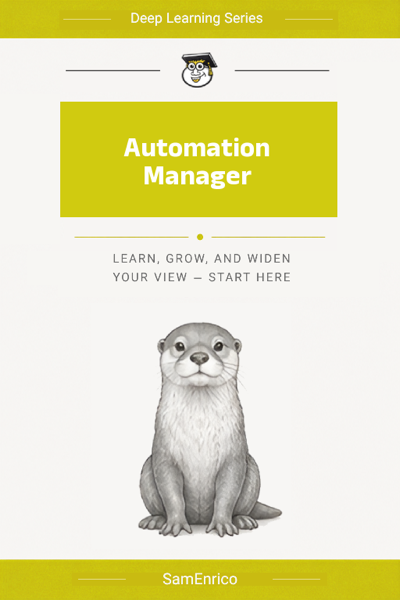
Non-FictionInformativeEducational
Automation Manager eBook
A Coursebook on Automation Manager
A Coursebook on Automation Manager
Formats
Free sample
Chapter 1: The Force Multiplier Mandate--–- The email arrived at 4:47 PM on a Friday. Subject line: “Urgent – 1,200 account unlocks by Monday.” No budget. No additional headcount. Just a manager’s expectation that “IT will figure it out.” You have two options: manually reset 1,200 passwords at three minutes each (sixty hours of soul-crushing clicks) or convince the organization that automation is not a luxury but a survival strategy. Most automation books start with a chapter on installing software or writing your first script.
This book starts here because if you cannot make the strategic case for automation, no tool will save you. Welcome to the first lesson of the Automation Manager: your success is not measured in lines of code written but in leverage created.The Great Misconception: Automation as Cost-Cutting Walk into any mid-sized company and ask the CFO why they invested in automation. The answer you will hear nine times out of ten is some variation of “we needed to reduce costs.” This is wrong. Not slightly imprecise. Not missing nuance.
Fundamentally, catastrophically wrong. When you frame automation as a cost-cutting exercise, you doom it to three fates: underfunding, resistance from the very people you need to champion it, and a ceiling on ambition that stops at “slightly cheaper manual process.”Consider the difference between a factory that automates to lay off workers and a factory that automates to produce higher-quality goods faster than any competitor. The first saves money for one quarter. The second captures market share for a decade. As an Automation Manager, your role is to lead the second type of transformation.The language of cost-cutting triggers defensive behaviors across the organization.
Finance departments demand perfect ROI calculations before you have any data. Line managers hide their manual inefficiencies because they fear their teams will be eliminated. Technicians resist documenting their workflows because they correctly sense that “automating their job” is a prelude to their unemployment. You cannot lead from this position. You will spend more time fighting internal politics than building automation.Now reframe the same investment.
Instead of “we will save $200,000 by automating invoice processing,” say “we will process 3,000 more invoices per month with the same team, reducing days sales outstanding from forty-five to thirty, unlocking working capital for new product development.” The first statement makes the accounts payable team your enemy. The second makes them your partner. They still do the same number of hours of work—but now that work is exception handling, vendor negotiation, and process improvement. Higher value. Lower tedium.
That is the promise of strategic automation.The Four Types of Automation ROITo move beyond cost-cutting, you need a framework that captures the full value of automation. The four-quadrant model below has been battle-tested in organizations ranging from small healthcare providers to global logistics firms. Each type of ROI serves a different stakeholder. Each requires a different measurement approach. And each matters.Efficiency: The Speed Dividend Efficiency is the most visible and the most dangerous.
It is the low-hanging fruit that every junior analyst spots first. “Look, this ten-minute manual task takes two seconds when automated.” You hear this pitch constantly. Efficiency ROI is real, but it is also the easiest to overpromise and underdeliver because saved time rarely materializes as cash.When you automate a ten-minute task that runs twenty times per day, the theoretical savings are 200 minutes per day, or roughly 1,000 hours per year. But in practice, those 1,000 hours do not appear as magic capacity. The people who used to do that task now have slack in their day.
Some of that slack gets absorbed by more valuable work. Some gets absorbed by longer coffee breaks. Some simply vanishes into the friction of organizational life.The correct way to measure efficiency ROI is not hours saved but cost avoidance. If your team of five has been working sixty-hour weeks to keep up with demand, and automation brings them back to forty-hour weeks, you have avoided the need to hire a sixth person at $100,000 per year. That is real money.
Similarly, if automation allows you to shut down a legacy system or reduce licensing fees, that is measurable. But abstract “time savings” without a specific avoided cost or redeployment plan is fantasy.Efficiency ROI should be your justification for pilot projects because the math is simple and the risk is low. But it should never be your only justification for enterprise automation.Reliability: The Zero-Defect Dividend Humans make mistakes. Not because they are lazy or stupid, but because repetition breeds boredom and boredom breeds errors. A data entry clerk processing 500 invoices per day will make a mistake on roughly five of them.
That is a 99 percent accuracy rate, which sounds excellent until you realize that five incorrect invoices per day means 1,250 per year. Each error requires manual discovery, investigation, correction, and often apology. The cost of quality is invisible until it is not.Automation does not get bored. Automation does not transpose digits. Automation does not accidentally close a ticket without actually resetting the password.
The reliability dividend is the reduction in error-handling labor, customer complaints, compliance violations, and rework.Consider a password reset automation. A manual helpdesk technician resets a password in three minutes. The automation does it in ten seconds. The efficiency gain is obvious. But the reliability gain is larger.
Manual resets fail about 2 percent of the time—the technician mistypes, selects the wrong user account, or forgets to enforce password history requirements. Each failure generates a follow-up ticket, a frustrated user, and another five minutes of escalation time. The automation fails at 0.1 percent, and those failures are usually due to external factors (network outage, locked account elsewhere) rather than the reset logic itself.When you present automation to quality-focused stakeholders (compliance officers, customer success leaders, production managers), lead with reliability. They care less about speed than about consistency. A process that takes two minutes and works every time is better than a process that takes thirty seconds but fails unpredictably.
Automation offers the first.Scalability: The Volume Dividend This is where automation transforms from a tactical tool to a strategic weapon. Efficiency is linear—doing the same thing faster. Scalability is non-linear—doing a thousand times more without a thousand times the cost.Imagine you run a subscription service with 10,000 customers. Each month, 5 percent of them change their payment method, upgrade their plan, or cancel. That is 500 changes, each requiring manual processing by a customer support agent at five minutes per change—about forty hours of work per month.
As you grow to 100,000 customers, the manual workload becomes 400 hours per month. At 1 million customers, it becomes 4,000 hours per month. You cannot hire enough humans. Your growth caps out not because of market demand but because of operational drag.Automation changes the math. The same script that processes 500 payment method changes can process 50,000 with no additional human cost.
The only limit becomes API rate limits and infrastructure capacity, both of which scale at pennies per transaction rather than dollars per minute.The scalability dividend is most powerful in organizations with variable or unpredictable workloads. E-commerce companies facing Black Friday traffic spikes. Tax preparers facing April deadlines. Government agencies facing open enrollment periods. In these environments, hiring peak…
This is the end of the free sample. Get the eBook to keep going. Buy now
About this book
Details
- Author
- Meacham Milagros
- Publisher
- SamEnrico
- Language
- English
- Genre
- Non-Fiction, Informative, Educational
- Released
- 2026-06-02
- Pages (approx.)
- 138
- Available as
- eBook, Audiobook

Read better in the ZLOADR app
Your eBooks on your phone or tablet. Sign in with your SamEnrico account and start reading.
More by Meacham Milagros
 Sleep Meditation for TeensMeacham Milagros$11.99
 The B Vitamin Dementia PreventionMeacham Milagros$11.99
 Mongolia Horse Trek LeaderMeacham Milagros$11.99
 Lonely Caregiver ConnectionMeacham Milagros$11.99
 The Pomodoro Single Task GuideMeacham Milagros$11.99
 The Great Escape of Abu Salim: Libya's Infamous Prison Tunnel Breakout (1964)Meacham Milagros$11.99
 How to Start a Carbon and Aramid Thread Weaving Business (Beginners Guide)Meacham Milagros$11.99
 IRCC Processing TimelinesMeacham Milagros$12.99
 Web Summit Pitch GuideMeacham Milagros$12.99
 Learn to Play the BombardeMeacham Milagros$11.99
You may also like
 Hong Kong Handover 1997Dunn Johnnie$11.99
 Zumba For Postnatal Recovery CourseNeal Christian$11.99
 Zumba for BeginnersLadner Nikia$11.99
 YouTube Comment Mining GuideHumes Pandora$12.99
 Worry Box MeditationCarlin Rudy$11.99
 Workplace Stress MeditationNguyen Lynn$11.99
 Workplace Stress and Sleep RepairHawley Ivory$11.99
 Workplace Perfectionism CureDelaney Jeffry$11.99
 Workplace Injustice Anger GuideWallen Isabelle$11.99
 Work Addiction and Burnout LinkGreenwood Ester$11.99
 Women in Yoga and WellnessBeattie Galina$11.99
 Women in Stand Up ComedyChun Evangeline$11.99