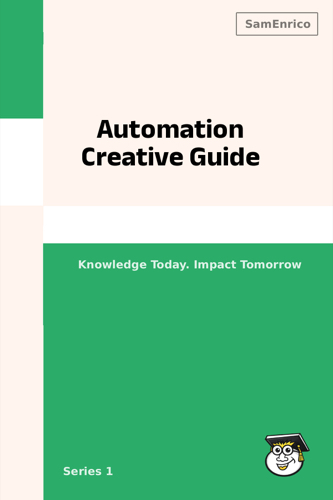
Automation Creative Guide eBook
Identify and eliminate manual tasks creatively usi
by Reeves Lena
Identify and eliminate manual tasks creatively using smart systems.
Formats
Free sample
Chapter 1: The 312-Hour Ghost--–- It was 3:47 PM on a Friday when Maya, a senior graphic designer at a mid-sized branding agency, realized she had just spent 45 minutes renaming and reformatting a spreadsheet of client logos. Not designing. Not creating. Not even thinking. She was copying, pasting, deleting columns, and standardizing date formats—work a high school student could have done.
The client invoice for that project was $4,500. Maya's hourly rate, based on her salary, was roughly $85. In the time she had just spent wrestling with spreadsheet cells, she had effectively thrown away $64 of her creative time. But the real cost was worse than money. When she finally opened her design software, her brain felt like cold oatmeal.
The creative spark she had felt that morning was gone, replaced by the dull hum of clerical exhaustion.Maya's story is not unusual. It is not even extreme. It is the quiet, unexamined reality of millions of creative professionals, knowledge workers, freelancers, and small business owners who lose an average of 312 hours per year to what this book calls invisible manual labor. That is the equivalent of eight full forty-hour work weeks. Eight weeks of your life, every single year, spent on tasks that require zero creativity, zero judgment, and zero satisfaction.
And the cruelest part? You barely notice it happening.Welcome to Automation Creative Guide. This book will not teach you to code. It will not ask you to become an engineer or a systems architect. It will do something far more valuable: it will teach you to see the invisible work that is stealing your time, and then give you the simplest possible methods to make it disappear.The Invisible Manual Labor Epidemic Let us define our enemy clearly.
Invisible manual labor refers to any task that meets three criteria. First, it is repetitive—you perform the same sequence of actions multiple times, often daily or weekly. Second, it requires zero creative decision-making—a simple flowchart or a high school intern could execute it correctly every time. Third, it has become so routine that you no longer register it as "work" in the traditional sense. You just do it, like breathing or blinking.Consider a few examples.
Have you ever retyped a client's name and address from an email into an invoice? That is invisible manual labor. Have you ever reformatted a spreadsheet because the exported data came in the wrong columns? That is invisible manual labor. Have you ever manually scheduled a meeting by exchanging four or five emails asking "When are you free?" That is invisible manual labor.
Have you ever copied data from one app and pasted it into another because they do not talk to each other? That, too, is invisible manual labor.These tasks are not difficult. That is precisely why they are so dangerous. Because they are easy, we do not fight them. We just do them.
And because we just do them, they accumulate like pennies in a jar—except the jar is our attention span, and the pennies are hours of our lives.A study conducted by the workflow automation platform Zapier in 2023 surveyed over 2,000 knowledge workers across the United States. The results were staggering: the average respondent reported spending 4.5 hours per week on manual, repetitive tasks that could be fully automated. That is 4.5 hours of copy-pasting, reformatting, re-entering, rescheduling, and refiling. Extrapolated over a forty-eight-week working year (allowing for four weeks of vacation), that totals 216 hours. Other studies have found even higher numbers.
A report by the consulting firm Mc Kinsey estimated that 31 percent of all work activities in the United States could be automated by 2030, and that knowledge workers spend an average of 20 percent of their week on "searching and gathering" information—much of which involves manual handoffs.But the real damage is not measured in hours. It is measured in creative context switching.The Creative Tax: Why Manual Work Destroys Your Best Thinking Every time you switch from a creative task (designing, writing, strategizing) to a manual task (reformatting, copying, scheduling), you pay a cognitive penalty. Psychologists call this attention residue. When you leave a creative task to do something clerical, a portion of your attention remains stuck on the original task. Even after you return to your creative work, your brain takes an average of twenty-three minutes to fully re-engage, according to research by Professor Sophie Leroy at the University of Washington.Now do the math.
If you perform just three manual interruptions per day—say, reformatting a report in the morning, manually scheduling a meeting mid-day, and copying data between spreadsheets in the afternoon—you lose nearly seventy minutes of focused creative time, not because of the manual tasks themselves, but because of the recovery time between them.Add that to the 4.5 hours of pure manual labor per week, and you are losing closer to 6.5 hours of creative potential every week. That is nearly an entire working day. Every week. Fifty weeks per year.Maya, the designer from our opening story, tracked her time for one month after reading an early draft of this chapter. She discovered that she was spending 6.2 hours per week on manual tasks—not because she was disorganized, but because no one had ever told her that these tasks could be automated.
The tasks themselves were not the problem. The problem was invisibility. She could not eliminate what she could not see.The Muscle Memory Test How do you spot invisible manual labor in your own life? This chapter introduces the first and most important diagnostic tool of this book: The Muscle Memory Test.Here is how it works. Think of a task you perform regularly.
Ask yourself one question: Can I do this task while half-watching a video, listening to a podcast, or carrying on a simple conversation?If the answer is yes, you have found a candidate for automation. Because here is the uncomfortable truth: if a task requires so little mental effort that you can do it while distracted, then a machine can do it perfectly every time without distraction.Let us test this on common activities. Can you sort a spreadsheet by date while watching a movie? Yes. Can you rename twenty files while listening to a podcast?
Yes. Can you copy a client's email address from one field to another while talking on the phone? Yes. Can you schedule a meeting by checking three calendars and proposing two times while half-paying attention to a video? Yes.
Every single one of these is invisible manual labor. And every single one can be automated.Contrast that with genuinely creative work. Can you write a persuasive proposal while half-watching a video? No. Can you design a logo while listening to a podcast?
No. Can you solve a complex client problem while carrying on a conversation? No. This is not a judgment of worth. It is a diagnostic test.
The Muscle Memory Test draws a clean line between what your brain should do and what a machine should do.The One-Task Challenge This chapter ends with a deliberately small action. You are not going to overhaul your entire workflow in the next thirty minutes. You are not going to learn a new software…
This is the end of the free sample. Get the eBook to keep going. Buy now
About this book
Details
- Author
- Reeves Lena
- Publisher
- SamEnrico
- Language
- English
- Genre
- Non-Fiction, Self-Help, Automation
- Released
- 2026-06-10
- Pages (approx.)
- 131
- Available as
- eBook, Audiobook

Read better in the ZLOADR app
Your eBooks on your phone or tablet. Sign in with your SamEnrico account and start reading.
More by Reeves Lena
 Gaming Urge SurfingReeves Lena$11.99
 Grandparents Grief GuideReeves Lena$11.99
 Plantar Fasciitis ReliefReeves Lena$11.99
 Lifelong Learning GuideReeves Lena$11.99
 Restructuring Anger for TherapistsReeves Lena$11.99
 Non Compete Clause NavigationReeves Lena$11.99
 Finding Motivated SellersReeves Lena$11.99
 Beanie Baby Bonanza: The Unlikely Million-Dollar Craze That Took Over the WorldReeves Lena$11.99
 Frostborn: The Ballad of the Troll King's LamentReeves Lena$11.99
 A Collector's Handbook to the Alfa Romeo 8c-2300Reeves Lena$11.99
 Promotion Case Peer Review GuideReeves Lena$12.99
 Co-Founder Vesting Schedule WorkbookReeves Lena$12.99