
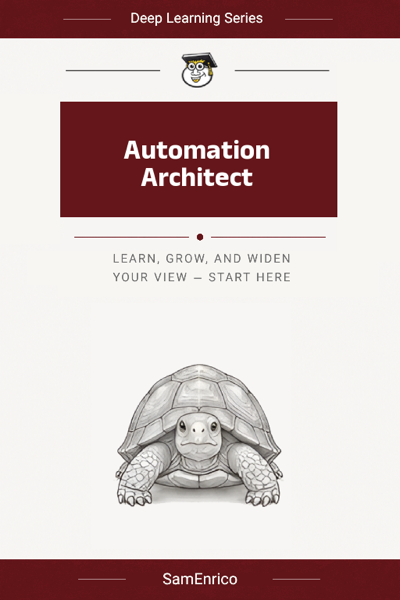
Automation Architect eBook
A Coursebook on Automation Architect
A Coursebook on Automation Architect
Formats
Free sample
Chapter 1: The Toil Trap--–- Every Monday morning, Sarah, a senior database administrator at a mid-sized financial firm, spends her first hour manually rotating credentials for seventeen legacy systems. She copy-pastes passwords from a shared spreadsheet, logs into each server via SSH, runs a series of commands she memorized six years ago, and updates a separate document for auditors. She has done this every week for 187 consecutive weeks. When asked why this process hasn't been automated, she shrugs: "We tried once. The script broke after two months because someone changed the server naming convention.
Nobody had time to fix it."Across the office, Marcus, a network engineer, receives his third alert of the morning: a firewall ACL has drifted from its golden configuration. He logs in, compares the current rules to a static screenshot saved on his desktop, manually corrects four entries, and documents the change in a ticket. This takes twenty-two minutes. The same firewall will drift again by Wednesday, triggered by an overzealous monitoring agent that no one fully understands. Marcus has fixed this same issue fifty-three times in the past year.In the executive suite, the Chief Technology Officer reviews a dashboard showing that infrastructure costs have risen eighteen percent while deployment frequency has dropped.
His team reports that they are too busy with "operational work" to focus on strategic initiatives. He approves budget for three more engineers, believing that more headcount will solve the problem.It will not.The Invisible Tax What Sarah and Marcus are experiencing is not a skills gap, a tooling problem, or a failure of individual effort. They are paying a tax that almost never appears on a balance sheet but consumes more organizational value than any line item in the IT budget. This tax is called toil.Toil is the hidden drag of manual, repetitive, interrupt-driven work that does not create enduring value. It is the password rotation that should be automatic.
The firewall drift that never stays fixed. The ticket routing that requires seven approvals. The log analysis done by eye. The deployment that needs a human to press "confirm" at 2:00 AM.Most organizations mistake toil for "the cost of doing business." They staff around it, normalize it, and eventually stop seeing it altogether. The engineers who perform toil burn out and leave.
The managers who report it learn to hide it. The executives who fund it mistake headcount growth for progress.This book begins with a radical premise: toil is not inevitable. It is a design flaw.And the person responsible for redesigning it is the Automation Architect.Defining the Role: City Planner, Not Bricklayer If you search job boards for "Automation Architect," you will find descriptions ranging from "write Python scripts to restart services" to "lead enterprise-wide digital transformation." This confusion is not accidental. The role is young, and organizations are still figuring out what they need.Let us settle this now.An Automation Architect is not a senior sysadmin who can write loops in Bash. That person is a valuable engineer, but they are a bricklayer – skilled at building individual components.
An Automation Architect is a city planner – someone who designs the roads, zoning laws, utilities, and emergency services that allow countless bricklayers to build safely, quickly, and without chaos.The bricklayer asks: "How do I automate this task?"The architect asks: "How do we build a system where any task can be automated safely, reused across teams, governed without bureaucracy, and scaled to ten thousand servers?"This distinction is not academic. It determines where you invest your time, how you measure success, and whether your automation survives past your departure.Consider two organizations:Company A (The Bricklayer Model): A brilliant engineer named Priya writes three hundred automation scripts over two years. She is legendary. Then Priya takes a new job. Within six months, seventy percent of her scripts have failed.
No one knows how they worked. There is no documentation, no version control, no shared secrets management. The company hires three people to replace her, and they start writing new scripts from scratch.Company B (The Architect Model): A team builds a centralized automation platform with job templates, role-based access, Git Ops workflows, and self-healing capabilities. When an engineer leaves, their automation content remains in the repository. A new hire can see every change, understand every dependency, and safely modify existing workflows.
Automation failure rates are below five percent. The platform has scaled to support six teams and eight hundred servers.Company A had a hero. Company B had an architect. Only one of these models scales.The Six Competencies of an Automation Architect Throughout this book, we will return to six core competencies that define successful automation architects. These are not technical skills alone – though technology matters.
They are a blend of strategy, process, people, and structure.1. Strategy – Aligning Automation with Business Goals The architect does not automate everything. They automate what matters. This requires understanding business priorities: Which processes, if accelerated, would increase revenue? Which manual tasks are causing regulatory risk?
Which toil is driving the highest employee turnover?A junior engineer might automate their own password rotation and call it a win. An architect asks: "Does password rotation appear on the CEO's list of top five concerns?" If not, they might be solving the wrong problem.2. Process – Understanding Workflows Before Coding The cardinal sin of automation is digitizing inefficiency. If a process requires seven approvals for a password reset, automating it will yield a very fast, very expensive, very stupid process. The architect knows how to map value streams, identify waste, and optimize before automating.3.
Prioritization – Choosing What NOT to Automate Automation opportunities are infinite. Engineering time is finite. The architect uses frameworks – like the Value vs. Complexity matrix we will explore in Chapter 11 – to kill low-value ideas before they consume resources. Saying "no" is a core competency.4.
People – Change Management and Upskilling Automation threatens identity. A network engineer who has spent fifteen years mastering manual firewall configurations may hear "we are automating your job" as "you are obsolete." The architect knows how to reframe automation as toil removal, not job replacement. They build training paths, create automation champions, and celebrate human contributions to higher-value work.5. Structure – Designing the Automation Platform This is the technical core. The architect selects or builds the control plane: job templates, workflows, inventories, secrets management, logging, and API access.
They make decisions about agentless versus agent-based architectures (Chapter 6), Git Ops workflows (Chapter 7), and policy-as-code (Chapter 8). They design for scale, failure, and observability.6. Operations – Monitoring, Logging, and Incident Response Automation is not "set and forget." It requires continuous attention. The architect defines service level indicators (SLIs), error budgets, and post-incident review processes. They ensure that when automation fails, it fails safely and notifies the right humans.These six competencies are not sequential.
You will use all of them, often in the same day. A single conversation with a stakeholder might require strategy (aligning with business goals), people (managing fear of change), and prioritization (saying no to a low-value request).The Anxiety Gap: Why 80% of Executives Fear Execution Industry surveys consistently reveal a striking contradiction: approximately eighty percent of executives believe automation is critical to their organization's future, yet a…
This is the end of the free sample. Get the eBook to keep going. Buy now
About this book
Details
- Author
- Sessions Lavonia
- Publisher
- SamEnrico
- Language
- English
- Genre
- Non-Fiction, Informative, Educational
- Released
- 2026-05-25
- Pages (approx.)
- 134
- Available as
- eBook, Audiobook

Read better in the ZLOADR app
Your eBooks on your phone or tablet. Sign in with your SamEnrico account and start reading.
More by Sessions Lavonia
 Default Off Notification Philosophy GuideSessions Lavonia$11.99
 Physics Essay AI PromptsSessions Lavonia$11.99
 Indian Agent Quality AssuranceSessions Lavonia$11.99
 Calm Response to Colleague AggressionSessions Lavonia$11.99
 The Vilna Gaon Opposing GuideSessions Lavonia$11.99
 The Underdog Champion: Pat McDermott's Olympic DreamSessions Lavonia$11.99
 How to Start a Opera House Business (Beginners Guide)Sessions Lavonia$11.99
 QuickBooks Tax Preparation GuideSessions Lavonia$12.99
 Dialysis Clinic M&ASessions Lavonia$12.99
 Understanding Platyspondylic Lethal ChondrodysplasiaSessions Lavonia$17.99