
Non-FictionAI OperatorMedia OperationsVideo Editing
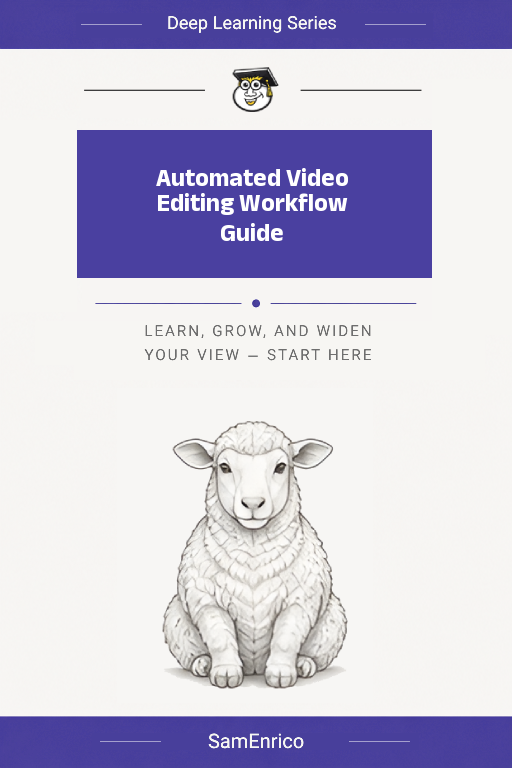
Automated Video Editing Workflow Guide eBook
Use AI to cut jump cuts, add captions, and align b
by Banks Latoya
Use AI to cut jump cuts, add captions, and align b-roll. Build preset prompt chains for interview highlights, tutorials, and social clips.
Formats
Free sample
Chapter 1: The 47-Hour Hard Drive--For the first five years of my video production career, I kept a shameful secret buried in a folder labeled "Archives_To_Sort." Inside that folder were 47 hours of unedited footage—interviews with fascinating people, tutorials I’d spent days filming, podcast episodes with guests who had since become famous. I told myself I was saving them for a slow weekend. But the slow weekend never came.Every time I opened my editing software, the same thing happened. I would stare at the timeline, a dense ribbon of blue and green blocks representing audio waveforms and video tracks. I would start scrubbing—dragging the playhead across the timeline, listening for the good parts.
Ten minutes in, I’d find a usable thirty-second segment. I’d mark it. Then I’d scrub another ten minutes. After two hours, I had maybe four clips and a headache.I thought I was lazy. I thought I lacked discipline.
I thought I just needed to try harder.I was wrong.The problem wasn’t my work ethic. The problem was that I was using a tool designed for Steven Spielberg to make content for Tik Tok. Traditional timeline editing—watching footage linearly, scrubbing frame by frame, cutting and trimming by hand—was invented for film editors who had weeks to cut a single scene. It assumes you have the luxury of time. It assumes your footage is precious and rare.But you are not editing a movie.
You are editing short-form content for an audience that scrolls past a video every 1.7 seconds. You have hours of raw footage and a deadline of tomorrow. The old way is not just inefficient. It is a form of slow violence against your creativity, your schedule, and your sanity.This book exists because I finally found another way. And that way starts with a simple but radical idea: stop editing video.
Start editing text.The Lie of the Timeline Let me be blunt. The timeline interface—that horizontal strip of visual information that every editing software uses—is a beautiful piece of design history. It was perfect for 1998. It is actively hostile to the way creators work in 2026.Here is what traditional editing requires you to do. Record a sixty-minute interview.
Open your software. Drag the clip onto the timeline. Press play. Listen. Wait for something interesting.
Pause. Trim the front. Trim the back. Move that segment to a new track. Repeat.
Do this fifty times. Then rearrange the segments so they tell a coherent story. Then realize you forgot a section. Then go back and find it. Then watch the whole thing again to check pacing.
Then export.That process takes hours. It takes hours because you are asking your brain to perform three impossible tasks simultaneously. First, you are listening for content. Second, you are watching for visual quality. Third, you are deciding where to cut.
Your brain is not designed to do these things at the same time. That is why editing is exhausting.But here is the secret that professional editors have known for decades but rarely admit. The best editors don't edit the video at all. They edit the transcript.Think about how you read a book. You don't shuffle pages randomly.
You read words in sequence. You understand meaning through language. Editing a transcript is the same. When you see the words "actually, the real problem is supply chains," you know instantly that this is a good clip. When you see the words "um, let me think about that for a second," you know instantly that this is dead air.
You don't need to hear the audio. You don't need to see the video. The text tells you everything.That is the paradigm shift. The transcript becomes your master document. You edit the words.
The AI handles the visual stitching. You delete a sentence, and the AI removes the corresponding video frames and smooths the jump cut. You reorder two paragraphs, and the AI swaps the video segments. You highlight a phrase as "important," and the AI flags that timestamp for export.This is not science fiction. This is how Opus Clip works.
This is how Descript works. This is how the new text-based editing in Premiere Pro works. The technology is here. The only thing missing is your willingness to stop doing things the hard way.The 3-Pillar Framework That Structures This Book Before we go any further, let me give you the map. This entire book is organized around three core processes.
I call them the Three Pillars. They appear in every automated editing workflow, in every tool, for every content type. Master these three things, and you master automated editing.Pillar One: Cutting (Clean Audio)This is the foundation. Raw footage is full of dead air, filler words, false starts, and awkward pauses. Removing these elements is not optional.
It is the single highest-return activity in all of video editing. An interview that starts at sixty minutes can become forty-five minutes just by deleting silences longer than half a second and removing every "um," "uh," and "like."Automation does this perfectly. AI can scan an audio waveform, detect decibel thresholds, and delete silence with surgical precision. AI can also recognize filler words and remove them, along with the surrounding micro-pauses. The result is a tight, energetic version of your original footage—no breath sounds, no stammering, just pure signal.But cutting audio creates a visual problem.
When you delete time from a talking head video, the remaining clips slam together, creating jump cuts. Those jump cuts are jarring. Viewers notice them subconsciously and click away. So we need to address them. That brings us to Pillar Two.Pillar Two: Context (B-Roll Alignment)B-roll is the footage you place over your main speaker to illustrate what they are saying.
If a podcaster says "I visited the Eiffel Tower," you show a clip of the Eiffel Tower. If a tutorial says "click the settings menu," you show a close-up of the settings menu. B-roll covers jump cuts, maintains visual interest, and reinforces your message.The manual way to add B-roll is excruciating. You watch the video, note every time the speaker mentions a concrete noun, search a stock footage website for that term, download the clip, drag it onto the timeline, trim it to length, and repeat. For a ten-minute video, this can take two hours.The automated way is almost absurdly simple.
You feed your transcript to an AI and ask it to extract every noun. You then automatically query stock footage APIs for those terms and insert the results at the relevant timestamps. For abstract concepts without stock footage, you generate custom visuals using text-to-video AI. The entire process takes minutes.Pillar Three: Captioning (Engagement)Captions are no longer an accessibility feature. They are the primary engagement driver for short-form video.
A 2024 study of 10,000 Tik Tok videos found that videos with dynamic captions—colored, animated, word-by-word highlighting—had 34% higher retention than videos with static captions and 58% higher retention than videos with no captions at all.Automated captioning tools can transcribe your audio, break it into timed lines, apply styling rules (yellow for nouns, green…
This is the end of the free sample. Get the eBook to keep going. Buy now
About this book
Details
- Author
- Banks Latoya
- Publisher
- SamEnrico
- Language
- English
- Genre
- Non-Fiction, AI Operator, Media Operations, Video Editing
- Released
- 2026-06-01
- Pages (approx.)
- 140
- Available as
- eBook, Audiobook

Read better in the ZLOADR app
Your eBooks on your phone or tablet. Sign in with your SamEnrico account and start reading.
More by Banks Latoya
 Dream Journaling for MeditationBanks Latoya$11.99
 Growth Hormone Infancy GuideBanks Latoya$11.99
 Cubicle Farm Stress ReductionBanks Latoya$11.99
 TM for ArchitectsBanks Latoya$11.99
 The Teen Self Worth JournalBanks Latoya$11.99
 Talking to Dentist About FearBanks Latoya$11.99
 Nicotine Metabolism Genetic TestBanks Latoya$11.99
 Croatian Green Tax CreditsBanks Latoya$11.99
 HGH And MelatoninBanks Latoya$11.99
 The Golden Hands of the Sahel: The Merchant Princes of TimbuktuBanks Latoya$11.99
 The Last Whisper of the Bison: The Great American Hunt’s Unseen LegacyBanks Latoya$11.99
 The Seer of the Shaking Earth: How an Ancient Indian Ocean Oracle Predicted the Great QuakeBanks Latoya$11.99
You may also like
 Hong Kong Handover 1997Dunn Johnnie$11.99
 Zumba For Postnatal Recovery CourseNeal Christian$11.99
 Zumba for BeginnersLadner Nikia$11.99
 YouTube Comment Mining GuideHumes Pandora$12.99
 Worry Box MeditationCarlin Rudy$11.99
 Workplace Stress MeditationNguyen Lynn$11.99
 Workplace Stress and Sleep RepairHawley Ivory$11.99
 Workplace Perfectionism CureDelaney Jeffry$11.99
 Workplace Injustice Anger GuideWallen Isabelle$11.99
 Work Addiction and Burnout LinkGreenwood Ester$11.99
 Women in Yoga and WellnessBeattie Galina$11.99
 Women in Stand Up ComedyChun Evangeline$11.99