
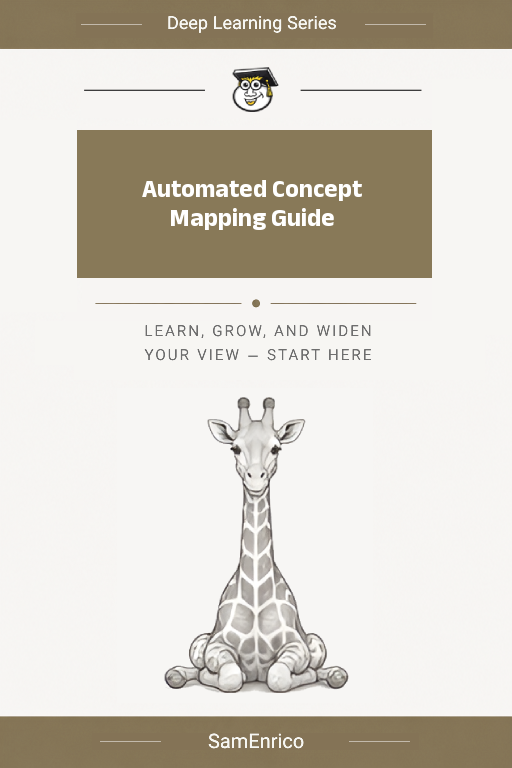
Non-FictionForecast & OutlookKnowledge Mapping
Automated Concept Mapping Guide eBook
Explore AI that generates knowledge graphs from te
Explore AI that generates knowledge graphs from textbooks, showing relationships between topics.
Formats
Free sample
Chapter 1: The Linear Lie--–- Every textbook you have ever used has been lying to you. Not maliciously, and not with false facts, but with a structure so deeply embedded in how we package knowledge that we have stopped seeing its flaws. The lie is this: that knowledge flows in a straight line, that learning is a sequence of pages flipped in order, and that the only way to understand a subject is to start at Chapter 1 and march obediently toward Chapter 12. This lie is so comfortable, so familiar, that we have built entire educational systems around it. And it is wrong.Consider how you actually learn when no one is watching.
You do not read a physics textbook from cover to cover like a novel. You jump. You encounter a problem about electrical circuits, realize you do not understand voltage, flip back four chapters, skim for the definition, then skip ahead to an example, then open a browser to search for a video, then return to the original problem with a new piece of knowledge that you have assembled from fragments scattered across time and space. This is not disorganized learning. This is relational learning.
This is how the human brain actually works.The textbook, in its linear glory, fights this process at every turn. It forces you to read what the author decided you should read next, not what your curiosity or confusion demands. It buries relationships between concepts in prose that you must rediscover each time. It treats knowledge as a sequence when knowledge is, in truth, a network.This chapter exposes the fundamental failure of the linear textbook and introduces the alternative that will drive everything else in this book: the automated concept map, powered by knowledge graphs and artificial intelligence. By the time you finish this chapter, you will understand why traditional textbooks cost students millions of hours of lost learning, why the most successful educational technologies have abandoned linearity, and why the combination of knowledge graphs and large language models finally makes automated concept mapping possible at scale.The Hidden Cost of Linearity Let us begin with a simple experiment.
Take any textbook you have used in the past year. Open it to a random chapter in the middle. Now ask yourself three questions about a concept in that chapter: What must I already know to understand this? What else does this concept connect to later in the book? How does this concept relate to ideas in other chapters that never explicitly reference it?Chances are, answering any of these questions requires significant work.
You must scan the index. You must flip backward and forward. You must infer relationships that the author never made explicit. This is not because the author is lazy. It is because the textbook format has no natural way to represent relationships.
It can only represent sequence.The cost of this linear constraint is staggering. A study at Carnegie Mellon University examined how students used traditional digital textbooks compared to an "intelligent textbook" augmented with a knowledge graph. The results were not subtle. Students using the linear version spent an average of forty-three minutes searching for prerequisite information across chapters for every hour of reading. They missed an average of sixty-two percent of cross-chapter connections when quizzed.
Their final exam scores were, on average, a full letter grade lower than students using the same content presented as a navigable knowledge network.Think about that. The only difference was the format. The facts were identical. The diagrams were identical. The practice problems were identical.
But one group saw the content as a linear sequence, and the other saw it as a network of connected concepts. The network group learned more, learned faster, and retained longer.This is not an isolated finding. Researchers at Stanford's Inquire Biology project spent five person-years manually constructing a knowledge graph for a single introductory biology textbook. When they deployed that graph as an interactive learning system, students showed a thirty-two percent improvement in relational question answering—questions like "How does photosynthesis affect cellular respiration?" that require tracing connections across chapters. The linear textbook readers, by contrast, could answer isolated facts about photosynthesis or cellular respiration but failed to connect them.The manual effort was enormous: five person-years for one textbook.
That is the hidden cost of linearity. It is not that educators do not know that knowledge is relational. It is that building the relationships manually is prohibitively expensive. The Stanford team employed Ph D-level biologists working full-time for years. No school district, no individual instructor, no educational technology startup can replicate that for every textbook they use.But what if that effort could be automated?
What if artificial intelligence could read a textbook and extract not just the key terms but the relationships between them? What if a knowledge graph could be built in hours instead of years? That is the promise of automated concept mapping, and it is the engine that will power the rest of this book.The Neuroscience of Relational Learning To understand why linear textbooks fail, we must understand how the brain actually encodes knowledge. The cognitive science is remarkably clear on this point: human memory is not a list. It is a network.Every piece of knowledge you possess—every fact, every skill, every concept—exists as a node in a vast associative network.
These nodes are connected by links that represent relationships. The strength of those links determines how quickly you can retrieve one concept when you encounter another. When a neurologist says that "neurons that fire together wire together," she is describing this process at the cellular level. Learning is the creation and strengthening of connections between nodes.Here is what this means for textbook design. When you read a linear textbook, you are forced to encounter concepts in an order chosen by the author.
But your brain does not store them in that order. It stores them in a network organized by meaning, by relationship, by relevance. Every time you need to access a concept, your brain must reconstruct the network from the linear sequence you read. This reconstruction is effortful, error-prone, and slow.Experts in any domain think in networks. A novice sees isolated facts; an expert sees a web of relationships.
This is why experts can solve problems faster and with fewer errors. They are not recalling more facts. They are navigating a richer network. They see the connections that novices miss.Consider a simple example. A novice learning about the human circulatory system might know separate facts: the heart pumps blood, arteries carry blood away, veins carry blood back, capillaries exchange gases.
An expert, by contrast, knows not just these facts but the relationships between them: that arteries branch into capillaries because pressure needs to drop before gas exchange, that veins contain valves because blood pressure is too low to push blood upward, that the heart has four chambers because it needs to separate oxygenated from deoxygenated blood. The expert does not have more facts. The expert has more relationships between the same facts.The linear textbook can only present these relationships as prose. "Arteries branch into arterioles, which further branch into capillaries." That sentence…
This is the end of the free sample. Get the eBook to keep going. Buy now
About this book
Details
- Author
- Cisneros Cassy
- Publisher
- SamEnrico
- Language
- English
- Genre
- Non-Fiction, Forecast & Outlook, Knowledge Mapping
- Released
- 2026-05-30
- Pages (approx.)
- 151
- Available as
- eBook, Audiobook

Read better in the ZLOADR app
Your eBooks on your phone or tablet. Sign in with your SamEnrico account and start reading.
More by Cisneros Cassy
 Pinterest Wedding Comparison GuideCisneros Cassy$11.99
 Chinese NEV Subsidy EvolutionCisneros Cassy$11.99
 Narcissistic Partner Recovery GuideCisneros Cassy$11.99
 CASL Email Compliance GuideCisneros Cassy$11.99
 The Serpent’s Gambit: How a Forgotten Pharaoh Outwitted the GodsCisneros Cassy$11.99
 The Billion-Dollar Bet That Broke a Nation: The Icelandic Financial CollapseCisneros Cassy$11.99
 EU Green Subsidy HandbookCisneros Cassy$12.99
 IceskatingCisneros Cassy$11.99
 Understanding I Cell DiseaseCisneros Cassy$17.99
 How to Start a Hobby in Motorcycle StuntsCisneros Cassy$11.99
You may also like
 Hong Kong Handover 1997Dunn Johnnie$11.99
 Zumba For Postnatal Recovery CourseNeal Christian$11.99
 Zumba for BeginnersLadner Nikia$11.99
 YouTube Comment Mining GuideHumes Pandora$12.99
 Worry Box MeditationCarlin Rudy$11.99
 Workplace Stress MeditationNguyen Lynn$11.99
 Workplace Stress and Sleep RepairHawley Ivory$11.99
 Workplace Perfectionism CureDelaney Jeffry$11.99
 Workplace Injustice Anger GuideWallen Isabelle$11.99
 Work Addiction and Burnout LinkGreenwood Ester$11.99
 Women in Yoga and WellnessBeattie Galina$11.99
 Women in Stand Up ComedyChun Evangeline$11.99