
Non-FictionAI OperatorAccessibility Tech
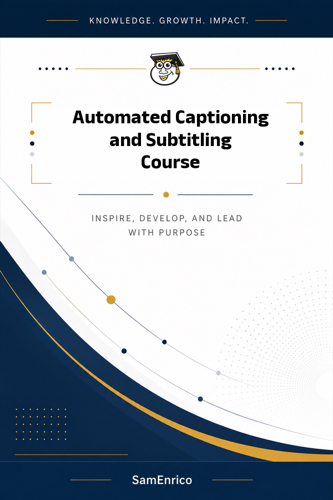
Automated Captioning and Subtitling Course
Implement AI-powered transcription, translation, a
Implement AI-powered transcription, translation, and dynamic caption styling for global video audiences.
Formats
About this book
Free sample
Chapter 1: Beyond the Black Bar--If you have ever watched a video with automated captions and found yourself laughing at a word that made no sense—"beach" instead of a word that rhymes with it, "peaceful" instead of "piece of," or a speaker's name replaced with a random noun—you have already experienced the central tension this book exists to resolve. The tension is this: automation promises speed, but speed without judgment produces garbage. The most advanced artificial intelligence on the planet cannot reliably distinguish between "their," "there," and "they're" when a speaker mumbles. It cannot hear the difference between sincere praise and sarcastic devastation. It cannot look at a frame and decide that a subtitle should shift from the bottom center to the top left because the director just placed a logo exactly where the text would go.This chapter lays the foundation for everything that follows.
You will learn the fundamental vocabulary of the profession: intralingual versus interlingual captions, open versus closed, pre-recorded versus live. You will travel through the history of subtitling from the analog era to the streaming revolution, understanding why the "Netflix Effect" broke traditional workflows and forced the adoption of Automatic Speech Recognition (ASR) and Neural Machine Translation (NMT). Most importantly, you will emerge with a clear framework for the entire book: the Human-in-the-Loop philosophy that treats AI as a powerful but flawed assistant, never as a replacement for the trained human eye and ear.The Vocabulary of Access: Words That Matter Before we can discuss automation, we must establish the language of the profession. Subtitling and captioning are often used interchangeably, but precision matters when you are billing clients or delivering to broadcasters.Intralingual captions are same-language transcriptions. What you hear is what appears on screen, in the same language.
These serve three primary audiences. First, the deaf and hard of hearing rely on captions for access to audio content—not just dialogue but also sound effects, music cues, and speaker identification. Second, language learners benefit from reading along as they listen, reinforcing vocabulary and pronunciation. Third, viewers in noise-sensitive environments—airports, gyms, hospital waiting rooms…
This is the end of the free sample. Get the eBook to keep going. Buy now
Contents
- Chapter 1
- Chapter 2
- Chapter 3
- Chapter 4
- Chapter 5
- Chapter 6
- Chapter 7
- Chapter 8
- Chapter 9
- Chapter 10
- Chapter 11
- Chapter 12
Details
- Author
- Duncan Suzanne
- Publisher
- SamEnrico
- Language
- English
- Genre
- Non-Fiction, AI Operator, Accessibility Tech
- Released
- 2026-06-08
- Pages (approx.)
- 140
- Available as
- eBook, Audiobook

Read better in the ZLOADR app
Your eBooks on your phone or tablet. Sign in with your SamEnrico account and start reading.
More by Duncan Suzanne
 Hearst Napa Valley KingdomDuncan Suzanne$11.99
 Cocaine Paranoia Management GuideDuncan Suzanne$11.99
 Fake Execution SurvivalDuncan Suzanne$11.99
 The Maharal of PragueDuncan Suzanne$11.99
 The Man Who Sold the Moon: How a Visionary Con Artist Fooled the WorldDuncan Suzanne$11.99
 The Silent Depths of the Coral Sea: The Lost Fleet of the Great WarDuncan Suzanne$11.99
 Building Science ConsultantDuncan Suzanne$11.99
 Shopify Virtual Internship GuideDuncan Suzanne$12.99
 Polish Remote Employer Tax ObligationsDuncan Suzanne$12.99
 Understanding Bosma–henkin–christiansen SyndromeDuncan Suzanne$17.99
 How to Start a Hobby in Ice SkatingDuncan Suzanne$11.99
You may also like
 Hong Kong Handover 1997Dunn Johnnie$11.99
 Zumba For Postnatal Recovery CourseNeal Christian$11.99
 Zumba for BeginnersLadner Nikia$11.99
 YouTube Comment Mining GuideHumes Pandora$12.99
 Worry Box MeditationCarlin Rudy$11.99
 Workplace Stress MeditationNguyen Lynn$11.99
 Workplace Stress and Sleep RepairHawley Ivory$11.99
 Workplace Perfectionism CureDelaney Jeffry$11.99
 Workplace Injustice Anger GuideWallen Isabelle$11.99
 Work Addiction and Burnout LinkGreenwood Ester$11.99
 Women in Yoga and WellnessBeattie Galina$11.99
 Women in Stand Up ComedyChun Evangeline$11.99