
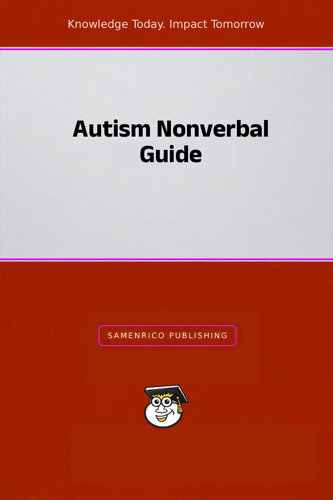
Autism Nonverbal Guide
Understand unique nonverbal expression in autistic
Understand unique nonverbal expression in autistic individuals.
Formats
About this book
Free sample
Chapter 1: The Silent Prison--Imagine waking up every morning fully conscious, fully aware, and fully intelligent—yet completely unable to move your body in the ways you intend. You can think the words “I am hungry” or “I love you” or “Please stop, that hurts,” but when you try to speak, nothing comes out. Or perhaps a different word emerges—one you did not choose. Your hand reaches for a cup but instead knocks it over. Someone asks you a question, and you know the answer perfectly, but your mouth hangs open while your body begins to rock back and forth on its own.
People around you conclude that you do not understand. They speak about you in the third person while standing two feet from your face. They lower their expectations. They stop asking. They stop believing that you are even in there.This is not a philosophical thought experiment or a metaphor for social anxiety.
This is the daily, lived reality for hundreds of thousands of non-speaking autistic individuals who experience a neurological condition that remains widely misunderstood by the medical establishment, the education system, and even by many loving families who would do anything to help. The condition is called apraxia of speech—sometimes referred to as verbal dyspraxia—and it is arguably the single most important concept for any caregiver, educator, or therapist to understand before attempting to support a non-speaking autistic person. Without understanding apraxia, well-intentioned interventions can cause harm, deepen frustration, and reinforce the very silence that everyone is trying to break. With an understanding of apraxia, however, the world begins to open, and genuine connection becomes possible.The Great Misdiagnosis of Our Time For decades, the field of psychiatry and developmental medicine operated under a devastating and largely unexamined assumption: if a person cannot speak, they likely cannot think. This assumption was rarely stated explicitly in professional literature, but it permeated diagnostic practices, educational placements, research priorities, and everyday interactions between clinicians and the families they served.
Children who did not speak were routinely labeled as “low-functioning” or “severely autistic” and were placed in separate classrooms where…
This is the end of the free sample. Get the eBook to keep going. Buy now
Contents
- Chapter 1
- Chapter 2
- Chapter 3
- Chapter 4
- Chapter 5
- Chapter 6
- Chapter 7
- Chapter 8
- Chapter 9
- Chapter 10
- Chapter 11
- Chapter 12
Details
- Author
- Mayers Porsha
- Publisher
- SamEnrico
- Language
- English
- Genre
- Non-Fiction, Self-Help, Autism
- Released
- 2026-06-08
- Pages (approx.)
- 154
- Available as
- eBook, Audiobook

Read better in the ZLOADR app
Your eBooks on your phone or tablet. Sign in with your SamEnrico account and start reading.
More by Mayers Porsha
 Black Dahlia and Elizabeth Short NamesMayers Porsha$11.99
 The Dirty Dozen GuideMayers Porsha$11.99
 Burnout Recovery for PharmacistsMayers Porsha$11.99
 The Vanishing of Eliza Armstrong: A Victorian Mystery in the Wilds of CanadaMayers Porsha$11.99
 Process Improvement ManagerMayers Porsha$11.99
 Theoretical Framework SelectionMayers Porsha$12.99
 How to Produce Bicycle ChainringsMayers Porsha$11.99
 How to Start a Nitrogen Business (Beginners Guide)Mayers Porsha$11.99
You may also like
 Hong Kong Handover 1997Dunn Johnnie$11.99
 Zumba For Postnatal Recovery CourseNeal Christian$11.99
 Zumba for BeginnersLadner Nikia$11.99
 YouTube Comment Mining GuideHumes Pandora$12.99
 Worry Box MeditationCarlin Rudy$11.99
 Workplace Stress MeditationNguyen Lynn$11.99
 Workplace Stress and Sleep RepairHawley Ivory$11.99
 Workplace Perfectionism CureDelaney Jeffry$11.99
 Workplace Injustice Anger GuideWallen Isabelle$11.99
 Work Addiction and Burnout LinkGreenwood Ester$11.99
 Women in Yoga and WellnessBeattie Galina$11.99
 Women in Stand Up ComedyChun Evangeline$11.99