
Non-FictionSelf-HelpPersonal Branding
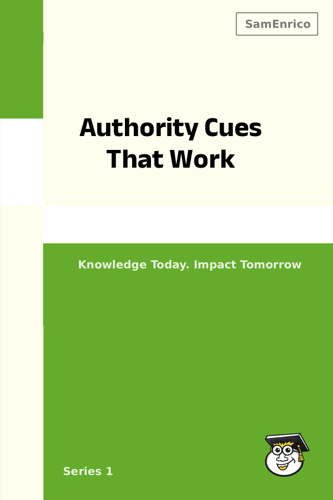
Authority Cues That Work eBook
Projects credibility to increase persuasive impact
by Allen Julian
Projects credibility to increase persuasive impact.
Formats
Free sample
Chapter 1: The Primal Gate...--–- Dr. Elena Vasquez had prepared for three weeks. She had thirty-seven slides, fourteen peer-reviewed studies, and a cost-benefit analysis so precise it could withstand any audit. She was, by every objective measure, the most qualified person in the room.She lost the pitch in eleven seconds.Not because her data was wrong. Not because her competitor had a better product.
But because when she stood up to speak, she looked down at her notes, shifted her weight from foot to foot, and began with a hedging filler: "So, um, I guess I'll just, kinda, walk you through what we're thinking..."The decision makers heard none of her evidence. Their primal brains had already filed her under "low authority" and moved on. Meanwhile, her competitor—a less experienced, less credentialed man—walked to the front of the room, planted both feet, paused for a full two seconds, made eye contact with the CEO, and said with descending inflection: "We don't need forty slides. We need four minutes."He got the deal.This is not an outlier. This is the rule.
And understanding why—and how to never let it happen to you—is what this entire book exists to teach.The Paradox That Launched a Thousand Failures Let me state the problem plainly: brilliant, knowledgeable, well-intentioned people fail to persuade every single day. They fail in boardrooms, in sales calls, in job interviews, in team meetings, in performance reviews, and even in casual conversations where they are objectively correct. Meanwhile, people with half their expertise, a fraction of their experience, and demonstrably worse ideas walk away with the promotion, the budget, the buy-in, and the credit.This is not justice. But it is predictable.For decades, we have been taught that persuasion is a logical exercise. If you have the right answer, the thinking goes, you simply present your evidence clearly and reasonable people will agree.
This assumption is wrong. It is wrong because it ignores the fundamental architecture of the human brain—an architecture that does not process logic first.The brain processes safety first. Threat detection first. Social status first. Belonging first.Logic arrives late to the party.
And if you haven't already been admitted through the door, your logic stands outside in the cold, knocking on a door that will never open.Introducing the Primal Gate Every person you will ever speak to has an invisible, automatic, subconscious filter operating in the first 100 to 200 milliseconds of any encounter. I call this filter the Primal Gate. It is not a metaphor. It is a neurological reality, rooted in the amygdala, the limbic system, and the oldest structures of the human brain.The Primal Gate scans every new person for one ancient question: Threat or safety?That is it. Not "Is this person smart?" Not "Does this person have good data?" Not "Should I trust this person's conclusions?" The gate does not care about your resume, your slide deck, your Nobel Prize, or your flawless logic.
It cares about one thing: whether your posture, your pacing, your tone, your eye contact, your physical distance, and your vocal inflection signal predator or pack member.If the gate detects threat—nervous energy, closed posture, up-talking, fidgeting, inappropriate distance—it slams shut. Your audience's conscious mind never even hears your argument. They will nod, they will smile, they may even ask polite questions. But their primal brain has already rejected you, and their logic brain will dutifully generate post-hoc reasons why your data "just didn't feel right."If the gate detects safety—calm presence, open posture, steady voice, appropriate eye contact, grounded feet—it swings open. Only then does the logic brain engage.
Only then do your facts, your evidence, and your expertise have any chance of landing.Here is the brutal truth that most professionals never learn: You cannot persuade an audience that has already decided to ignore you.And the Primal Gate decides in milliseconds.Positional Authority vs. Earned Authority Before we go further, we need to distinguish between two very different sources of authority, because confusing them is one of the most common—and costly—mistakes that smart people make.Positional authority is the power that comes from an external source: your title, your organization, your rank, your credentials, your uniform. A police officer has positional authority. A CEO has positional authority. A doctor in a white coat has positional authority.
You do not generate this authority yourself; it is borrowed from the system that certified you.Positional authority can open the Primal Gate, but only partially and only temporarily. People may listen to you because they have to—because of your title, because of your rank, because of the consequences of ignoring you. But listening under duress is not the same as being persuaded. Forced attention often generates resistance rather than receptivity.Earned authority is different. Earned authority is projected through your behavior, your presence, and your delivery.
It is not assigned by any institution. It is generated by you, in real time, through the cues that your audience's primal brain is scanning for. Earned authority cannot be faked for long. It can, however, be learned. And it is the primary subject of this book.The highest-performing persuaders—the trial lawyers who never lose, the salespeople who close at three times the average, the leaders whose teams follow them anywhere—have learned to project earned authority regardless of their positional authority.
They could walk into a room wearing no badge, no title, no uniform, and within seconds, people would listen. Not because of who they are, but because of how they show up.That is what this book will teach you.The Courtroom Experiment That Changed Everything Let me ground this in research. In a famous study of trial lawyers, legal scholars analyzed thousands of hours of courtroom footage to identify what separated winning attorneys from losing ones. The results were startling. The winning attorneys did not have better legal arguments.
They did not have more favorable evidence. They did not have more prestigious law degrees.They had better authority cues.Winning attorneys stood still. Losing attorneys shifted their weight, paced, or gestured excessively. Winning attorneys paused before delivering key statements. Losing attorneys filled silence with filler words—"um," "uh," "like," "you know." Winning attorneys made eye contact with jurors for three to five seconds at a time.
Losing attorneys glanced at notes, at the judge, at the ceiling.Most tellingly, winning attorneys used descending inflection at the end of their sentences. They sounded like they were making statements. Losing attorneys used up-talking, ending their sentences as if asking a question. They sounded uncertain—and uncertainty is the primal brain's single strongest trigger for threat detection.The study's conclusion was unforgiving: juries decided cases based on authority cues within the first thirty seconds of opening statements. The evidence that followed merely justified the decision the primal brain had already made.This is not irrational.
This is neurology.Why "Just Be Yourself" Is Terrible Advice Before we go further, I need to address the most common objection to everything this book stands for. It usually sounds something like this:"Isn't all of this just manipulation? Shouldn't…
This is the end of the free sample. Get the eBook to keep going. Buy now
About this book
Details
- Author
- Allen Julian
- Publisher
- SamEnrico
- Language
- English
- Genre
- Non-Fiction, Self-Help, Personal Branding
- Released
- 2026-06-06
- Pages (approx.)
- 134
- Available as
- eBook, Audiobook

Read better in the ZLOADR app
Your eBooks on your phone or tablet. Sign in with your SamEnrico account and start reading.
More by Allen Julian
 CPR Recertification GuideAllen Julian$11.99
 Energy Audit WorkbookAllen Julian$11.99
 Reading Hour Morning PlanAllen Julian$11.99
 Sales Professional ImposterAllen Julian$11.99
 Performance Anxiety TriggersAllen Julian$11.99
 HIIT for Beginners ProtocolAllen Julian$11.99
 Burn Blister ManagementAllen Julian$11.99
 The Ballerina Kings: How African Grace Conquered the World StageAllen Julian$11.99
 Budapest's Jazz Pioneer: The Untold Story of Márton Szűts and the Birth of Hungarian SwingAllen Julian$11.99
 How to Produce SapoteAllen Julian$11.99
 A Collector's Handbook to the Austin 14Allen Julian$11.99
 QuickBooks AI Automation GuideAllen Julian$12.99
You may also like
 Hong Kong Handover 1997Dunn Johnnie$11.99
 Zumba For Postnatal Recovery CourseNeal Christian$11.99
 Zumba for BeginnersLadner Nikia$11.99
 YouTube Comment Mining GuideHumes Pandora$12.99
 Worry Box MeditationCarlin Rudy$11.99
 Workplace Stress MeditationNguyen Lynn$11.99
 Workplace Stress and Sleep RepairHawley Ivory$11.99
 Workplace Perfectionism CureDelaney Jeffry$11.99
 Workplace Injustice Anger GuideWallen Isabelle$11.99
 Work Addiction and Burnout LinkGreenwood Ester$11.99
 Women in Yoga and WellnessBeattie Galina$11.99
 Women in Stand Up ComedyChun Evangeline$11.99