
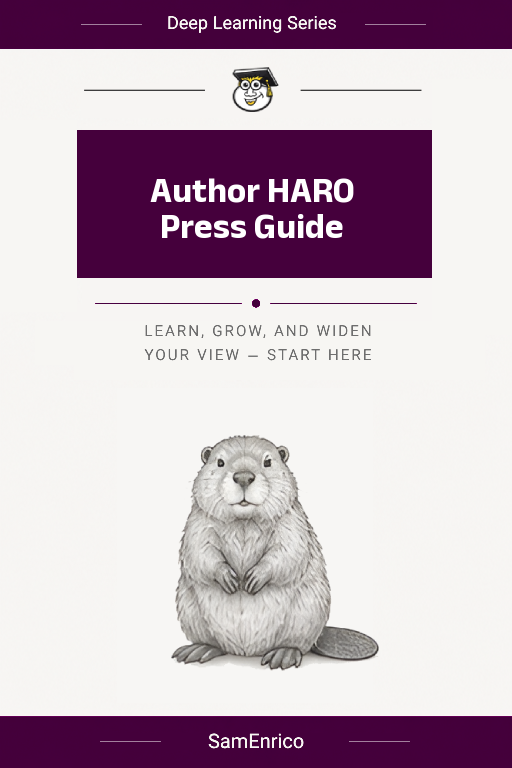
Non-FictionFirst 30 DaysAuthor
Author HARO Press Guide eBook
Uses HARO to get book mentions, author interviews,
Uses HARO to get book mentions, author interviews, and expert quotes promoting your writing and expertise.
Formats
Free sample
Chapter 1: The Invisible Economy...--It was 2:47 on a Tuesday afternoon when Peter Shankman posted what he thought was a throwaway message on Facebook. A journalist friend had emailed him in a panic—deadline in three hours, zero sources, and an editor breathing down her neck. Shankman, then a serial entrepreneur with a modest following but an outsized reputation for knowing everyone, typed a quick post: "Anyone want to be a source for a reporter writing about travel etiquette? Reply here." Within minutes, he had fifteen responses. He forwarded them to his friend, she filed her story on time, and he forgot about the exchange entirely.That forgettable Facebook post, made on a whim in 2008, would become the foundation of a platform that now sends over 75,000 journalist queries to more than 200,000 expert sources every single month.
The story of HARO—Help a Reporter Out—is not a story about technology or venture capital or clever algorithms. It is a story about a fundamental mismatch in the media economy that most authors never realize exists, and once they do, everything changes.Consider the numbers for a moment. Every day, in newsrooms across America and around the world, thousands of journalists sit down at their desks with a blank document and a brutal reality: they have to fill column inches, broadcast minutes, or web pages with content, and they have to do it by a deadline that is measured in hours, not days. They need experts. They need data.
They need stories. They need voices other than their own to bring reporting to life.And yet, the vast majority of these journalists will tell you the same thing when you ask them about their inboxes: it is a graveyard of irrelevant pitches. Public relations professionals, well-meaning but often misguided, send them press releases about products no one asked for, interviews with executives no one has heard of, and "exclusive" announcements that are anything but. The average journalist receives over one hundred pitches per day. The average journalist responds to fewer than five of them.This is the invisible economy that this book is built upon.
It is a simple equation: journalists need sources, and sources need journalists. But the traditional channels for connecting these two groups are broken beyond repair. PR agencies charge five thousand to twenty thousand dollars per month to send those ignored pitches. Press release distribution services promise "guaranteed media pickup" that never materializes. And authors, the very people who have the most to gain from media coverage, are often left standing outside the room with no clear way in.Help a Reporter Out was not designed to solve this problem.
It was an accident. But accidents, when they reveal a deeper truth, have a way of becoming revolutions.The deeper truth that HARO exposed is this: journalists do not hate sources. They hate bad pitches. They hate being sold to. They hate the feeling that someone is using their platform as a billboard rather than a conversation.
But they love experts. They love people who can explain complex things simply, who can offer a unique perspective on a breaking story, who can provide a quote so good that it does not need editing. They love sources who understand that the journalist's deadline is the only clock that matters.And here is the thing that most authors never grasp until it is too late: you are already an expert. You wrote a book. Whether it is a memoir about grief, a thriller set in a world you built from scratch, a cookbook filled with recipes you tested a hundred times, or a business guide based on years of hard-won experience—you have already done the hard part.
You have already organized your knowledge into a coherent, valuable form. You have already proven that you can finish what you start. You have already demonstrated that you have something to say that other people might want to hear.The only thing standing between you and a quote in the Wall Street Journal, a feature in Fast Company, or an interview on a national podcast is not your lack of connections or your missing publicist. It is your understanding of how this invisible economy works. And that understanding begins with a single, counterintuitive shift in perspective.Stop leading with your book.This is not a rhetorical flourish.
It is not a metaphor. It is the single most important operational rule in this entire book, and every successful author who has ever used HARO will tell you the same thing. When you pitch a journalist, your book does not matter. Not because your book is not valuable, and not because you should be ashamed of it. Your book does not matter because the journalist does not care about your book.
They care about their deadline. They care about their story. They care about their editor's expectations and their audience's attention span. Your book is invisible to them until you make yourself indispensable to them.Think of it this way. A journalist working on a story about the future of remote work does not wake up thinking, "I wonder if I can help someone sell their book today." They wake up thinking, "I need three experts who can tell me whether hybrid schedules actually improve productivity, and I need them in the next four hours." If you are the author of a book called "The Remote Revolution," and you lead your pitch with "My book is available on Amazon," you have just told the journalist that you care more about your sales than their story.
They will delete your email before finishing the sentence.But if you lead with, "I have surveyed four hundred remote workers over the past year, and the data shows that hybrid schedules increase productivity by twelve percent only when companies enforce 'no meeting Wednesdays'—here is the full breakdown," you have just become indispensable. The journalist will quote you. They will link to your website. They might even ask for your book title. And you did not have to ask for any of it, because you gave them value first.This is the paradigm shift that separates authors who get quoted from authors who get ignored.
It is not about being selfless or noble. It is about being strategic. When you understand that the journalist's primary need is not to help you but to help themselves, you stop fighting against that reality and start working with it. You become the solution to their problem rather than another problem demanding their attention.The data backs this up. In an analysis of over ten thousand HARO responses conducted by the platform's parent company, the single biggest predictor of a source being quoted was not their credentials, their publication history, or even the quality of their expertise.
It was the speed and relevance of their response to the specific query. Journalists who posted a query received an average of seventy-eight responses. The source who responded within the first hour was quoted forty-three percent of the time. The source who responded after three hours was quoted less than seven percent of the time. The source who mentioned their book in the first sentence was…
This is the end of the free sample. Get the eBook to keep going. Buy now
About this book
Details
- Author
- Bordelon Cherelle
- Publisher
- SamEnrico
- Language
- English
- Genre
- Non-Fiction, First 30 Days, Author
- Released
- 2026-05-30
- Pages (approx.)
- 135
- Available as
- eBook, Audiobook

Read better in the ZLOADR app
Your eBooks on your phone or tablet. Sign in with your SamEnrico account and start reading.
More by Bordelon Cherelle
 Letting Go Of Shame HandbookBordelon Cherelle$11.99
 Time Zone Friendly Comms GuideBordelon Cherelle$11.99
 The Gaming and Mental Health GuideBordelon Cherelle$11.99
 Metta For Suicidal ThoughtsBordelon Cherelle$11.99
 The Active Listening for HealthcareBordelon Cherelle$11.99
 The Tides of Discovery: John Cabot and the Birth of the Atlantic WorldBordelon Cherelle$11.99
 Toxicity Testing (Off-gassing)Bordelon Cherelle$11.99
 How to Start a Acetylene Gas Generators (wholesale) Business (Beginners Guide)Bordelon Cherelle$11.99
 Understanding Spastic Paraparesis DeafnessBordelon Cherelle$17.99
You may also like
 Hong Kong Handover 1997Dunn Johnnie$11.99
 Zumba For Postnatal Recovery CourseNeal Christian$11.99
 Zumba for BeginnersLadner Nikia$11.99
 YouTube Comment Mining GuideHumes Pandora$12.99
 Worry Box MeditationCarlin Rudy$11.99
 Workplace Stress MeditationNguyen Lynn$11.99
 Workplace Stress and Sleep RepairHawley Ivory$11.99
 Workplace Perfectionism CureDelaney Jeffry$11.99
 Workplace Injustice Anger GuideWallen Isabelle$11.99
 Work Addiction and Burnout LinkGreenwood Ester$11.99
 Women in Yoga and WellnessBeattie Galina$11.99
 Women in Stand Up ComedyChun Evangeline$11.99